


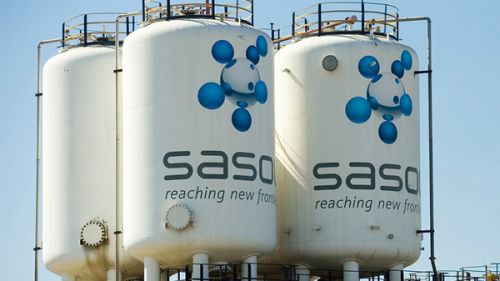
South African petrochemical group Sasol posted stronger earnings for the year ended June 2026 as higher oil prices, improved fuel production and disruptions to Middle Eastern supply routes boosted its coal-to-liquids operations, underscoring the financial resilience of its legacy energy model even as declining gas production and rising transition costs complicate its shift away from coal.
Sasol reported headline earnings per share of R38.31, up 9% from the previous year, while adjusted earnings before interest, tax, depreciation and amortisation increased 17% to about R61 billion. The improvement came as stronger production at its Secunda complex and Natref refinery helped the fuels business offset weaker performance in chemicals and gas.
The results come against a volatile global energy backdrop. Geopolitical tensions and disruptions affecting shipping through the Strait of Hormuz pushed crude oil prices higher during the financial year, creating stronger market conditions for Sasol’s fuel operations. The company said the average Brent crude price increased by 7%, contributing to the improvement in earnings. Sasol’s Secunda operations in Mpumalanga were central to the recovery. The facility converts coal into synthetic fuels and recorded an 8% increase in production, supported by improved equipment availability and better coal quality. The higher output helped the company take advantage of stronger fuel demand and tighter regional supply conditions.

Natref, the crude oil refinery in Sasolburg in which Sasol holds a 63.64% interest, also recorded a substantial improvement. Production increased 76% from the previous year, helped by improved operational reliability and the use of capacity associated with partner Prax South Africa during its business rescue process. The result was a dramatic turnaround in Sasol’s fuels business. Operating profit rose to R19.9 billion from R5.2 billion a year earlier, while fuels turnover increased 27% to R125.3 billion. The improvement demonstrates how quickly Sasol’s earnings can respond when higher commodity prices are combined with stronger utilisation of its large-scale production assets.
But the strength of the fuels business also exposes the complexity of Sasol’s transition strategy. The company remains one of the world’s most carbon-intensive energy producers, with its Secunda coal-to-liquids facility among the largest single-site sources of greenhouse gas emissions globally. Sasol has been pursuing a gradual shift towards lower-carbon feedstocks and renewable electricity, but the latest results show that coal remains deeply embedded in its operating and financial model. Natural gas was expected to provide part of the bridge away from coal. Instead, Sasol’s Mozambican gas operations weakened during the year. Gas production from the Pande and Temane fields declined 7%, reflecting operational constraints, flooding impacts and the natural decline of producing wells. The decline contributed to a 60% fall in the gas business’s operating profit, which dropped to R1.2 billion.
Sasol also recorded a R3.8 billion impairment against its production-sharing agreement development in Mozambique, reflecting changes to the expected production profile and broader economic assumptions. The impairment adds to the financial pressure facing a business that had been expected to play an important role in reducing the group’s dependence on coal. The weakness in gas highlights a broader challenge for Africa’s energy transition: lower-carbon alternatives need to be available at sufficient scale, reliability and commercial viability before heavy industrial users can move away from established fossil-fuel systems.
For Sasol, that transition is already requiring significant investment. During the financial year, the company brought an additional 330 MW of renewable energy into operation, taking renewable capacity in operation above 500 MW. Its total secured renewable energy capacity exceeded 1,350 MW through power purchase agreements. Sasol has set a target of reaching 2,000 MW of renewable electricity capacity by 2030. Renewable energy is increasingly becoming part of the company’s strategy to lower emissions and reduce exposure to volatile electricity costs. Yet the scale of the challenge remains considerable because Sasol’s most energy-intensive operations are closely linked to coal-based production.
The company’s chemicals business illustrates another pressure point. Sasol’s South African chemicals operations recorded an operating loss of R3.3 billion, compared with a R5 billion profit in the previous year. A stronger rand, weaker market conditions and higher costs weighed on the business. The stronger rand was particularly significant because Sasol operates across markets and commodities priced in different currencies. While it helped cushion South African consumers from higher international oil prices, it reduced the rand value of some international-linked revenues and contributed to weaker earnings in parts of the portfolio.
Financial resilience therefore remains a critical consideration for the transition. Sasol reduced net debt excluding leases by 11% to $3.3 billion, while maintaining liquidity of about $5 billion. However, debt remained above the $3 billion threshold required under its dividend policy. The company consequently did not declare a final dividend, extending the period without shareholder distributions to a third consecutive year.
The absence of a dividend illustrates the competing demands facing large African industrial companies undergoing energy transformation. Sasol must allocate capital towards maintaining existing assets, reducing debt, investing in cleaner energy and positioning its businesses for a lower-carbon economy, while also responding to shareholder expectations for returns.
For South Africa, the implications extend beyond Sasol. The company is deeply integrated into the country’s industrial and energy system. Its fuels operations provide a significant share of domestic liquid fuel supply, while its chemical operations feed multiple industrial value chains. Its transition therefore has implications for energy security, employment, industrial competitiveness and the country’s emissions trajectory.
This makes Sasol’s decarbonisation challenge partly a national policy challenge. A rapid reduction in coal dependence without sufficient replacement capacity could create risks for energy security and industrial output. Conversely, maintaining coal-intensive production for too long could increase exposure to carbon costs, climate-related regulation and investor pressure.
The company’s latest results consequently reveal a paradox at the heart of Africa’s energy transition. The same coal-based infrastructure that creates one of Sasol’s largest environmental challenges also provided a significant earnings buffer during a period of international energy-market disruption. At the same time, the lower-carbon gas supply intended to support the transition is experiencing declining production and weaker economics.
For African policymakers and investors, the lesson is that energy transition cannot be viewed solely through the lens of replacing fossil fuels with renewable generation. Industrial economies also need reliable alternative feedstocks, transmission infrastructure, storage, competitive financing and markets capable of supporting cleaner technologies at scale.
Sasol’s financial recovery provides breathing room, but it does not resolve that structural challenge. The company is generating stronger cash earnings while simultaneously confronting the cost and complexity of transforming an industrial model built around coal. The next phase of Sasol’s strategy will therefore be measured not only by how much renewable capacity it adds, but by whether it can translate that investment into a sustained reduction in coal dependence without undermining the financial and energy security that underpin its operations. For South Africa and the wider African energy sector, that balance could become one of the continent’s most consequential tests of how industrial competitiveness and decarbonisation can advance together.
Sasol’s FY2026 performance shows that Africa’s energy transition is not a simple shift from fossil fuels to renewables. Existing coal, oil and gas infrastructure remains economically important, particularly for industrial production and energy security, even as companies face growing pressure to decarbonise. The challenge is to build enough renewable generation, storage, cleaner industrial feedstocks and enabling infrastructure to make the transition commercially viable.
Sasol’s experience also demonstrates the importance of transition finance. Companies with carbon-intensive assets may need substantial capital to modernise operations while maintaining the financial strength required to invest in cleaner technologies. For Africa, the broader question is whether the continent can use its expanding renewable-energy potential to decarbonise existing industries without weakening the industrial capacity needed to support economic growth.


