


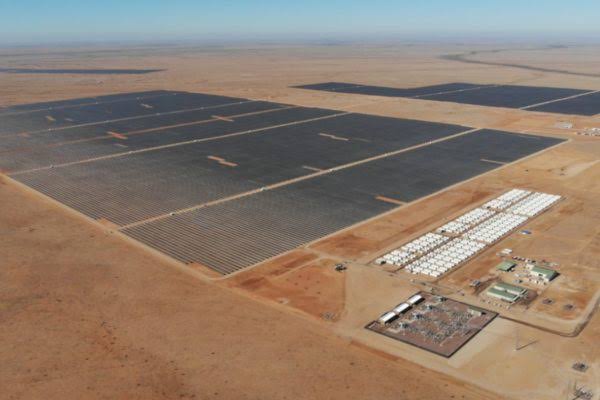
Yellow Door Energy and Nedbank Corporate and Investment Banking have reached financial close on the 49 MWp Lion Thorn Solar Park in South Africa’s North West province, clearing the way for construction of a project backed by long-term corporate power purchase agreements and underscoring the growing role of private capital in the country’s electricity market.
The solar park, located in Leeudoringstad, is expected to begin construction in September 2026 and enter commercial operation in 2028. Nedbank CIB is providing the project financing, although the value of its commitment has not been disclosed. Once operational, Lion Thorn is expected to produce approximately 115 GWh of renewable electricity in its first year and avoid an estimated 104,190 tonnes of carbon emissions annually.
The project has secured two 24.5 MWp long-term power purchase agreements, one with POWERX, a private electricity trader licensed by the National Energy Regulator of South Africa (NERSA), and another with PPC, the South African cement producer. Each agreement is expected to support approximately 57.5 GWh of electricity generation in the first year of operation.

The financial close is significant beyond the individual project because it illustrates how South Africa’s electricity market is changing. Renewable power development is increasingly being driven not only by state-led procurement programmes but also by direct agreements between independent power producers, private electricity traders and large commercial and industrial consumers.
That model has become increasingly important as companies seek greater control over electricity costs, supply reliability and emissions exposure. Under South Africa’s wheeling framework, privately generated electricity can be injected into the national transmission or distribution network and financially allocated to customers elsewhere on the grid. Eskom describes wheeling as the delivery of electricity from a generator to an end user through existing network infrastructure, allowing renewable projects to be developed where solar or wind resources are strongest while serving customers in other locations.
For Lion Thorn, the arrangement with POWERX demonstrates how this model can connect generation in the North West with customers located elsewhere in South Africa. POWERX’s 2025 agreement with Yellow Door Energy covered 24.5 MWp of solar capacity, with the electricity to be wheeled across the Eskom grid to its customers under a 20-year PPA. The agreement was expected to generate 57.5 GWh in its first year and avoid about 59,800 tonnes of carbon emissions annually.
The second PPA with PPC broadens the project’s commercial base and illustrates the growing interest among energy-intensive industries in securing renewable electricity through private procurement. Cement manufacturing, like mining and metals processing, is highly dependent on reliable electricity and faces increasing pressure to manage both energy costs and carbon intensity. The project nevertheless comes to financial close later than originally anticipated. Under the initial POWERX agreement, construction had been expected to start in 2025, with commissioning targeted for 2026. The revised schedule now places construction in September 2026 and commercial operations in 2028. The project partners have not publicly provided an explanation for the change.
The delay highlights one of the less visible challenges facing Africa’s renewable energy expansion: moving projects from signed agreements to financed construction can take considerably longer than the initial development timetable suggests. Land arrangements, grid connections, permitting, equipment procurement, offtaker requirements, financing conditions and broader market conditions can all affect project schedules.
Financial close is therefore a particularly important stage in the development cycle. A signed PPA demonstrates that there is an identified buyer for the electricity, while financial close indicates that the project’s financing structure has been sufficiently developed for construction to proceed. In South Africa, the pipeline behind this market has expanded sharply. NERSA data show that registered private generation projects represented 7,464 MW of capacity and approximately R158.0 billion in investment during 2025, compared with 4,164 MW and R89.5 billion in 2024. Since the registration regime began in 2018, NERSA has registered 2,383 generation facilities representing about 18,000 MW and R361.1 billion of investment.
The increase points to a structural change in South Africa’s power market. The private sector is no longer participating only as an investor in state procurement programmes. Independent power producers, electricity traders, banks and corporate buyers are increasingly forming commercial arrangements outside the traditional utility model. The growth of wheeling is an important part of that shift. Eskom says the framework allows privately generated electricity to be transported through its network to willing buyers and can help renewable developers locate projects in areas with stronger solar and wind resources while serving customers elsewhere.
Eskom is also developing virtual wheeling arrangements that can enable multiple generators and off-takers to participate in transactions across different network boundaries. The utility describes virtual wheeling as a financial mechanism that allows businesses to access renewable generation without requiring a direct physical connection to the generating plant. For African economies, these mechanisms have implications beyond emissions reduction. They can create new routes for private investment into electricity infrastructure while reducing the amount of generation capacity that must be financed directly through government balance sheets.
South Africa’s experience is being closely watched because other African electricity markets face similar constraints around public-sector financing, utility financial sustainability and the need to expand generation rapidly. Private power purchase agreements and wheeling models could provide additional routes to mobilise capital, although their success depends on credible regulation, bankable contracts, functioning grid infrastructure and customers with sufficient credit quality.
The financing role of commercial banks is consequently becoming more important. Nedbank CIB has been active in South Africa’s renewable energy market through project finance and structured transactions. Its Power & Renewables Finance team is led by Amith Singh, who has worked across utility-scale renewable energy, embedded generation and energy trading platforms. Nedbank’s wider renewable energy portfolio illustrates the scale of capital that can be mobilised when private electricity procurement becomes bankable. The bank has previously helped finance projects involving Anglo American and EDF Renewables, while also supporting renewable developments linked to industrial customers through wheeling arrangements.
The Lion Thorn transaction also fits into POWERX’s broader expansion as a private electricity trader. The company says its pipeline exceeded 800 GWh in 2026, while its activities have increasingly focused on connecting renewable generators with commercial and industrial customers through power trading and wheeling structures. For the North West province, the project adds another layer to an electricity market increasingly shaped by private generation. The province has significant solar resources and an established mining and industrial base, making reliable power infrastructure particularly important to economic activity. The availability of renewable electricity can potentially help businesses manage energy costs while meeting corporate decarbonisation requirements.
The expected 115 GWh of first-year generation is modest relative to South Africa’s national electricity demand, but the significance of projects such as Lion Thorn lies partly in their replicability. A growing portfolio of similarly structured projects can collectively add substantial generation capacity without relying entirely on a single procurement mechanism. The challenge will be ensuring that this expansion keeps pace with grid capacity and broader system requirements. More private generation increases the importance of transmission investment, network planning and transparent wheeling rules. Eskom notes that wheeling requires generators and customers to comply with network connection requirements and pay approved use-of-system charges.
There is also a wider economic consideration. South Africa’s electricity transition is taking place within an economy where mining, manufacturing and other energy-intensive industries remain major contributors to exports, employment and fiscal revenues. Reliable renewable electricity therefore has implications for industrial competitiveness as well as climate policy.
The Lion Thorn project shows how those interests are increasingly converging. A solar developer needs a bankable revenue stream; a trader needs generation and customers; an industrial buyer needs predictable electricity; a bank needs a financeable project; and the grid operator needs a framework that allows private electricity to move through existing infrastructure.
That combination is becoming an increasingly important feature of South Africa’s energy transition. As more projects reach financial close, the question for the market will be whether private investment can continue to expand while grid infrastructure, regulation and electricity demand develop at a comparable pace.
For other African countries watching South Africa’s experience, Lion Thorn offers a practical example of how renewable energy can move from policy ambition to commercial infrastructure through a combination of long-term contracts, private finance and open-grid arrangements. The broader lesson is that renewable generation capacity is only one part of the transition; the financial and institutional structures that allow electricity to be bought, sold, transmitted and paid for are equally central to building a more resilient African power system.


