


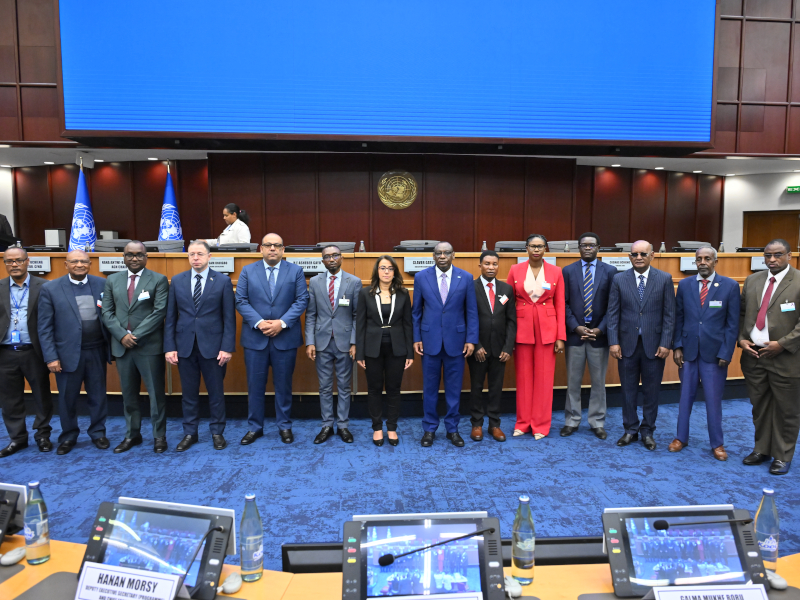
Africa needs to move from negotiating climate commitments to delivering projects, budgets and institutions capable of implementing them, delegates at the 14th Conference on Climate Change and Development in Africa (CCDA-14) said as the three-day meeting ended in Addis Ababa on September 9. With COP31 in Antalya approaching and Ethiopia preparing to host an African-led COP32 in 2027, the conference called for more predictable and accessible climate finance, stronger African influence over global climate governance and greater investment in adaptation, infrastructure, data and productive capacity.
The conference, convened under the Climate for Development in Africa programme by the United Nations Economic Commission for Africa, the African Union Commission, the African Development Bank and the African Export-Import Bank, brought together policymakers, climate negotiators, financial institutions, researchers, civil society and private-sector representatives. Its central message was that Africa’s climate agenda must increasingly be measured by what reaches national budgets, investment projects and communities rather than by the volume of commitments made at international conferences.
 The financing gap remains substantial. According to figures presented at CCDA-14, Africa contributes less than 4% of global greenhouse gas emissions but requires about $277 billion a year through 2030 to implement its Nationally Determined Contributions, while current climate-finance flows cover only about 11% of that requirement. The gap has direct implications for public finances because governments are being asked to invest simultaneously in climate resilience, energy access, food systems, transport, housing and other development priorities while operating under tight fiscal conditions.
For African governments, the debate over climate finance is therefore also a debate about the cost and structure of development finance. CCDA-14 called for financing that is predictable, adequate, accessible and does not unnecessarily increase debt burdens. It also argued that the effectiveness of climate finance should be assessed by the economic value retained within African economies, including local value addition, industrialisation, employment and technology transfer, rather than solely by the amount of capital mobilised.
That approach places climate finance closer to the broader question of how Africa finances structural transformation. The conference called for stronger domestic fiscal institutions and African-owned financing mechanisms, while highlighting the need to address debt servicing, profit repatriation, illicit financial flows and import dependence. Adaptation, in particular, was framed as an investment that should be incorporated into national planning, public budgets and the decision-making frameworks of multilateral development banks.
The emphasis on implementation also extends to Africa’s growing carbon-market ambitions. Delegates called for carbon pricing to be introduced progressively and adapted to national circumstances, with revenues directed towards clean technology, economic transformation and employment. They also urged governments and institutions to move beyond carbon-market capacity building towards high-integrity markets capable of attracting private capital while delivering measurable benefits to communities. Strong monitoring, reporting and verification systems will be important as African countries seek to develop carbon markets without compromising environmental credibility or economic interests.
Climate data and early-warning systems emerged as another area where the gap between technical capability and practical delivery remains important. CCDA-14 called for Africa to move from generating climate information to producing decision-ready risk intelligence that can inform investment, public planning and financial accountability. It also backed a more integrated early-warning chain linking observation, forecasting, communication, anticipatory action, financing and emergency response.
The issue is particularly relevant to African cities and local governments, which increasingly face the fiscal and infrastructure consequences of floods, droughts, heat and climate-related displacement. The conference called for direct and predictable finance for local governments and for housing, secure land and essential services to be treated as part of climate adaptation infrastructure. This would shift some of the responsibility for climate resilience from national policy frameworks towards the institutions that manage roads, drainage, housing, water and other services on the ground.
Energy and critical minerals were also positioned within Africa’s wider industrialisation strategy. The continent holds about 60% of the world’s solar potential, according to the African Development Bank’s James Kinyangi, yet much of Africa continues to face significant electricity-access and affordability constraints. CCDA-14 therefore called for an energy transition that prioritises reliable and affordable energy while creating greater opportunities for local manufacturing, processing and regional value chains.
Critical minerals present a similar economic calculation. African mineral-producing countries hold resources that are increasingly important to global energy and technology supply chains, but delegates argued that extraction alone would provide limited development benefits without local processing, technology transfer, employment and stronger governance. The conference linked this agenda to the Africa Mining Vision, the African Green Minerals Strategy and the African Continental Free Trade Area, reflecting an effort to connect mineral resources with regional industrial development rather than treating them solely as export commodities.
There are already examples of the financing structures being discussed. Afreximbank announced at the conference that it intends to direct 5% of its long-term loans to climate finance by 2030, with 70% of that allocation aimed at adaptation. The bank also cited the $3 billion Democratic Republic of Congo-Zambia battery value-chain project as an example of how critical minerals, industrialisation and the energy transition could intersect. Meanwhile, the African Development Bank’s Climate Action Window has mobilised $450.9 million for 37 low-income countries, according to figures presented at the meeting.
Agriculture presents another test of whether climate finance can translate into economic resilience. CCDA-14 called for African agriculture to be treated as part of integrated climate-resilient food systems linking production, natural resources, markets, nutrition and livelihoods. For economies where agriculture remains closely tied to employment, food prices, exports and rural incomes, the consequences of climate shocks extend well beyond the farm sector. Financing resilience therefore has implications for inflation, trade balances, household incomes and public spending on emergency responses.
The conference also placed climate change within Africa’s peace and security landscape, describing it as a risk multiplier for food, water and energy insecurity, resource competition, displacement and inequality. It called for climate and conflict-risk analysis to be incorporated into early-warning systems, disaster-risk planning and national climate strategies, particularly in fragile and conflict-affected settings where the capacity to finance adaptation is often weakest.
The next stage will test whether the Addis Ababa discussions can produce institutional follow-through. CCDA-14 established six working committees covering climate finance and carbon markets, agriculture and food systems, just transition and critical minerals, circular economy, adaptation, and climate change and development. Coordinated by the ClimDev-Africa Secretariat, the committees are expected to incorporate outcomes from COP31 into a consolidated report for CCDA-XV and identify priorities ahead of COP32, which Ethiopia is scheduled to host in Addis Ababa in November 2027.
For Africa, the significance of the CCDA-14 outcome will ultimately depend less on the language adopted in Addis Ababa than on whether it changes how climate investment is financed, governed and implemented. The continent’s financing requirement is large, while governments face competing fiscal pressures and investors remain sensitive to risk, currency exposure and project viability. Turning climate commitments into bankable projects, resilient infrastructure, stronger institutions and productive regional value chains will therefore be central to determining whether the transition becomes an additional financial burden or a mechanism for broader economic transformation.
 As Africa approaches COP31 and looks towards an African-hosted COP32, the shift from pledges to implementation is becoming a question of economic management as much as climate diplomacy. The decisions taken on finance, energy, agriculture, cities, critical minerals and data will shape not only the continent’s climate resilience but also its ability to attract investment, create jobs, strengthen public institutions and retain more value from the transition within African economies.


