


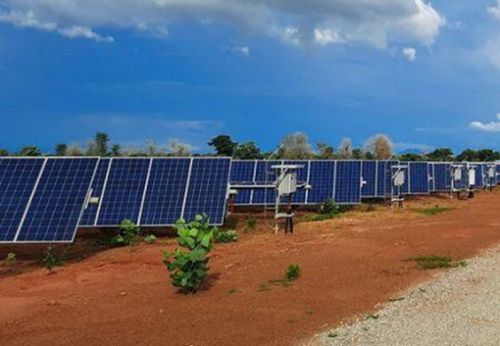
Africa’s renewable energy market is on course to more than double its installed capacity between 2026 and 2031, as falling solar costs, concessional finance and rising demand for cleaner electricity accelerate investment across the continent. But the expansion is likely to test the ability of African power systems, financial markets and governments to absorb new generation, with grid congestion, renewable-energy curtailment and foreign-exchange constraints emerging as some of the biggest risks to project economics.
According to Mordor Intelligence’s 2026-2031 market analysis, Africa’s renewable energy installed base is expected to increase from 86.95 gigawatts in 2026 to 179.66 GW in 2031, equivalent to a compound annual growth rate of 15.62%. Hydropower remained the dominant renewable technology in 2025, accounting for 62.25% of the market, but solar is expected to expand fastest, with projected annual growth of 27.84% through 2031.
The changing technology mix reflects a fundamental shift in the economics of power generation. Solar photovoltaic projects can be developed more quickly than many large hydropower projects, while falling module and equipment costs have reduced the amount of capital required to add capacity. Mordor Intelligence says utility-scale solar auction tariffs in Egypt and Morocco fell below $0.03 per kilowatt-hour in 2025, while solar module prices reached about $0.12 per watt in early 2026 amid global polysilicon oversupply.

South Africa offers another illustration of the decline in renewable-energy costs. The country’s seventh renewable-energy auction awarded 2.6 GW at an average price of about $0.025 per kWh, according to the report, substantially below the prices achieved when the country’s renewable procurement programme began. The decline in generation costs is changing the investment proposition for African economies, particularly for industries that have historically depended on expensive and unreliable grid electricity or diesel generation. Mining companies, manufacturers and large commercial consumers are increasingly turning to corporate power-purchase agreements and private renewable generation to manage electricity costs and improve supply security.
But cheaper electricity generation does not automatically translate into cheaper or more reliable electricity for consumers. The central challenge increasingly lies in the infrastructure connecting generation to demand. South Africa’s experience illustrates the problem. Mordor Intelligence estimates that the country curtailed 4,363 gigawatt-hours of renewable electricity in 2024 because the grid was unable to absorb all available generation. Curtailment occurs when renewable plants are forced to reduce output because transmission or distribution networks cannot accommodate the electricity being produced.
For investors, the issue is more than technical. A solar or wind project can have a competitive tariff and strong resource conditions, but if transmission constraints prevent it from delivering electricity when contracted, projected revenues can weaken. That can affect debt-service capacity, trigger renegotiations and increase the risk premium attached to future projects.
The problem is particularly relevant to Africa because renewable resources and electricity demand are often geographically separated. High-quality solar resources may be located far from industrial centres, while some of the continent’s strongest wind resources are found in areas with limited transmission infrastructure. Building generation without simultaneously expanding networks can therefore create an imbalance in which installed capacity rises faster than the ability of the grid to use it.
This is one reason the continent’s renewable-energy expansion is increasingly becoming a transmission and storage story as much as a generation story. Batteries, flexible generation, interconnections and stronger regional power pools could help absorb variable solar and wind output, but these assets require additional capital and regulatory frameworks that allow investors to recover their costs.
The financing challenge is equally important. Development finance institutions are increasingly using concessional capital, guarantees and blended-finance structures to make renewable projects bankable in markets where commercial borrowing costs remain high. The World Bank’s Mission 300 initiative is central to that effort. The programme aims to connect 300 million Africans to electricity by 2030 and is supported by large-scale commitments from development partners. The World Bank says the initiative is intended to modernise electricity systems while expanding access for households, businesses and industries.
Nigeria’s Distributed Access through Renewable Energy Scale-Up programme provides an example of how concessional finance can be used to build distributed energy markets. The World Bank approved $750 million for DARES, which is designed to leverage more than $1 billion in private capital and provide new or improved electricity access to more than 17.5 million Nigerians through mini-grids and standalone solar systems.
The significance of such programmes extends beyond the number of households connected. Reliable electricity can reduce the dependence of businesses and public institutions on diesel generators, lower operating costs and support productive activity. In Nigeria, the earlier Nigeria Electrification Project helped establish 125 mini-grids and deploy more than one million solar home systems, providing electricity access to more than 5.5 million people and creating more than 5,000 local green jobs.
For Africa’s renewable-energy market, however, the next phase of growth will require investors to assess country risk beyond the cost of solar panels or wind turbines. Foreign-exchange convertibility remains a major concern for independent power producers whose revenues are earned in local currency while debt, equipment and shareholder obligations may be denominated in dollars or euros. Where currencies depreciate sharply, projects can face a mismatch between local revenues and hard-currency liabilities.
Ethiopia’s experience illustrates the broader challenge. Chronic foreign-exchange shortages have resulted in delays for companies seeking to repatriate profits, while restrictions on foreign-currency availability have affected imports, maintenance and access to inputs. Such constraints can increase the cost of operating energy projects and complicate investment decisions. The implications are significant for African governments seeking to attract private capital. Competitive renewable-energy tariffs are unlikely to be sufficient on their own if investors remain uncertain about whether project revenues can be converted into hard currency or whether payments under power-purchase agreements will be made on time.
This is where guarantees and blended finance can play a larger role. First-loss capital, political-risk insurance, partial credit guarantees and currency-risk mechanisms can reduce the risks that commercial lenders and equity investors are unable to absorb on their own. The objective is not simply to make projects cheaper to finance, but to make their risk profile compatible with the requirements of institutional and commercial capital.
Green hydrogen represents another potential source of demand for renewable generation, particularly in North Africa and Southern Africa. Morocco has positioned itself as an emerging green-hydrogen hub and has approved large-scale investment plans linking renewable generation with hydrogen production and potential European markets. Namibia’s Hyphen project is similarly designed around large quantities of renewable generation for hydrogen and ammonia production.
These projects could create new markets for renewable electricity, but they also raise questions about whether scarce clean power should primarily support domestic electricity access and industrialisation or be directed towards export-oriented commodities. For African economies, the economic value of green hydrogen will depend not only on export revenues but also on whether associated infrastructure creates domestic industrial capacity, jobs, skills and more reliable electricity systems.
The same tension applies to corporate power-purchase agreements. Mining companies in South Africa, Ghana, Zambia and the Democratic Republic of Congo are increasingly seeking renewable electricity to reduce exposure to unreliable grids and fossil-fuel costs. Such demand can provide developers with long-term offtake contracts and help mobilise private capital, while giving energy-intensive industries greater certainty over electricity supply.
Yet corporate demand can also expose a structural divide in African electricity markets if well-capitalised companies secure the most attractive renewable resources while households and smaller businesses remain dependent on financially stressed utilities. Policymakers therefore face the challenge of expanding private renewable investment without weakening the financial viability of national power systems.
The market is also becoming more competitive. Gulf-based developers such as ACWA Power and Masdar are expanding their presence in large-scale African tenders, while European companies including TotalEnergies, Enel Green Power and ENGIE are pursuing renewable projects and hybrid systems. Chinese-origin manufacturers remain significant suppliers of photovoltaic equipment, while developers such as Scatec and Mainstream Renewable Power have built portfolios around long-term project ownership and operating revenues.
The growing presence of international capital brings financing and technical capacity, but it also increases the importance of local value creation. African governments are increasingly looking beyond the number of megawatts installed towards questions of local manufacturing, engineering skills, operations and maintenance, tax revenues and domestic industrial development.
The continent’s renewable-energy expansion is therefore entering a more demanding phase. The first challenge was demonstrating that solar and wind could compete economically with conventional generation. The next is building power systems and financial markets capable of turning low-cost renewable generation into reliable electricity and productive economic activity.
For Africa, that distinction is critical. The continent has substantial renewable resources, but energy access remains closely linked to economic development, industrialisation and public finance. The success of the next wave of renewable investment will depend on whether governments and financiers can solve the infrastructure and currency constraints that sit between a power plant and the consumer.
The projected rise from 86.95 GW to nearly 180 GW by 2031 therefore represents more than an expansion of installed capacity. It is a test of whether Africa can build the transmission networks, financing mechanisms, regulatory institutions and domestic markets needed to convert its renewable-energy potential into reliable power and broader economic value.


