


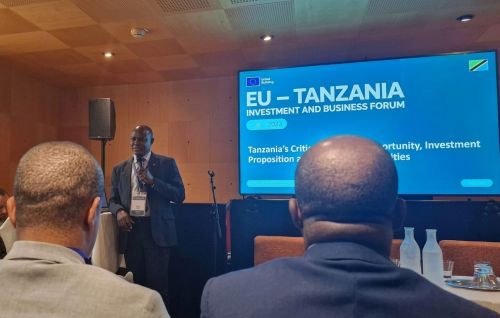
Tanzania is seeking new international investors to finance and develop its critical minerals industry as governments and companies in Europe move to diversify supplies of strategic raw materials used in batteries, electronics, defence and clean-energy technologies. At the EU-Tanzania Business Roadshow in Helsinki on September 28–29, Deputy Permanent Secretary in Tanzania’s Ministry of Minerals Msafiri Mbibo said the government was looking for investors that would bring not only capital but also technology, expertise and access to international markets. The event was part of a wider European investment roadshow intended to connect Tanzanian and European businesses and institutions ahead of an EU-Tanzania Investment and Business Forum planned for Dar es Salaam in early 2027.
The emphasis on investment beyond extraction reflects a broader shift in Tanzania’s mining strategy toward value addition and deeper participation in mineral supply chains. The government has identified graphite, nickel, rare earth elements, uranium and copper among minerals with strategic potential, while European cooperation with Tanzania already includes geological mapping, technical cooperation, infrastructure development and support for graphite and nickel value chains. The European Commission says its Tanzania partnership is designed to help develop geological intelligence, improve responsible mining practices and facilitate investment in mineral value chains rather than concentrating solely on extraction.
The investment case is particularly visible in two major projects. Lifezone Metals’ Kabanga Nickel Project in north-western Tanzania is progressing through pre-final-investment-decision activities and project financing, while Black Rock Mining’s Mahenge Graphite Project is also advancing toward financial close. Lifezone reported in July that project financing work was continuing with development finance institutions, export credit agencies and potential strategic investors, with about $854 million of contracts released to market for major project packages. The company subsequently indicated that the final investment decision was expected in the first quarter of 2027 following slower-than-expected negotiations on amendments to its framework agreement with the Tanzanian government.

Kabanga illustrates the scale of capital required to move Tanzania’s critical-minerals ambitions from resource development to production. Lifezone’s feasibility work puts pre-production capital expenditure at about $942 million, while the company has already used bridge financing to support early works and development activities. The project is also seeking a diversified financing structure involving strategic equity, project-level debt, development finance institutions and export credit agencies.
Mahenge presents a similar financing challenge in graphite. Black Rock Mining has an existing US$204 million credit facility and has extended the deadline for financial close to November 30, 2026, giving the company additional time to secure the equity required to fully fund development. The financing syndicate includes CRDB Bank, the Development Bank of Southern Africa and South Africa’s Industrial Development Corporation, alongside strategic support from POSCO of up to $50 million.
The timing of Tanzania’s investment campaign is significant because Europe is attempting to reduce vulnerabilities in critical-mineral supply chains. The EU’s Critical Raw Materials Act, which entered into force in May 2024, establishes 2030 benchmarks for the bloc to extract at least 10% of its annual strategic raw-material consumption domestically, process 40% and recycle 25%, while seeking to ensure that no single third country supplies more than 65% of a strategic raw material. The framework also promotes strategic projects and diversification of external supply.
For Tanzania, this creates a potential opening for minerals such as nickel and graphite to become part of more diversified international supply chains. But capturing that opportunity requires more than geological resources. Investors need bankable projects, predictable financing structures, infrastructure, reliable power, transparent regulatory processes, environmental and social safeguards, technical capacity and credible routes to international markets. Tanzania’s recent cooperation with China, which includes geological exploration, technology transfer, training and mineral-data interpretation, also demonstrates that the country is pursuing multiple international partnerships around its mineral sector.
The economic importance of the sector is already substantial. Tanzania’s mining and quarrying activities contributed 12.5% to real GDP growth during January–September 2025, according to Bank of Tanzania data, while other estimates put mining’s overall contribution to GDP at 10.3% for 2025. Mineral exports also remain an important source of foreign exchange, although gold continues to account for a large share of Tanzania’s mineral export earnings.

The next phase, therefore, is less about establishing whether Tanzania possesses minerals of strategic interest and more about converting those resources into financed, operating and economically integrated projects. For European investors and policymakers, Tanzanian graphite and nickel could contribute to supply diversification. For Tanzania, the larger question is how much of the resulting value can be retained domestically through processing, infrastructure, skills, supplier development, technology transfer and industrial linkages.
The Helsinki discussions put that question directly into the investment conversation. Tanzania is seeking partners willing to participate across the mineral value chain, while the EU is looking for more diversified and resilient sources of strategic raw materials. Whether those interests translate into financial close for projects such as Kabanga and Mahenge will depend on the ability of government, project developers, financiers and industrial partners to turn investment opportunities into commercially and technically bankable projects.


