


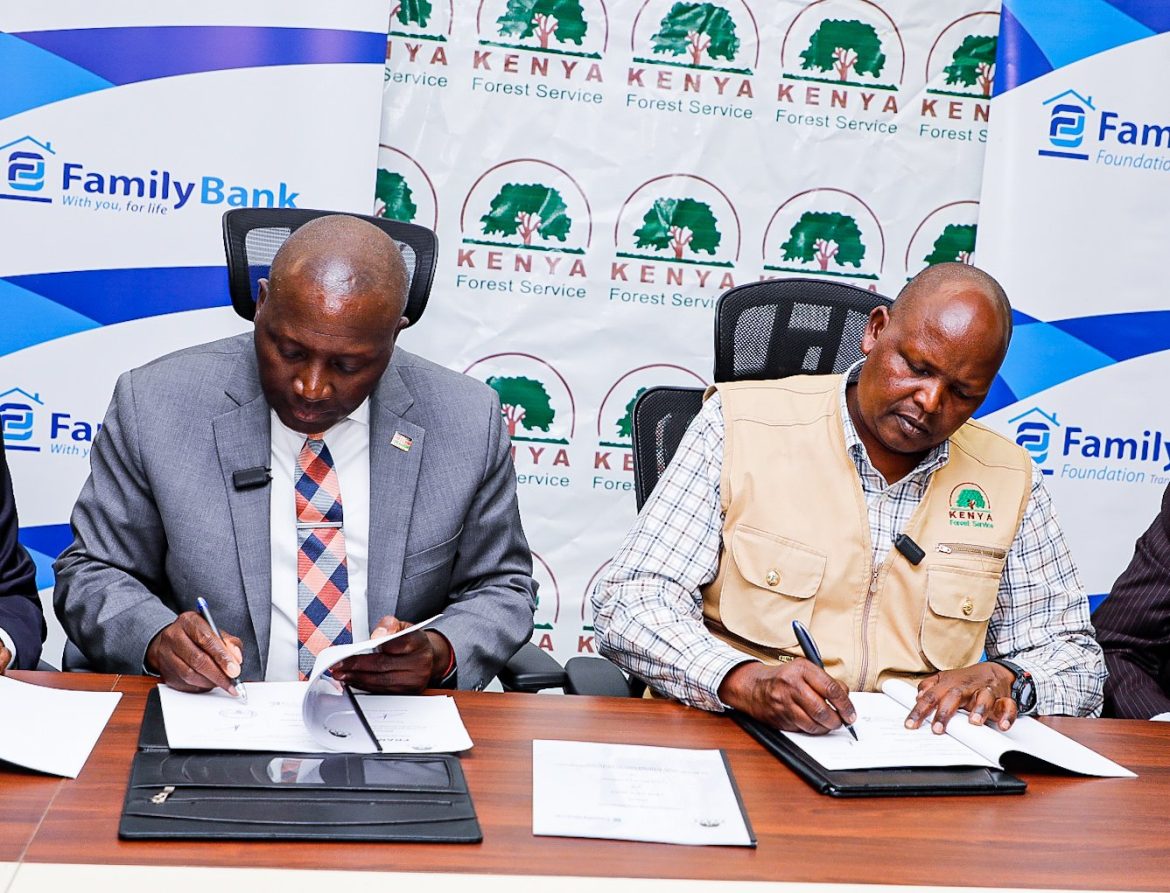
The Family Group Foundation and the Kenya Forest Service (KFS) have entered a three-year partnership to accelerate restoration of the Ngong Hills Forest Ecosystem, with a planned nursery capable of producing one million tree seedlings as Kenya seeks to expand forest cover, rehabilitate degraded landscapes and involve communities more directly in conservation. The agreement, formalised on September 8, builds on restoration work initiated by the Foundation in 2021 and will combine private-sector financing with KFS technical expertise to expand indigenous seedling production, tree growing and landscape restoration across a targeted 240-acre area by 2030.
The scale of the planned nursery is significant because Kenya’s restoration challenge is increasingly shifting from the symbolic planting of individual trees to the more difficult task of establishing functioning ecosystems that can survive beyond the initial planting season. The Family Group Foundation said it has invested more than KSh18 million in restoration activities since 2021, resulting in the planting of more than 20,000 indigenous seedlings and placing 70 acres under active restoration. The new partnership is intended to expand that work while strengthening the institutional and technical systems supporting the landscape.

Family Group Foundation Executive Director John Waimiri said the partnership would allow the organisation to move beyond individual tree-planting activities towards longer-term ecosystem restoration. KFS, he said, brings the technical expertise and statutory mandate required to manage forest ecosystems, while the Foundation will continue supporting seedling production and tree-growing activities. KFS Chief Conservator of Forests Alex Lemarkoko said the programme would also focus on communities living around the forest, reflecting a growing recognition in Kenya’s forestry policy that restoration cannot be sustained solely through government enforcement or corporate tree-planting campaigns. The partnership will use KFS’s Model Tree Nursery blueprint, designed to improve the scale and consistency of quality seedling production.
That emphasis on quality and survival is important. Kenya’s national restoration programme is not simply a numerical exercise in putting seedlings into the ground. The government’s 15 Billion Tree Growing Programme aims to restore 10.6 million hectares of degraded landscapes and increase national tree cover to 30% by 2032. The programme covers forests, rangelands, farmlands, wetlands, marine ecosystems and urban areas, while seeking to generate green employment, strengthen water resources and improve community livelihoods.
The Ngong Hills project therefore sits within a much larger national policy and financing challenge. Achieving the country’s restoration ambitions requires a sustained supply of appropriate seedlings, land management, protection against grazing and encroachment, monitoring, community participation and financing beyond the planting stage. The State Department for Forestry has increasingly called for stronger partnerships between government, the private sector, research institutions and development partners to mobilise investment for landscape restoration and climate resilience.
Ngong Hills presents a particularly important case because of its proximity to Nairobi and its role as part of a wider forest landscape serving both ecological and social functions. KFS describes Ngong Hills Forest as covering about 3,077.6 hectares in the northern part of Kajiado County, roughly 25 kilometres from Nairobi. The forest contains both indigenous and exotic vegetation and supports wildlife, while also providing sites for tourism and other economic activities.
Its proximity to a rapidly expanding metropolitan area, however, also creates competing pressures. Research from the University of Nairobi examining changes in Ngong Hills between 1984 and 2019 found significant declines in forest cover, with researchers identifying settlement and logging among the pressures contributing to degradation. The study also highlighted the importance of remote sensing and mapping in identifying areas experiencing changes in vegetation cover.
That makes the planned use of geo-mapping and landscape-level restoration particularly relevant. Restoration can be more effective when degraded areas, existing vegetation, water flows and land-use pressures are identified before interventions are designed. In this respect, the proposed nursery is only one component of the wider restoration equation. Producing one million seedlings creates capacity, but the environmental return will depend on where those seedlings are planted, which species are selected, their survival rates and how restored areas are protected over time.
There is already evidence that partnerships can produce measurable restoration outcomes in the Ngong landscape. In July 2026, KFS and I&M Bank reported that their conservation partnership in Ngong Forest had resulted in more than 35,000 trees being planted, more than 40 hectares being rehabilitated and 14.2 kilometres of electric fencing completed. The programme also included infrastructure intended to support forest protection and conservation activities.
KenGen has also undertaken restoration within the Ngong landscape. Its first phase of a 25-acre restoration project, launched in 2018, involved planting more than 7,000 indigenous trees around a degraded area near its Ngong Hills wind power station. The company reported that more than 7,100 seedlings survived the intervention, highlighting the importance of protecting restoration sites during the establishment period. The growing number of initiatives in Ngong also raises a question of coordination. Multiple actors can bring valuable financing and technical resources to the same ecosystem, but fragmented interventions can make it harder to measure cumulative results, identify gaps or maintain consistent restoration standards. KFS’s role as the institution mandated to manage the forest therefore becomes important in aligning private-sector projects with forest management plans and wider landscape objectives.
KFS maintains a Participatory Forest Management Plan for Ngong Hills, while the agency also has a forest plantation management plan covering Ngong Hills and Loitoktok. These frameworks provide an institutional basis for connecting individual restoration projects with longer-term forest management. Community participation will be equally important. Forest restoration can impose costs or restrictions on communities where land, grazing, fuelwood and other livelihood activities intersect with conservation objectives. Kenya’s forestry framework increasingly recognises community involvement as part of forest management, while the national 15 Billion Tree Growing Programme explicitly positions communities, county governments, private companies and development partners as participants in restoration.
For communities surrounding Ngong Hills, a successful restoration programme could generate benefits extending beyond additional tree cover. Forest ecosystems can support water regulation, biodiversity, soil protection, recreation and other ecosystem services. Restoration can also create demand for nursery work, tree-growing, maintenance and monitoring, although the scale and durability of such economic benefits will depend on how projects are structured locally.
This is particularly relevant as Kenya attempts to translate climate and environmental commitments into economic activity. The State Department for Forestry has been seeking new financing mechanisms and strategic partnerships to accelerate the 15 Billion Tree Growing Programme, while stressing the need for measurable environmental and socio-economic outcomes. Research institutions also have a role in ensuring that restoration is based on ecological evidence rather than planting targets alone. The Kenya Forestry Research Institute (KEFRI), led by Director-General Dr Jane Njuguna, is responsible for forestry research and tree improvement, providing an important technical link between seedling quality, species selection and landscape restoration.
The wider environmental governance system is also relevant. The National Environment Management Authority, led by Director-General Dr Mamo B. Mamo, is responsible for coordinating environmental management and implementing national environmental policies. Its mandate includes sustainable environmental management and coordination across environmental issues.
For Kenya, the significance of the Family Group Foundation and KFS agreement will therefore ultimately be measured less by the number of seedlings produced than by the condition of the landscape several years after planting. A million seedlings can provide the physical inputs for restoration, but survival, biodiversity recovery, protection from degradation, community participation and credible monitoring determine whether those inputs translate into functioning ecosystems.
The partnership also illustrates how Kenya’s restoration agenda is becoming a shared financing and governance responsibility. Government agencies possess statutory mandates and technical systems, while foundations, companies and other private actors can contribute capital, implementation capacity and community programmes. Bringing those capabilities together can reduce duplication and increase the scale of interventions, provided projects remain aligned with ecological priorities and are measured against outcomes rather than planting numbers.
As Kenya works towards its 2032 tree-cover target, the Ngong Hills initiative offers a local test of that broader approach. Its success will depend on whether a large nursery can be translated into durable forest restoration, whether communities can participate in and benefit from the process, and whether private financing can complement rather than substitute the long-term institutional responsibilities of the state. For Nairobi and the surrounding counties, the stakes extend beyond climate policy: the condition of the forest affects biodiversity, land management, water systems, local livelihoods and the quality of an increasingly urbanised landscape.


