


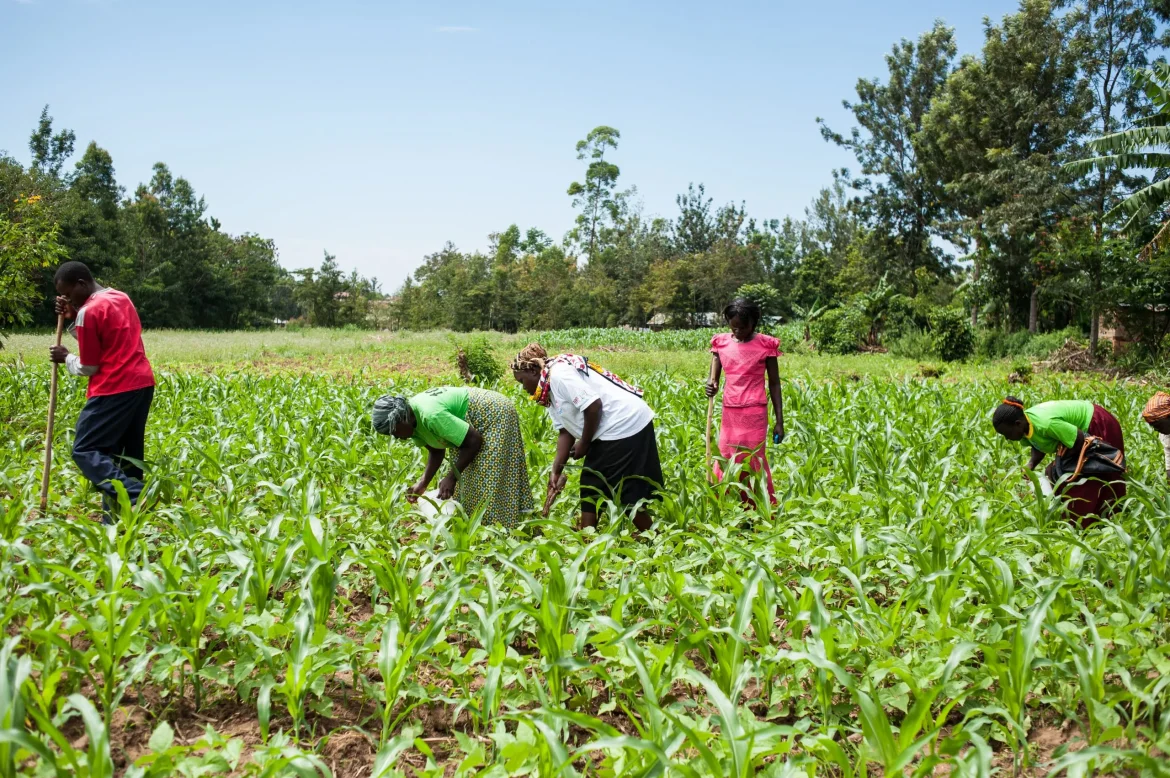
Africa’s growing carbon-finance market is facing a practical test in the fields where climate projects are expected to deliver both emissions reductions and greater resilience for smallholder farmers. New research from Uganda and Kenya suggests that while carbon payments can create an additional source of agricultural income and finance climate-smart land management, low returns, volatile carbon prices, monitoring costs and unequal bargaining power can limit participation and weaken the development impact of projects intended to bring private climate finance into rural economies.
The issue is significant for a continent where agriculture remains central to employment, household incomes and food security, while farmers are increasingly exposed to droughts, floods, soil degradation and changing rainfall patterns. In Sub-Saharan Africa, where more than 80% of the population relies on farming according to the research cited by ESG News, the ability to convert carbon finance into reliable agricultural investment is closely linked to the wider question of how Africa can finance climate adaptation without placing the burden entirely on households and governments.
 A study of rural Uganda highlighted by ESG News found that existing carbon projects can provide farmers with average payments of about $8 per hectare annually, while the farmers surveyed placed the compensation required for land-use changes and ongoing management at roughly $54 per hectare per year. The difference illustrates a central problem in agricultural carbon markets: the price paid for carbon does not necessarily reflect the economic cost of changing how land is used or the labour required to maintain climate-related practices.
For farmers with limited financial and labour resources, the economics can be particularly difficult. Tree planting and agroforestry projects can require several years of maintenance before carbon benefits are realised, while farmers may also have to weigh the land used for trees against food production or other income-generating activities. Measurement, reporting and verification requirements add another layer of cost to projects operating across dispersed smallholder farms.
The research found that farmer participation is influenced by both financial incentives and experience. Each additional dollar of compensation increased the likelihood of participation by about 1%, while previous experience with agroforestry increased participation by 22%. Households that had experienced severe flooding were also 14% more likely to participate, suggesting that climate exposure can make farmers more receptive to projects that offer both environmental and livelihood benefits. At the same time, greater price uncertainty reduced participation, while stronger confidence in climate policy and local governance increased adoption.
These findings reinforce a broader body of evidence from Kenya, where researchers have examined how different carbon-farming financing structures affect the economic viability and inclusiveness of projects involving smallholders. A 2026 study published in Land Use Policy assessed 12 carbon-farming projects in Kenya and identified four financing models: donor-funded projects, investor finance backed by forward purchase agreements, private-sector equity finance and buyer-led models.
The Kenyan research found that the structure of financing can determine who carries the risks and who captures the potential rewards. Donor finance can help establish projects and deliver community benefits but may create dependence on grants. Investor-backed models can provide more stable upfront capital, but future carbon revenues may be committed to investors under pre-agreed arrangements. Buyer-led models can give investors significant influence over projects and potentially weaken farmers’ bargaining position over how revenues are shared.
Read also: https://www.esgnews.earth/latest-news/unlocking-carbon-finance-for-africas-smallholders/21931.html
Transparency therefore becomes a financial issue as much as a governance concern. The Kenyan study identified transparent accounting of project costs and carbon revenues as important for equitable benefit sharing and argued that farmer organisations can play a stronger role in reducing reliance on international intermediaries. The findings also suggest that reaching sufficient scale early and reinvesting project revenues can improve the commercial viability of carbon-farming schemes.
For African policymakers, this raises questions about how carbon markets should be integrated into agricultural and climate-finance policy. Carbon credits can potentially provide a new revenue stream for agroforestry, soil restoration and other land-management practices, but they do not remove the underlying costs of adapting agriculture to climate change. If carbon payments remain too low or unpredictable, farmers may have little economic reason to adopt practices that impose immediate costs while producing climate benefits over a much longer period.
The financing gap is already visible beyond carbon markets. In East Africa, the International Fund for Agricultural Development and Equity Group launched a $200 million, 12-year blended-finance mechanism in September aimed at reaching about 260,000 smallholder producers and 500 rural enterprises across Kenya, Uganda, Tanzania and Rwanda. The mechanism combines concessional finance with Equity Group’s own balance sheet and is intended to make adaptation finance more accessible to farmers and rural businesses.
That development highlights an important distinction between carbon finance and adaptation finance. Carbon markets primarily reward measurable emissions reductions or removals, while many of the investments farmers need, such as irrigation, drought-resistant inputs, soil improvement, storage and climate information may generate significant resilience benefits without producing carbon revenues that can be readily monetised.
This distinction matters because the most financially attractive carbon projects are not necessarily those that address the highest adaptation needs. A farmer in a drought-prone area may need irrigation or improved water management immediately, while the carbon value associated with planting trees may take years to materialise. Financing models that depend heavily on future carbon revenues can therefore leave a gap between the timing of investment and the timing of returns.
The issue also has implications for Africa’s emerging carbon-market architecture. Governments across the continent are developing frameworks for voluntary carbon markets and Article 6 transactions under the Paris Agreement, seeking to attract international buyers while retaining greater oversight of environmental integrity and national climate objectives. At the same time, regional initiatives are attempting to strengthen project pipelines and improve access to finance.
The challenge is to ensure that these markets do not become another mechanism through which environmental value is generated locally while financial value is captured disproportionately outside Africa. Land ownership, contractual terms, revenue-sharing arrangements, project governance and access to information will increasingly determine whether carbon markets function as agricultural finance instruments or remain primarily markets for emissions reductions.
For governments, this makes regulation and institutional capacity central to the economics of carbon markets. Clear rules on land rights, community participation, project approval, carbon ownership and revenue distribution can reduce uncertainty for investors while protecting farmers from poorly structured agreements. Cooperatives and farmer organisations can also provide a practical channel for negotiating contracts, aggregating projects and reducing the transaction costs of working with thousands of individual producers.
The implications extend to public finances. If well-designed carbon projects generate additional private investment in soil health, agroforestry and rural infrastructure, they could complement limited public resources for climate adaptation. But governments may also face pressure to intervene when carbon markets fail to deliver predictable returns or when farmers bear costs that are not reflected in carbon prices.
The emerging evidence suggests that scale alone will not determine the success of Africa’s agricultural carbon markets. The quality of financing arrangements, the distribution of risk, the reliability of carbon prices and the strength of local institutions will be equally important. Research from Kenya has already shown that different financing models produce different distributions of risks and returns, while the Uganda evidence highlights the gap between current payments and the economic costs faced by farmers.
For Africa’s smallholders, the question is ultimately straightforward: whether carbon finance can provide a sufficiently reliable economic return to justify changing land-use practices while protecting food production and household incomes. For investors and policymakers, the question is broader, whether carbon markets can be structured as credible climate-finance mechanisms that strengthen rural economies rather than simply increasing the supply of low-cost carbon credits.
 As African countries expand their carbon-market frameworks and seek new sources of climate finance, the experience of smallholder farmers will provide an important measure of whether those markets are delivering on their economic promise. The durability of the model will depend not only on the tonnes of carbon removed or avoided, but on whether the financial value created reaches the people undertaking the work and whether the resulting investment strengthens the resilience of Africa’s food systems.


