


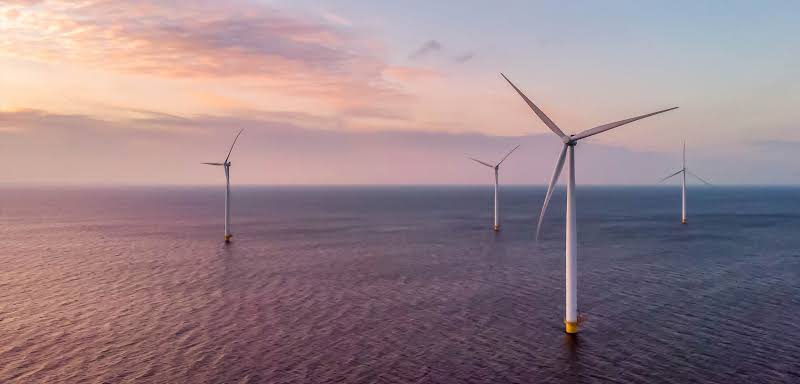
South Africa’s first proposed offshore wind farm has been delayed after the environmental impact assessment for the 800-megawatt Gagasi project on the country’s east coast stalled, highlighting the regulatory, technical and infrastructure challenges facing a technology that the World Bank says could become a significant source of new electricity and economic activity. The project, planned off Richards Bay, is awaiting additional technical information from its developers after its environmental authorisation application was withdrawn during a redesign from floating to anchored turbines.
The delay comes as South Africa considers a much larger role for offshore wind in its electricity system. According to a World Bank strategic framework released this month, selected coastal areas could support about 95 gigawatts of offshore wind capacity, predominantly through floating technologies. The scale of that potential is significant for a country whose electricity system remains heavily dependent on coal and where expanding reliable generation has become central to economic growth, industrial competitiveness and emissions reduction.
 The Gagasi project was launched in 2022 by GenesisHexicon, a joint venture between Sweden’s Hexicon and South Africa’s Genesis Eco-Energy Developments. Acer Africa Environmental Consultants, which was appointed to undertake the environmental assessment, told Reuters that the application was withdrawn last year to allow the project to be redesigned from floating to anchored turbines for technical rather than environmental reasons. The consultancy said the assessment remains stalled pending further technical information, while Genesis Eco-Energy has indicated that it will provide a project update next month.
The experience illustrates one of the practical difficulties facing offshore wind development in emerging markets: significant technical potential does not automatically translate into investable projects. Offshore developments require detailed environmental assessments, marine planning, grid connections, specialised engineering, port infrastructure and financing structures capable of absorbing the higher upfront costs associated with a relatively new technology in many African markets.
For South Africa, the issue is particularly relevant because the country’s energy transition is increasingly being shaped by the need to replace ageing coal generation while maintaining sufficient electricity supply for households and industry. The World Bank’s wider infrastructure reform programme has identified electricity as one of the areas requiring structural change, including measures to support private investment in transmission and strengthen the country’s electricity market.
Offshore wind could eventually add another source of large-scale electricity to that system, but its contribution will depend on more than the availability of strong coastal winds. The World Bank’s offshore wind framework notes that South Africa’s geography presents particular technical considerations, especially because much of the country’s offshore resource is in deeper waters where floating wind technology is more relevant. The World Bank has previously identified substantial offshore wind potential along South Africa’s coastline while noting that deep waters and strong currents create technical challenges, particularly for floating installations.
Those conditions have implications for the cost and structure of future investment. Floating offshore wind generally requires different foundations, vessels, port facilities and installation capabilities from conventional fixed-bottom projects. For African economies, that can create a tension between the need to deploy new energy capacity and the need to develop the industrial and financial ecosystems required to support it.
The potential economic gains are nevertheless material. The World Bank’s latest framework estimates that large-scale offshore wind development could generate about $6.7 billion in employment wages for South Africa’s domestic economy by 2050. It also estimates that offshore wind could reduce electricity-generation emissions by about 530 million tonnes of carbon dioxide over the next 25 years, primarily through its contribution to reducing dependence on coal-fired generation.
For Africa, the significance extends beyond South Africa’s electricity mix. Renewable-energy projects increasingly intersect with industrial policy, local manufacturing, skills development, infrastructure investment and the ability of countries to retain more value from energy transitions. Offshore wind could support demand for specialised engineering, marine services, construction, operations and maintenance, although the extent of those domestic benefits would depend on how procurement, skills development and industrial participation are structured.
South Africa has already been pursuing reforms intended to increase private participation in its energy sector. Eskom, the state-owned electricity utility, established Eskom Green in 2026 as a wholly owned renewable-energy subsidiary with the ability to raise funding for utility-scale renewable projects. The move forms part of a broader effort to expand renewable generation while improving the governance and financing structure of the electricity sector.
The country’s experience also matters for other African economies assessing offshore wind. Morocco, Egypt and several countries along the continent’s Atlantic and Indian Ocean coastlines have significant wind resources, while African governments are increasingly examining renewable electricity as an input into industrial development, green hydrogen, manufacturing and energy-intensive infrastructure. The World Bank has identified South Africa, Morocco and other emerging markets as countries where offshore wind could play a role in expanding electricity supply, while noting that the commercial viability of such markets depends on policy, infrastructure and proximity to demand.
The Gagasi delay therefore presents a governance and project-development issue as much as an energy story. Environmental assessment is intended to identify and manage ecological and social risks before major infrastructure is built, but lengthy or uncertain development processes can also increase project costs and financing risks. For governments seeking to attract private capital, the challenge is to maintain credible environmental safeguards while providing sufficiently clear regulatory processes for developers and investors.
This balance will become increasingly important as African countries seek to mobilise private capital for energy infrastructure. The World Bank reported this week that it mobilised a record $112 billion in private capital during the fiscal year ending June 2026, alongside $123 billion of its own resources, underscoring the growing emphasis among development institutions on using public finance to attract private investment into infrastructure and other development priorities.
For South Africa, offshore wind is therefore likely to be judged not simply by the size of its theoretical resource, but by whether projects can move through environmental approval, financing, construction and grid connection in a manner that delivers reliable electricity and measurable domestic economic value. The Gagasi project is an early test of that process. Its delay does not diminish the country’s estimated offshore wind potential, but it underscores the institutional, technical and financial work required to convert that potential into operating infrastructure.
 For the wider continent, the lesson is similarly practical. Africa’s energy transition will depend not only on the availability of renewable resources, but on the capacity of governments, utilities, regulators, financiers and developers to prepare projects, manage environmental and social risks, build supporting infrastructure and create investment conditions capable of turning renewable-energy potential into productive economic assets.


