


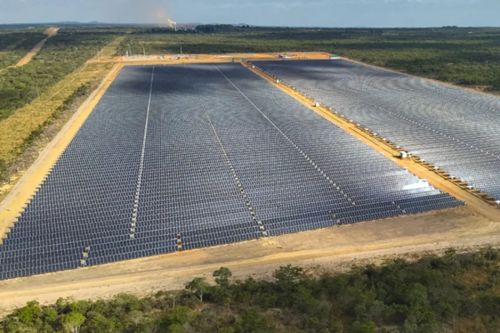
Zambia has added another 500 MW solar project to its development pipeline after state-owned utility ZESCO signed a 25-year power purchase agreement with Hungary-based EnerSynk Group, taking the utility’s newly signed solar PPAs in 2026 to 1 GW and highlighting both the scale of the country’s renewable-energy ambitions and the financing challenge that comes next.
The EnerSynk agreement covers a planned 500 MW solar photovoltaic project in Zambia’s Copperbelt Province. Signed on September 15, the PPA establishes the commercial framework for the future sale of electricity to ZESCO and allows the developer to move into the next phase of technical studies, environmental and regulatory processes, financing and implementation planning. The project is significant relative to Zambia’s existing solar fleet. Government figures show operational solar capacity reached 841 MW in 2026, up from 88 MW in 2021. The proposed 500 MW EnerSynk project alone would therefore represent close to 60% of the country’s current operational solar capacity if completed.
The agreement also follows a separate 500 MW PPA signed by ZESCO in June with South Korea’s KS Eco Solutions Holdings. That project combines solar generation with battery storage and was presented by Zambia’s Ministry of Energy as part of efforts to diversify the electricity mix, strengthen energy security and increase private-sector participation in power generation. Together, the two PPAs establish a 1 GW development pipeline, but they do not represent 1 GW of newly operational generation. Both projects still have substantial development requirements before electricity can flow into Zambia’s grid.

That distinction is particularly important in a market where the government is seeking to attract billions of dollars of private capital into new energy infrastructure. EnerSynk has said that the Copperbelt project still requires technical studies, environmental and regulatory approvals, financing and implementation planning. The company has not disclosed its financing sources, while the project is expected to be implemented in phases. The development timetable released by Zambian reporting indicates that the project is planned in three phases, with 300 MW targeted for commercial operation within 16 months of the effective date, followed by 100 MW within 22 months and the final 100 MW within 28 months. The project’s reported contracted value is about $519 million.
For Zambia, the significance of the agreements extends beyond solar capacity. The country has been attempting to reduce its dependence on hydropower following the severe drought that affected generation and contributed to electricity shortages in 2024 and 2025. The response has been to accelerate diversification into solar and other sources while expanding transmission infrastructure and reforming the electricity market. Zambia’s Ministry of Energy reported that installed generation capacity increased from 3,100 MW in 2021 to 4,576 MW in 2026, while solar capacity increased almost tenfold over the same period.
The country’s National Energy Compact provides a broader framework for that expansion. Under the Mission 300-backed plan, Zambia aims to develop 3,000 MW of solar capacity by 2030, increase the share of non-hydro renewables in its generation mix from 3% to 33%, and expand electricity access to an additional 26 million people. The compact estimates that Zambia will need $9.5 billion in private-sector investment to support its energy ambitions. It identifies bankable power purchase agreements and risk-mitigation instruments as important tools for mobilising that capital.
That makes the latest PPAs relevant not simply as renewable-energy announcements but as tests of whether Zambia’s emerging procurement and market reforms can translate contractual commitments into investment-grade projects. A PPA can provide a project with an identifiable buyer and a long-term revenue framework, both of which are central to the financing of utility-scale renewable energy. But lenders and investors will also assess the creditworthiness of the off-taker, tariff structure, foreign-exchange exposure, transmission availability, regulatory approvals, land rights, environmental risks and the broader financial structure of the project.
ZESCO’s own financial position is therefore part of the equation. The National Energy Compact identifies strengthening ZESCO’s financial and operational performance as a core pillar, including tariff reforms, debt restructuring and a target of full cost recovery by 2027. The issue is particularly relevant because the utility is expected to absorb electricity from an expanding portfolio of independent power producers while simultaneously maintaining and expanding the national grid.
ZESCO has been positioning itself for that role. Managing Director Justin Loongo has previously described the utility’s transition towards becoming a market enabler capable of connecting capital, projects and customers, alongside reforms to open the electricity market and standardise interconnection. The transmission system will also become increasingly important as Zambia moves towards a larger and more geographically diverse renewable-energy portfolio. The government is implementing the Zambia-Tanzania power interconnector, which is intended to strengthen electricity security, facilitate regional trade and provide an additional route for power flows between Zambia and neighbouring markets.
The National Energy Compact also identifies regional integration as a strategic priority, including stronger interconnections and Zambia’s potential role as a regional power-trading hub. For solar developers, however, more generation capacity also creates a need for better system flexibility. Zambia’s 500 MW KS Eco Solutions project includes battery storage, illustrating the growing role of storage in new utility-scale developments.
The combination of solar and storage can help address the timing mismatch between daytime solar production and periods of higher electricity demand. It can also provide additional system services and reduce some of the operational challenges associated with increasing variable renewable generation.
Other projects are following similar models. Globeleq’s Leopards Hill project near Lusaka, for example, combines 250 MWp of solar photovoltaic capacity with a 150 MW/600 MWh battery energy storage system. The project has been developed with Leopard Investment Company and has targeted financial close by the end of 2026.
These developments point to a changing investment proposition in Zambia. The market is moving beyond simply adding solar panels towards developing complete power infrastructure involving generation, storage, transmission, financing and long-term offtake arrangements. That shift is important for an economy where electricity demand is closely linked to industrial activity, particularly mining. Zambia is seeking to expand copper production and develop its industrial base, increasing the requirement for reliable electricity at a time when climate variability is placing pressure on hydropower. The Copperbelt location of the EnerSynk project is therefore significant. The province is one of Zambia’s principal industrial and mining regions, and additional grid-connected renewable generation could contribute to meeting electricity demand from economic activity in the area.
The investment challenge, however, remains substantial. Signing a PPA does not eliminate construction risk, financing risk or regulatory risk. It creates the commercial framework within which those risks can be assessed and allocated. For Zambia, the next milestone will consequently be financial close rather than another announcement of development capacity. If the EnerSynk and KS Eco projects reach financial close and construction, the combined 1 GW would materially expand the country’s solar base. If additional projects already in the pipeline also progress, Zambia could move closer to its 2030 renewable-energy objectives while reducing the exposure of its electricity system to hydrological conditions.

But the distinction between announced capacity, contracted capacity, financed capacity and operating capacity will become increasingly important as the pipeline grows. The country’s recent solar expansion demonstrates that the development model is gaining momentum. The 88 MW of solar operating in 2021 has grown to 841 MW in 2026, while reforms have opened greater space for private developers and independent power producers. The question now is whether the financial and institutional architecture can scale at the same pace. For international investors, that means evaluating not only Zambia’s solar resource but also the bankability of its PPAs, the financial resilience of ZESCO, the availability of transmission, currency and payment risks, and the mechanisms available to mitigate them.
For government, it means ensuring that the investment pipeline translates into projects that can reach construction without creating new pressure on public finances. And for the electricity system, it means ensuring that new solar capacity arrives alongside the transmission, storage and grid-management infrastructure needed to absorb it. The EnerSynk PPA is therefore a significant commercial milestone, but it is not the final investment decision. The company’s own description of the next phase technical development, approvals, financing and implementation planning—underscores the distance that remains between a signed contract and a functioning power plant.
Zambia’s 1 GW in newly signed solar PPAs shows how quickly the country’s renewable-energy pipeline is expanding. The next test will be whether those contracts can attract the capital required to become physical infrastructure. For a country seeking to reach 3,000 MW of solar capacity by 2030 while mobilising $9.5 billion in private energy investment, the ability to convert PPAs into financial close may ultimately matter as much as the pace at which new agreements are signed. The solar opportunity is increasingly visible. The harder task is making it bankable.


