


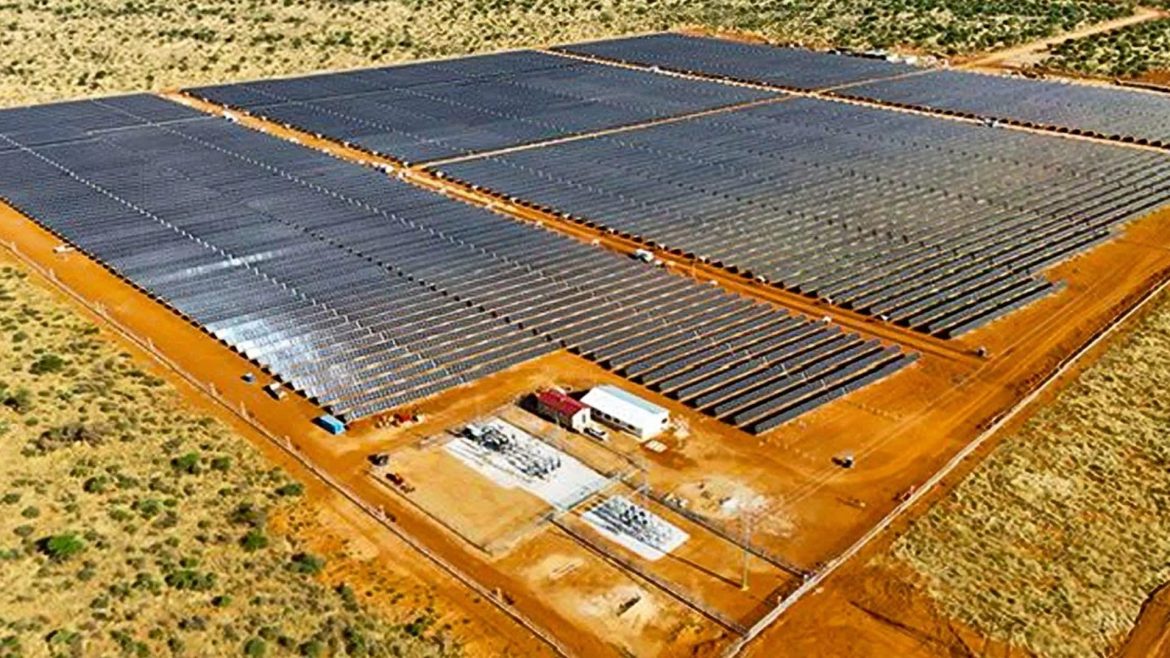
Solarcentury Africa, a wholly owned subsidiary of the independent global energy trading group BB Energy, has formally commissioned the 19.3-megawatt-peak Gerus solar photovoltaic plant in Namibia’s Northern Kunene Region, establishing the nation’s first utility-scale renewable energy facility to operate entirely on a merchant model without sovereign power purchase agreements. Developed in partnership with Sino Energy over an accelerated 12-month construction window and backed by approximately $20 million in international private equity, the installation bypasses traditional state utility off-take guarantees to trade electricity directly onto the Southern African Power Pool. The project represents a fundamental structural departure from conventional African infrastructure financing, substituting public balance-sheet risk with private capital and cross-border wholesale market dynamics.
According to project disclosures from Solarcentury Africa, the facility is engineered to yield approximately 50.8 gigawatt hours of clean electricity annually. This generation volume is calculated to satisfy equivalent consumption demand for more than 14,000 Namibian households while mitigating roughly 17,000 tonnes of carbon dioxide emissions each year. Wholly integrated with Solarcentury Trading, an active trading member of the SAPP, the asset leverages regional wholesale architecture to monetize power dynamically. The deployment follows the July 2025 commercial launch of the company’s 25-megawatt-peak Mailo solar facility in Zambia, establishing Gerus as the second purpose-built merchant solar installation on the continent to plug directly into multinational power pools.
 The arrival of a merchant solar framework in Namibia highlights a broader institutional evolution across Sub-Saharan Africa, where traditional infrastructure funding models face severe fiscal bottlenecks. Historically, utility-scale independent power producer projects across the continent have relied heavily on sovereign guarantees, long-term bilateral power purchase agreements with state-owned monopolies, and multilateral concessional lending. While these mechanisms successfully catalyze early renewable energy deployment, they have increasingly strained public finances. Sovereign utilities burdened by structural debt and weak balance sheets frequently struggle to absorb additional long-term liabilities, leading to procurement gridlock, delayed projects, and constrained generation capacity.
By shifting market exposure away from state treasuries and onto private trading desks, the merchant model redefines how renewable assets are capitalized and operated. Financing for the Gerus installation, channeled directly through BB Energy’s corporate balance sheet without public sector debt exposure, exemplifies this shift. Industry analysts note that this funding structure constitutes the largest UK-backed private investment into Namibia’s clean energy sector to date, illustrating how independent trading houses are deploying corporate liquidity directly into African energy markets to bypass traditional institutional lending delays.
From a regulatory standpoint, the smooth execution of the project reflects sophisticated coordination between private developers, the Electricity Control Board of Namibia, and state power utility NamPower. Rather than viewing merchant generators as a threat to domestic monopoly structures, Namibian regulatory authorities have accommodated the integration of market-driven assets that align with national developmental priorities. The facility operates within an evolving legal framework that permits private generators to wheel power across national transmission grids, setting a precedent for other resource-rich African nations seeking to mobilize private capital without expanding sovereign debt portfolios.
Read also: https://solarcenturyafrica.com/en/articles/gerus-solar-cimmercial-operation
The broader macroeconomic implications for Africa hinge on the capacity of regional power pools to absorb and distribute decentralized private generation efficiently. The Southern African Power Pool, which interconnects national grids across twelve countries, provides the transactional platform necessary to balance localized supply deficits through cross-border trade. When generation assets like Gerus inject power directly into the SAPP, they decouple national electrification strategies from the fiscal health of single domestic utilities. Power can flow dynamically to regions experiencing acute industrial or residential deficits, transforming renewable energy from a localized compliance asset into a regionally traded commodity.
This dynamic carries profound consequences for regional industrialization and institutional development. Chronic power deficits have long served as a primary bottleneck for manufacturing and mineral processing across Southern Africa, depressing regional GDP growth and forcing industrial operators to rely on costly, carbon-intensive backup diesel generation. By introducing market-based merchant solar into the transmission mix, regional grids gain access to agile, rapidly deployed capacity that can be scaled without protracted sovereign procurement cycles. Furthermore, trading desks can optimize pricing signals across borders, ensuring that electricity flows to high-value industrial nodes where demand is most acute.
 However, the merchant solar model also introduces distinct market risks that distinguish it from guaranteed-offtake frameworks. Unlike traditional independent power producers shielded by fixed tariffs over twenty-year horizons, merchant operators absorb direct exposure to wholesale electricity price volatility within the SAPP. Fluctuations in regional supply and demand, seasonal generation variances, and changes in cross-border transmission wheeling tariffs directly impact asset yields. Consequently, the viability of future merchant investments depends heavily on the liquidity and pricing stability of regional power exchanges, as well as the continuous physical reliability of transnational transmission interconnectors.


