


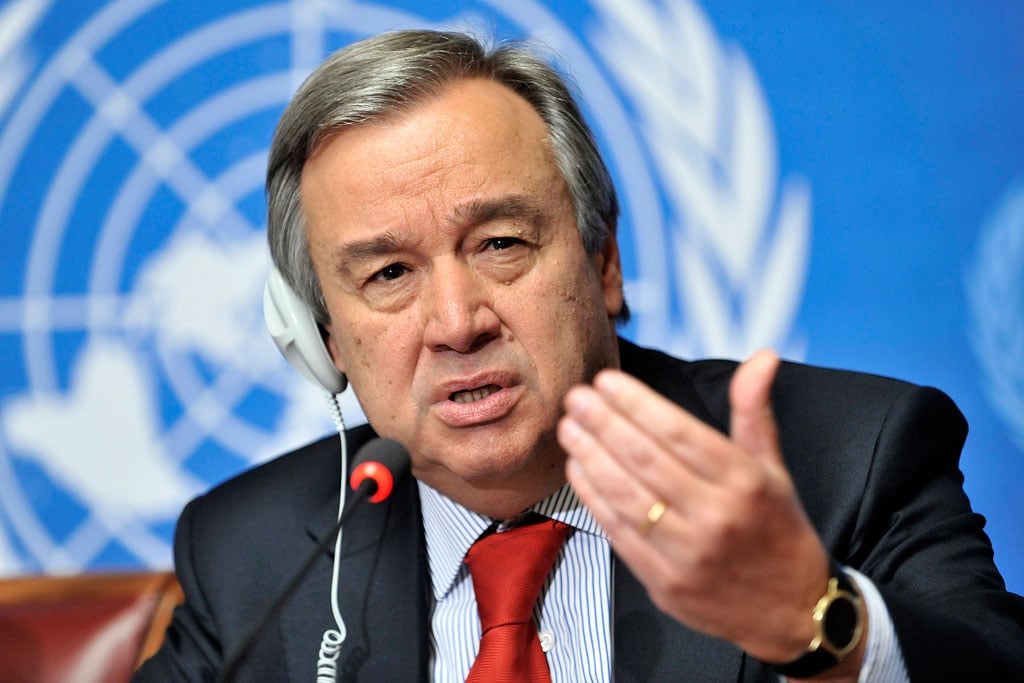
UN Secretary-General António Guterres has called for a tripling of climate adaptation finance and universal access to early-warning systems by 2027 as East Africa confronts a worsening convergence of climate shocks, conflict, displacement and economic pressure. His warning comes as more than 40.3 million people across six Intergovernmental Authority on Development (IGAD) member states face high levels of acute food insecurity in 2026, equivalent to 34% of the population covered by the latest regional analysis. The figure has risen from 13.9 million in 2016, although the 2026 total is lower than the 43.3 million recorded in 2025 because of improvements in Sudan and Uganda. Food insecurity nevertheless worsened in Djibouti, Kenya, Somalia and South Sudan, according to IGAD’s regional focus of the 2026 Global Report on Food Crises.
Guterres’ intervention places adaptation finance at the centre of an increasingly immediate economic question for African governments: how to protect food systems, infrastructure and public services before climate shocks develop into larger humanitarian emergencies. Speaking during the United Nations’ high-level climate discussions in September 2026, he argued that adaptation needs to be embedded in national policies, public budgets and infrastructure decisions. He called for adaptation finance to triple and for every person on Earth to be protected by an early-warning system by 2027.
The message is particularly relevant to East Africa, where climate variability is interacting with conflict and economic disruption rather than operating as a standalone environmental risk. IGAD’s 2026 food-security assessment covers Djibouti, Kenya, Somalia, South Sudan, Sudan and Uganda and identifies conflict, weather extremes and economic shocks among the principal drivers of food insecurity. Sudan remains the region’s largest food crisis, with 19.5 million people facing high levels of acute food insecurity during the assessment period, while South Sudan has the highest proportion of its population affected, at 55%.

The regional figures demonstrate why the distinction between climate adaptation and economic policy is becoming increasingly difficult to maintain. A failed rainy season can reduce crop yields and livestock productivity, weaken household incomes and increase food prices. Flooding can then damage roads, bridges, health facilities, homes and agricultural assets, increasing the fiscal demands on governments already operating with limited budgetary room. For households, the same sequence can translate into lost income, higher food costs and displacement. For governments, it can mean additional expenditure on emergency relief and reconstruction while tax revenues and local economic activity come under pressure.
Kenya illustrates the challenge. According to the latest IGAD assessment, 4.1 million people in the country’s arid and semi-arid lands were facing high levels of acute food insecurity between April and June 2026, including almost 429,500 refugees. The number represented a 46% increase, or almost 1.3 million more people, compared with the 2025 peak. The deterioration followed poor rainfall in parts of the region, including failed October-December 2025 rains that affected southeastern Ethiopia, eastern Kenya and much of Somalia.
The climate outlook adds another layer of uncertainty. IGAD’s regional forecast for October to December 2026 points to wetter-than-normal conditions in eastern parts of the region as El Niño strengthens, while flooding is identified as one of the major hazards. The regional bloc has urged member states to activate national anticipatory-action frameworks and prepare contingency plans before the season begins.
For agriculture, above-average rainfall can provide relief after dry conditions, but it does not automatically translate into improved food security. Excessive rainfall can destroy crops, erode soils, overwhelm drainage systems, cut roads and isolate communities from markets. IGAD and the IGAD Climate Prediction and Applications Centre have previously documented how El Niño can produce both beneficial rainfall and damaging floods in the Horn of Africa. During the 2023 El Niño, for example, wetter conditions brought relief to drought-affected areas but also contributed to flash floods, displacement and infrastructure damage in Kenya and Somalia.
That dual exposure increases the value of early-warning systems because the objective is not simply to forecast a hazard but to trigger decisions before the hazard becomes a crisis. IGAD’s September 2026 call for action includes pre-positioning food, health, WASH and agricultural supplies, protecting roads and health facilities, strengthening flood-related disease surveillance and providing timely farming and livestock advisories. The regional body has also called for a shift from response to anticipation, with financing and action triggered before shocks escalate.
The UN’s Early Warnings for All initiative is built around a similar principle. Launched by Guterres in 2022, the initiative seeks to ensure that everyone on Earth is protected by multi-hazard early-warning systems by the end of 2027. Its action plan identifies four core areas: disaster-risk knowledge, observation and forecasting, warning dissemination and communication, and preparedness and response. The initiative estimates that about $3.1 billion in targeted investment is required over five years to strengthen these systems globally.
For African economies, the economic case for these systems extends beyond saving lives. Weather intelligence affects decisions across agriculture, insurance, transport, energy, water management and public health. A timely flood warning can allow farmers to move livestock, protect equipment and harvest crops earlier. Municipal authorities can prepare drainage and emergency services. Governments can pre-position food and medical supplies rather than purchasing them after prices have risen. Financial institutions and insurers can also incorporate weather information into lending, risk assessment and insurance products.
The cost of failing to anticipate these events can be considerably higher. Guterres has framed the relationship bluntly, warning that without adaptation, droughts can become hunger crises, storms can become debt crises and heatwaves can become killers. His argument places climate resilience within the wider debate over fiscal sustainability, particularly for developing countries where repeated disasters can force governments to redirect resources from development programmes towards emergency response and reconstruction.
The financing gap remains central to that challenge. Recent UN discussions have highlighted that developing countries are estimated to need between $310 billion and $365 billion annually for adaptation by 2035, while international public adaptation finance flows stood at about $26 billion in 2023. The resulting gap means that many countries must pursue resilience investments while facing higher financing costs and constrained fiscal space.
For Africa, where climate adaptation needs are often concentrated in agriculture, water, transport, health and local infrastructure, the structure of finance matters as much as the headline amount. Concessional finance, grants, guarantees and risk-sharing mechanisms can influence whether governments and businesses are able to invest before climate risks materialise. Guterres has also argued that the international financial system needs to make greater use of multilateral development banks and risk-sharing instruments to reduce the cost of capital for developing countries.
East Africa is already developing some of the institutional architecture required for this transition. In June 2026, IGAD and the African Development Bank launched the SECURES-IGAD project to strengthen early-warning data and crisis prevention across Djibouti, Sudan, Somalia and South Sudan. The initiative is designed to improve the region’s ability to anticipate emerging fragility risks by bringing climate, conflict and humanitarian information closer to decision-making.
The region’s food crisis, however, is not solely a climate problem. Conflict remains a major driver, particularly in Sudan and South Sudan, while displacement disrupts agricultural production, market access and household livelihoods. Around 19 million people across the six countries covered by the latest assessment were forcibly displaced by July 2026, including 14.5 million internally displaced people and 4.5 million refugees and asylum-seekers. About nine million children aged between six and 59 months are also estimated to require treatment for acute malnutrition, including 2.3 million facing severe acute malnutrition.
That combination makes the policy challenge more complex than simply increasing emergency food assistance. Humanitarian funding can address immediate needs, but resilient food systems require investment in irrigation, water storage, climate information, roads, market infrastructure, agricultural inputs, livestock systems and social protection. IGAD’s Food and Nutrition Security Strategy for 2025-2034 similarly identifies climate change, conflict, economic shocks, pests and disease as interconnected pressures on regional food systems and calls for stronger preparedness, resilience and coordination.
Data is another part of the infrastructure required for anticipation. IGAD has identified weaknesses in food-security information as a constraint on timely intervention. Reliable data allows governments and development partners to determine where rainfall deficits, crop losses, market disruptions or displacement are becoming significant enough to trigger early action. Without that information, financing can arrive after households have already sold productive assets, livestock have died or communities have begun moving in search of food and water.
For African policymakers, the broader implication is that adaptation needs to move from a project category into mainstream economic planning. Roads need to be designed for changing rainfall patterns. Agricultural investment needs to account for drought and flood exposure. Public-health systems need to anticipate climate-sensitive disease outbreaks. Financial institutions need better climate-risk information when lending to farmers and businesses. Urban authorities need to incorporate heat and flood risks into infrastructure investment.

Guterres’ call for more adaptation finance therefore arrives against a regional test already unfolding in East Africa. The immediate challenge is managing the risks associated with the coming rainy season, including the possibility that heavy rainfall will provide agricultural relief in some areas while producing floods and infrastructure damage in others. The longer-term challenge is whether governments, development banks and private investors can shift enough resources towards anticipation and resilience to reduce the economic cost of recurring shocks.
The direction of travel is increasingly clear in the region’s institutions. IGAD is calling for earlier action, stronger food systems, better regional markets and improved data, while the UN is pushing for wider early-warning coverage and greater adaptation finance. The remaining question is implementation: whether climate information can trigger financing and government action early enough to protect crops, livelihoods, infrastructure and public finances before an extreme event becomes a humanitarian crisis.
For East Africa, where food insecurity has risen sharply over the past decade despite periodic improvements, adaptation is becoming inseparable from economic resilience. The 40.3 million people currently facing acute food insecurity are not only a humanitarian statistic; they represent pressure on agricultural markets, public services, household incomes and national budgets. The challenge for governments and development institutions is increasingly to finance resilience before those pressures compound, rather than mobilise scarce resources only after the damage has occurred.


