


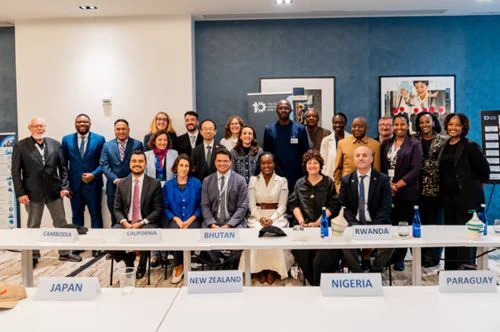
Rwanda, Brazil and the United Kingdom have revived the Friends of the Kigali Amendment coalition and backed a new $100 million philanthropic funding goal to accelerate the deployment of energy-efficient and climate-friendly cooling technologies, putting cooling access at the centre of the next phase of global climate and development policy. Launched in New York on September 23, 2026, as the Kigali Amendment approaches its 10th anniversary, the initiative seeks to strengthen implementation of the agreement, reduce hydrofluorocarbon emissions, improve the efficiency of cooling equipment and strengthen refrigerant management across its lifecycle.
The renewed coalition brings together governments seeking to maintain political momentum behind an agreement adopted in Kigali in 2016 under the Montreal Protocol. Rwanda, Brazil and the United Kingdom presented a new Ministerial Communiqué establishing priorities around the phasedown of hydrofluorocarbons, sustainable and energy-efficient cooling, increased access to finance, technology and capacity, and stronger partnerships with industry. The Climate and Clean Air Coalition said the Friends of the Kigali Amendment will complement rather than duplicate the formal institutions and processes of the Montreal Protocol.
The financing component reflects the scale of the challenge. Major climate philanthropies, including the Sequoia Climate Foundation, have announced a $100 million fundraising goal to support faster reductions in HFC emissions and the expansion of sustainable cooling. The funding is intended to complement public and private capital as well as resources mobilised through the Multilateral Fund for the Implementation of the Montreal Protocol, which provides financial and technical assistance to developing countries implementing the treaty.

The urgency is being driven by the rapid growth in demand for cooling. The global stock of air conditioners is projected to rise from about 1.6 billion units in 2018 to 5.6 billion by 2050. At the same time, UNEP‘s Global Cooling Watch 2025 estimates that cooling demand could more than triple by 2050 under a business-as-usual pathway, with cooling-related greenhouse gas emissions potentially reaching 7.2 billion tonnes of carbon dioxide equivalent. The growth is being driven by rising temperatures, population and income growth, urbanisation and increased access to cooling in lower-income economies.
For Africa, the implications extend well beyond air conditioning. Cooling is closely linked to the performance of food supply chains, healthcare systems, vaccine and medicine storage, digital infrastructure and businesses operating in increasingly hot conditions. UNEP estimates that around 1.2 billion people in Africa and Asia currently lack adequate access to cooling services, exposing households and productive sectors to risks ranging from heat stress and food losses to constraints on healthcare delivery.
The food system provides one of the clearest examples. Reliable refrigeration and cold-chain infrastructure can extend the shelf life of agricultural products, reduce post-harvest losses and allow farmers and traders to access markets that would otherwise be difficult to serve. For African economies seeking to increase agricultural processing and move from commodity production towards higher-value food systems, cold-chain capacity is therefore an infrastructure issue with implications for farm incomes, food prices, trade and industrial development.
Healthcare presents another critical dimension. Refrigeration is required to maintain vaccines and temperature-sensitive medicines, while hospitals increasingly require dependable cooling as extreme heat puts additional pressure on patients, medical workers and equipment. In countries where electricity systems already face capacity constraints, however, expanding conventional air-conditioning without improving energy efficiency can increase peak electricity demand and add pressure to power grids.
That creates the central policy challenge behind the renewed Friends of the Kigali Amendment: expanding cooling access while preventing the growth in cooling demand from becoming a new source of energy and emissions pressure. The coalition is therefore pursuing three mutually reinforcing measures phasing down HFCs, improving the energy efficiency of cooling appliances and equipment, and strengthening refrigerant management throughout the equipment lifecycle.
HFCs are powerful greenhouse gases widely used as refrigerants in air-conditioning and refrigeration equipment. The Kigali Amendment establishes a global schedule for reducing their production and consumption. The United Nations Environment Programme estimates that full implementation of the amendment could avoid up to 0.5°C of global warming by 2100, while the UN Ozone Secretariat notes that combining the refrigerant transition with improvements in equipment efficiency could produce additional climate benefits.
Energy efficiency is particularly significant because the environmental footprint of cooling is determined by both the refrigerants used and the electricity required to operate equipment. UNEP’s analysis indicates that cooling already represents a substantial share of global electricity consumption, with demand expected to increase sharply as access expands. Improving appliance efficiency can therefore reduce emissions while also limiting the amount of additional generation and grid infrastructure required to meet peak demand.
For African power systems, that relationship is increasingly important. Many countries are simultaneously trying to expand electricity access, support industrialisation and accommodate rising demand from households and businesses. A rapid increase in inefficient cooling equipment could compound peak-load pressures, particularly during heatwaves when electricity demand for air conditioning rises at the same time that heat can reduce the efficiency of some power infrastructure.
Sustainable cooling can instead become part of energy-system planning. Higher minimum energy-performance standards, efficient appliances, passive cooling measures, improved building design, distributed renewable energy and better thermal management can reduce the amount of electricity required to provide the same cooling service. UNEP’s Global Cooling Watch 2025 estimates that a Sustainable Cooling Pathway could cut cooling-sector emissions by 64% relative to business as usual by 2050, while simultaneously expanding access to cooling.
The financing question will determine how quickly these technologies can reach consumers and businesses. Efficient equipment can have lower operating costs over its lifetime, but higher upfront prices can create barriers for households, farmers, hospitals, small businesses and cold-chain operators with limited access to affordable capital. This makes blended finance, concessional funding, commercial investment and appropriate consumer-finance models relevant to the transition alongside public policy.
The renewed $100 million philanthropic target is therefore not intended to finance the entire global cooling transition. Rather, it is designed to help accelerate implementation, catalyse additional finance and support the institutional and technical capacity required to move from policy commitments to deployment. The Friends of the Kigali Amendment specifically identifies finance, technology and capacity as one of its four shared objectives, while emphasising the continuing role of the Montreal Protocol’s Multilateral Fund.
Rwanda’s role in the initiative gives the country an additional opportunity to connect international climate diplomacy with implementation on the continent. The Kigali Amendment was adopted in Rwanda in 2016, and the country will host the 38th Meeting of the Parties to the Montreal Protocol from November 2 to 6, 2026. The meeting will bring governments, international organisations, industry and other stakeholders together to assess progress on ozone protection and climate-related commitments.

The meeting also gives African governments an opportunity to examine how cooling policies can be integrated into broader national development planning. UNEP’s guidance on incorporating cooling into Nationally Determined Contributions highlights measures including minimum energy-performance standards, Kigali-compliant refrigerant phase-downs, passive cooling, nature-based solutions and climate-responsive urban planning.
This integrated approach matters because cooling is increasingly connected to several policy portfolios that are often treated separately. Energy ministries oversee electricity demand and efficiency; environment authorities regulate refrigerants and climate commitments; agriculture ministries have an interest in cold chains; health ministries depend on reliable refrigeration; and finance ministries determine how public resources and incentives can support infrastructure investment. Coordinating these interests could determine whether cooling becomes an additional burden on already constrained infrastructure or an opportunity to improve productivity and resilience.
For African businesses, the implications are equally broad. Food processors require dependable refrigeration, retailers depend on cold storage, hospitals need temperature-controlled facilities, telecommunications and data infrastructure generate heat that must be managed, and commercial buildings face increasing cooling requirements as temperatures rise. Efficiency improvements can therefore affect operating costs and infrastructure requirements as well as emissions.
The renewed Friends of the Kigali Amendment comes at a point when the economics of cooling are becoming harder to separate from the economics of climate adaptation. Higher temperatures increase demand for cooling, while inefficient cooling can increase electricity consumption and emissions, which in turn contribute to further warming. Breaking that cycle requires investment in equipment, refrigerants, buildings, grids and skills rather than treating air conditioning and refrigeration as isolated consumer technologies.
The next decade will therefore test whether the Kigali Amendment can move from a successful international agreement into a larger deployment effort across emerging markets. With cooling demand expected to rise rapidly and Africa facing simultaneous pressures around heat, food security, health infrastructure and electricity access, the quality and affordability of cooling systems will increasingly influence economic resilience.
The renewed coalition and its $100 million philanthropic target do not resolve those challenges on their own. But they place sustainable cooling within a broader investment conversation that links climate mitigation with infrastructure, health, agriculture, energy efficiency and economic productivity. For African countries, that connection may be particularly important: the transition is not simply about using cleaner refrigerants, but about building cooling systems capable of supporting development without creating another major source of pressure on already constrained energy and infrastructure systems.


