


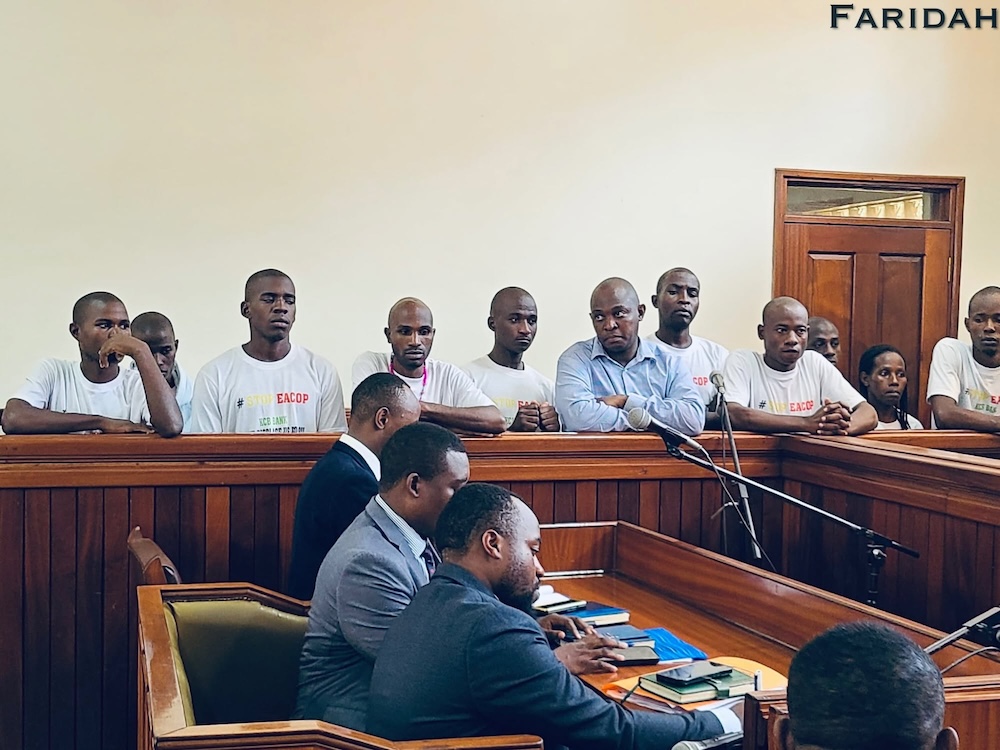
Eleven Ugandan environmental activists are due back in court , more than 17 months after they were arrested while attempting to deliver a letter opposing financing for the East African Crude Oil Pipeline, with no prosecution witness having yet testified in the criminal trespass case. The group, known as the KCB11, was arrested at the Kampala headquarters of KCB Bank Uganda on April 23, 2025, after seeking to submit a petition asking the bank to stop financing the 1,443-kilometre pipeline linking Uganda’s oil fields to Tanzania’s Indian Ocean port of Tanga. Climate Rights International has called for the charges to be withdrawn, while the case has become part of a broader debate over environmental activism, judicial process, corporate accountability and the governance of Uganda’s oil development.
According to Climate Rights International, the activists were taken into the basement of KCB’s Kampala headquarters after being told that a bank official was arranging a meeting, where police and security personnel were waiting. They were charged with criminal trespass two days later and spent 85 days in Luzira prison before being released on bail in July 2025. The organisation said the case was adjourned on September 8, 2026, with the court giving prosecutors what was described as a final opportunity to present witnesses before potentially dismissing the matter for failure to proceed.
Brad Adams, executive director of Climate Rights International, has characterised the prolonged proceedings as punishment through the legal process and called for the charges to be dropped. Those are the organisation’s conclusions about the case, rather than a judicial finding. KCB had not responded to the allegations concerning its employees by the time of publication of the source material cited by Climate Rights International. The bank’s role is particularly significant because KCB Bank Uganda was among the financial institutions that participated in the first external financing tranche for EACOP.

The case has emerged as the pipeline itself moves closer to operation. EACOP Ltd reported that construction had reached 92.7% overall completion by the end of August 2026, while almost the entire 1,443-kilometre pipeline had been welded and lowered into its trench. The company said the project remains on course towards operational readiness and first oil.
EACOP is designed to transport crude from the Tilenga and Kingfisher developments in western Uganda to the Chongoleani terminal near Tanga in Tanzania. The project is owned by TotalEnergies E&P Uganda with a 62% stake, Uganda National Oil Company with 15%, Tanzania Petroleum Development Corporation with 15% and CNOOC Uganda with 8%. The pipeline is electrically heated and insulated because of the characteristics of Uganda’s crude, and its development includes pumping stations and associated export infrastructure.
The financing structure illustrates the regional economic importance of the project as well as the debate around financial exposure. EACOP announced in March 2025 that it had closed its first external financing tranche with a syndicate including African Export-Import Bank, Standard Bank of South Africa, Stanbic Bank Uganda, KCB Bank Uganda and the Islamic Corporation for the Development of the Private Sector. The financing brought regional banks directly into a project that had faced years of difficulty securing external debt.
For Uganda and Tanzania, EACOP is being developed as a piece of strategic energy infrastructure intended to connect Uganda’s landlocked oil resources to international markets. Supporters of the project have linked it to government revenues, foreign-exchange earnings, infrastructure development, employment and local-content opportunities. EACOP reported in September that more than 12,000 people had been directly employed across the project, including more than 4,000 Ugandans.
The project’s economic rationale, however, exists alongside concerns over land acquisition, compensation, livelihoods, environmental impacts and the treatment of people challenging oil development. Climate Rights International has documented allegations concerning delayed or inadequate compensation and loss of productive land around the Tilenga development, while its research into the Kingfisher project has alleged forced evictions, military violence, destruction of fishing boats, sexual and gender-based violence and labour abuses. These allegations have been contested within the wider debate over Uganda’s oil developments and should be distinguished from findings by courts or regulators.
The American Bar Association’s 2026 review provides a wider legal context. Its analysis of more than 25 criminal cases involving opponents of EACOP and other oil projects in Uganda identified what it described as a recurring pattern involving mass arrests, broad or vague charges, prolonged pretrial detention and repeated adjournments. The review said a number of cases ultimately ended in dismissal for want of prosecution. The report is an assessment by the American Bar Association and not a ruling by a Ugandan court.
That broader pattern matters because the governance environment surrounding large infrastructure projects can affect more than civil liberties. For investors and lenders, the quality of institutions, predictability of legal processes and ability of affected communities to raise grievances are increasingly relevant components of environmental, social and governance risk. A project may have strong engineering and financial structures, but unresolved disputes over land, compensation, community rights or legal process can create reputational, operational and potentially financial exposure over the life of an asset.
The KCB11 case therefore brings the financial sector into a wider discussion about responsible project finance. KCB Bank Uganda’s participation in the first EACOP financing tranche illustrates how regional banks are becoming important providers of capital for major African infrastructure projects. EACOP said the financing syndicate included $1.1 billion of external debt across conventional and Islamic financing arrangements, according to its March 2025 financing announcement.
For banks, this creates a due-diligence question extending beyond the financial viability of the borrower. International standards on responsible finance increasingly place emphasis on assessing environmental and social risks, stakeholder engagement and grievance mechanisms. Where projects generate sustained community opposition, lenders can face pressure to demonstrate that their financing decisions accounted for those risks and that credible mechanisms exist for affected groups to raise concerns without retaliation.
The issue is particularly relevant in Africa because the continent is entering a period of substantial infrastructure investment across energy, transport, mining and extractive industries. Governments need capital for development, while financial institutions are increasingly expected to assess the wider environmental and social consequences of projects they support. The EACOP experience demonstrates the tension that can arise when strategic infrastructure objectives intersect with contested land use, climate policy, community rights and civil society scrutiny.
The pipeline is also part of a wider climate-policy debate. EACOP is a major fossil-fuel infrastructure investment at a time when African countries are seeking to expand energy access and industrial capacity while also attracting climate finance and responding to international pressure to reduce emissions. The pipeline itself is intended for crude-oil transportation rather than electricity generation, but its development has become a prominent test of how African oil-producing countries balance near-term development and fiscal objectives with longer-term climate and transition considerations.
The project’s proponents argue that Uganda’s oil resources can generate economic value and support development, while critics have raised questions about environmental impacts, community rights and the compatibility of a long-lived oil export infrastructure with global efforts to reduce fossil-fuel dependence. These positions reflect a broader debate across Africa, where governments are seeking greater access to domestic resources and energy investment while questioning whether the continent should be expected to follow the same transition pathway as high-income economies that have historically produced and consumed far more fossil fuels.
The governance dimension is particularly important as Uganda approaches first oil. EACOP’s construction progress means decisions made during the development phase will increasingly become embedded in the operational structure of the project. Compensation arrangements, land-use disputes, environmental management, labour practices and grievance mechanisms will remain relevant after construction ends because communities living along the pipeline corridor will continue to interact with the infrastructure and its operators.
The legal proceedings involving the KCB11 therefore carry significance beyond the eleven defendants. If a case involving peaceful petitioning continues for years without prosecution witnesses appearing, questions inevitably arise about the efficiency of the judicial process and the ability of citizens to participate in decisions concerning major development projects. At the same time, allegations about judicial independence require careful attribution because they concern statements and interpretations that have not necessarily been tested through a judicial finding.
Climate Rights International has also criticised remarks attributed to Uganda’s Chief Justice Flavian Zeija during an August 2026 visit to an EACOP facility, arguing that comments about judicial intervention in oil projects could create concerns about judicial independence. EACOP separately reported that Zeija participated in a petroleum-sector familiarisation programme involving the judiciary, the Petroleum Authority of Uganda, Uganda National Oil Company, Bank of Uganda and Uganda Revenue Authority. The programme was presented by EACOP as an effort to improve institutional understanding of the legal, regulatory, economic and environmental dimensions of the petroleum sector.
The contrast illustrates the institutional challenge facing Uganda as its petroleum sector moves from development towards production. Courts, regulators, financial institutions, oil companies and government agencies will increasingly be required to operate within a framework where economic development objectives coexist with environmental obligations and public scrutiny. The credibility of those institutions will influence how disputes are managed and how investors assess the broader operating environment.

For the financial sector, the KCB11 case also raises a more specific question about how banks respond when their customers or stakeholders seek to challenge projects they finance. Receiving petitions and maintaining channels for peaceful engagement can form part of a wider stakeholder-management framework, particularly for projects with significant environmental and social footprints. Whether individual banks adopt such approaches is ultimately a matter for their governance structures and policies.
As the EACOP project approaches completion, the dispute over its consequences is therefore moving into a new phase. The pipeline is increasingly a physical reality, but the questions surrounding its social, environmental and institutional impacts have not disappeared. The outcome of the KCB11 proceedings will provide another indication of how Uganda’s institutions handle dissent around a strategically important infrastructure project.
The broader lesson for African infrastructure development is that financing and construction are only part of a project’s long-term risk profile. Land rights, community engagement, legal predictability, environmental safeguards and access to credible grievance mechanisms can influence whether infrastructure delivers its intended economic benefits without creating additional social and institutional costs. For EACOP, those questions will remain relevant as Uganda and Tanzania move from construction towards operations and as the region assesses the economic and governance consequences of its oil-development strategy.


