


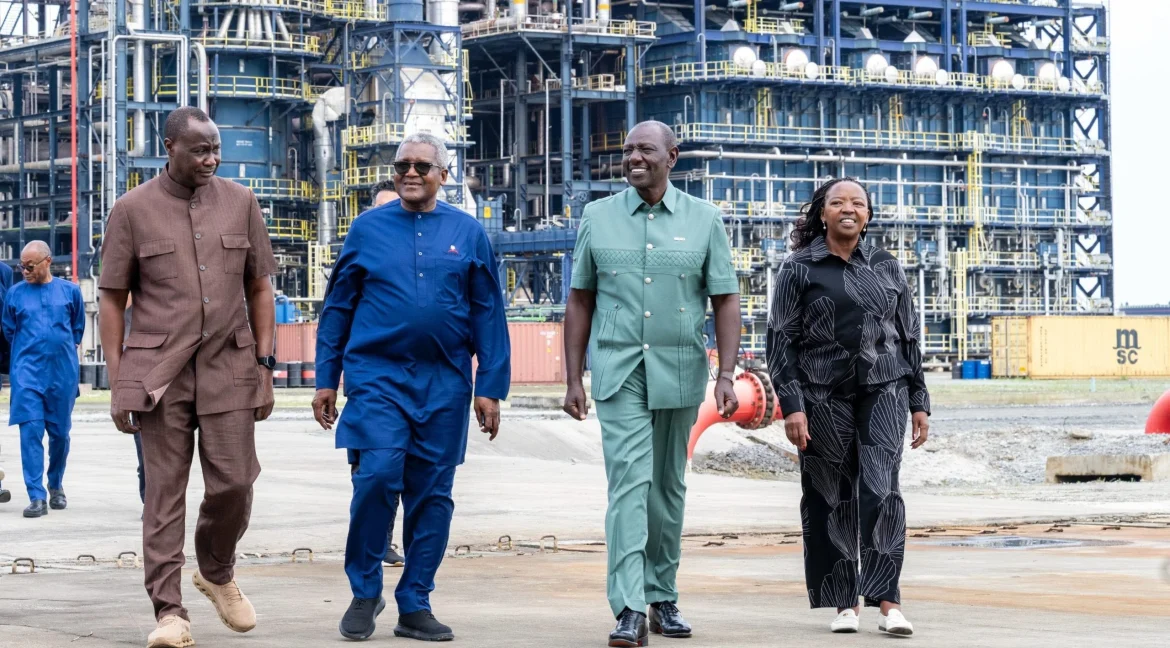
Nigerian industrialist Aliko Dangote and Kenyan President William Ruto are set to break ground on a $16 billion oil refinery in Lamu on Wednesday, launching one of Africa’s largest planned energy investments and a project designed to supply petroleum products to a region that remains heavily dependent on imports. The 700,000-barrel-per-day facility is expected to be completed by 2030, with Dangote offering East African governments a combined 30% stake as the project seeks to strengthen regional refining capacity, reduce exposure to imported fuel and establish Lamu as a larger industrial and energy hub.
The scale of the proposed refinery reflects the size of East Africa’s petroleum market. According to David Ndii, Chief Economic Adviser to President Ruto, annual regional demand for petroleum products is estimated at between 20 million and 30 million metric tonnes. A financier involved in African refinery projects told Reuters that meeting that demand would require more than 1 million barrels per day of refining capacity. The proposed Lamu facility would therefore represent a significant addition to the region’s ability to process crude locally rather than rely predominantly on imported refined products.

That dependence has become increasingly visible whenever international supply chains are disrupted. East African economies remain exposed to global crude and refined-product prices, freight costs, foreign-exchange movements and geopolitical shocks. For countries such as Kenya, where petroleum products are important inputs into transport, agriculture, manufacturing and logistics, changes in fuel prices can move quickly through the wider economy.
Kenya’s own petroleum planning recognises this exposure. The Energy and Petroleum Regulatory Authority’s medium-term petroleum development plan projects national demand for white liquid fuels, excluding LPG and fuel oil, to rise from about 5.93 billion litres in 2025 to 6.63 billion litres in 2029. The authority says petroleum infrastructure, including terminals, storage, pipelines and distribution facilities, remains central to maintaining reliable supply and managing disruptions.
The refinery could therefore alter more than Kenya’s fuel supply chain. If successfully developed and integrated with regional infrastructure, it could support a broader industrial ecosystem around Lamu, including petrochemicals and bitumen production, while creating demand for transport, engineering, logistics and other services. Reuters reports that officials expect the project to create more than 50,000 jobs, although the ultimate scale of employment will depend on construction, operational and supply-chain requirements as the project develops.
The proposed regional ownership structure is also significant. Dangote has offered East African governments a combined 30% stake, potentially giving governments a direct financial interest in an infrastructure asset intended to serve a regional market. For African economies, such arrangements raise a broader question about how major infrastructure projects can generate domestic ownership and retain more economic value within the continent rather than functioning primarily as externally financed assets.
Yet the project faces a fundamental commercial question: where will the refinery obtain enough crude?
Kenya currently does not have sufficient domestic crude production to supply a refinery of this scale. Dangote’s proposed model depends partly on crude from Kenya and neighbouring producers, including Uganda and potentially South Sudan, but those supply chains require infrastructure, political coordination and reliable transport arrangements. Reuters reported earlier this month that the Lamu project faces uncertainty over crude availability and that the special economic zone where the refinery is planned lacks some of the infrastructure needed to support a facility of this scale.
That creates an important distinction between refining capacity and energy security. A large refinery can reduce dependence on imported refined products, but it does not automatically eliminate dependence on international energy markets. If crude has to be imported over long distances, the economics of the refinery will still be affected by international oil prices, shipping costs and geopolitical disruptions. The project’s commercial viability will consequently depend not only on the refinery itself but also on the reliability and cost of the wider supply chain.
The environmental and social dimensions present another test. The refinery is planned near Lamu Old Town, a UNESCO World Heritage site and an area containing sensitive marine and coastal ecosystems. Environmental campaigners and conservation groups have raised concerns over potential impacts on the area.
Land rights have also become an immediate governance issue. Kenya’s High Court has ordered the preservation of parts of the project site pending a hearing in a case brought by local residents. Reuters reported that the legal dispute could affect work on the refinery, while local residents have challenged aspects of the land acquisition process. The Malindi Environment and Land Court ordered the status quo on disputed land to remain in place until an October 14 hearing.
For a project of this scale, these issues are not peripheral to the investment case. Land acquisition, environmental assessment, community participation and infrastructure planning can affect construction schedules, financing conditions and investor confidence. They also determine whether the economic benefits of large infrastructure projects are distributed alongside the costs borne by communities and ecosystems.
The refinery is also arriving at a complicated moment for Africa’s energy transition. Kenya has expanded renewable electricity rapidly and has pursued policies aimed at reducing the carbon intensity of its energy system, while petroleum remains deeply embedded in transport, logistics and industrial activity. EPRA’s latest petroleum demand planning explicitly incorporates changing consumption patterns, the substitution of some fuels by LPG, solar and biofuels, and Kenya’s longer-term decarbonisation commitments.
This means the refinery’s long-term economic case will exist alongside a gradual transformation of energy demand. The facility could improve regional fuel security and provide feedstock for industrial activity, but it will also operate in markets where electric mobility, renewable power, cleaner cooking technologies and other forms of energy substitution are developing. The investment therefore places a premium on flexibility, efficiency and sound long-term infrastructure planning rather than simply maximising petroleum output.
For Kenya, the project is closely linked to the wider ambition of turning Lamu into a logistics and industrial centre. The location connects the refinery to the country’s broader Lamu Port–South Sudan–Ethiopia Transport corridor, potentially creating opportunities for energy, manufacturing and logistics infrastructure to develop around the port. But that opportunity depends on complementary investment in roads, storage, pipelines, power, water and other supporting systems.
For East Africa, the more consequential question is whether the refinery can become part of a genuinely integrated regional energy market. A facility serving several countries would require cross-border infrastructure, harmonised standards, dependable transport networks and commercial arrangements capable of moving petroleum products efficiently across national borders. That makes the project relevant not only to Kenya’s energy policy but also to the region’s wider integration agenda.
The $16 billion investment consequently represents both an energy project and an infrastructure coordination challenge. Its contribution to African development will ultimately be measured not only by its refining capacity, but by whether it strengthens energy security, supports productive industries, creates durable local economic participation and manages environmental and social risks within a credible governance framework.

As East Africa seeks to reduce its exposure to external energy shocks while expanding industrial capacity, Dangote’s Lamu refinery will provide a significant test of how the continent balances petroleum security, regional industrialisation, local ownership and the longer-term transition towards lower-carbon energy systems.


