


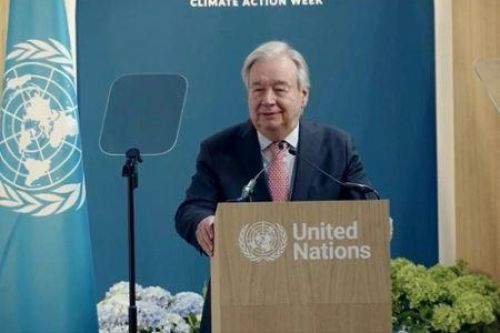
The United Nations has launched a new initiative to help African governments turn electricity-grid priorities into investable projects, as the continent faces the dual challenge of connecting hundreds of millions of people to power while expanding networks capable of carrying growing volumes of renewable electricity. UN Secretary-General António Guterres launched the Global Grids Accelerator on September 23, 2026, with Africa and Southeast Asia as its initial focus, bringing together policy expertise, project preparation, financing and implementation support around government-led grid projects. The initiative does not create a new financing institution or come with a dedicated funding package, but is intended to help countries navigate the technical, regulatory and financial barriers that often prevent grid projects from reaching implementation.
The initiative comes against a widening investment gap. The International Energy Agency estimates that annual investment in African electricity grids needs to rise from around $10 billion to nearly $50 billion by 2030 under its Sustainable Africa Scenario. The increase is required not only to extend electricity access but also to modernise existing networks, improve reliability and accommodate a more diversified generation mix as solar, wind and other renewable technologies expand. The IEA has warned that weak grid infrastructure is one of the constraints limiting Africa’s ability to translate its renewable-energy potential into reliable electricity supply.
The scale of the challenge is particularly evident in electricity access. The IEA estimated in its 2025 Financing Electricity Access in Africa report that around 600 million people in sub-Saharan Africa lacked electricity access as of 2024, equivalent to about 47% of the population. Under the agency’s pathway to universal access by 2035, around 45% of currently unelectrified households would receive connections through the grid, while decentralised systems such as mini-grids and stand-alone solutions would remain essential, particularly in remote and rural areas.

The Global Grids Accelerator is therefore addressing a problem that sits between infrastructure planning and finance. Many African countries already have national energy plans, regional power-pool strategies and identified transmission projects. The difficulty is often converting those priorities into projects with sufficient technical preparation, regulatory clarity, implementation capacity and financial structures to attract capital.
According to the African Development Bank, the accelerator will build on initiatives already operating across the continent, including the Continental Power System Master Plan, the African Single Electricity Market, the Programme for Infrastructure Development in Africa, Mission 300 and national energy compacts. The initiative is expected to work with African governments, the African Union Commission, development banks and other regional and international partners to advance grid investments and regional interconnections.
That emphasis on existing programmes is significant because Africa’s grid challenge is not simply a question of building more transmission lines. Electricity networks operate across national borders, regulatory systems and markets, while the economics of generation and transmission increasingly depend on whether countries can share electricity efficiently. Regional interconnections can allow countries to trade surplus power, diversify supply and reduce the need for each national system to maintain excess generation capacity.
The African Single Electricity Market is intended to support this broader integration by creating a framework for greater cross-border electricity trade. The Continental Power System Master Plan similarly seeks to strengthen long-term coordination of power-system development across Africa. The Global Grids Accelerator can potentially provide additional project-preparation and implementation coordination around these existing frameworks rather than creating parallel structures.
The financing problem, however, remains substantial. The IEA found that Africa attracts a disproportionately small share of global energy investment despite its large population and development needs. Its 2023 analysis estimated that achieving Africa’s energy and climate goals would require more than $200 billion of annual energy investment by 2030. The report also identified high financing costs, limited domestic capital and weak utility balance sheets as barriers to investment.
Grid infrastructure presents a particularly difficult financing challenge because revenues often depend on regulated tariffs and the financial condition of state-owned utilities. The IEA found that many African utilities face poor financial health and high system losses, limiting their ability to finance network expansion and modernisation from their own balance sheets. Average system losses across the continent were around 15% in 2020, compared with a global average of about 7%, according to the agency’s analysis.
This financial weakness matters because grid investment is capital intensive and generally requires long repayment periods. Utilities that cannot recover costs through tariffs or collect sufficient revenues can struggle to borrow for transmission and distribution upgrades. Governments may then have to provide guarantees, subsidies or direct capital injections, placing additional pressure on public finances.
The Global Grids Accelerator is designed partly to address this gap by connecting project preparation with potential financing partners. The United Nations said the initiative will bring together policy, technical, financing and implementation capabilities from governments, development-finance institutions, investors, utilities and international organisations around specific grid priorities. It will be convened by the United Nations Development Programme, UN Office for Project Services and Sustainable Energy for All, working alongside UN agencies including the Economic Commission for Africa, UNIDO and UNCTAD.
The African Development Bank, Asian Development Bank, Asian Infrastructure Investment Bank, European Investment Bank, World Bank, Climate Investment Funds, International Renewable Energy Agency and International Energy Agency are among the institutions expected to engage with the accelerator. That network is important because grid projects often require several forms of capital at different stages, ranging from grants and concessional financing for preparation to commercial debt and private investment for construction and operation.
For Africa, the ability to combine these financing sources could determine whether grid plans move beyond feasibility studies. The IEA has identified concessional finance as particularly important for energy-access projects because many investments serve low-income consumers or remote areas where commercial returns are limited. In its 2025 analysis, the agency estimated that universal electricity access in sub-Saharan Africa by 2035 would require nearly $150 billion of investment, with concessional resources playing a major role in reducing risks and attracting private capital.
Grid expansion also has implications beyond household electricity connections. Reliable networks are a prerequisite for industrial development because factories, data centres, cold-storage facilities, hospitals and other productive infrastructure require predictable power. Poor grid reliability can force businesses to rely on diesel generators or other backup systems, increasing operating costs and exposing companies to fuel-price volatility.
The relationship between grids and renewable energy adds another layer. Africa has substantial solar, wind, hydropower and geothermal resources, but generation capacity cannot automatically translate into usable electricity without adequate transmission and distribution networks. Renewable projects located far from demand centres require transmission capacity, while variable generation requires networks capable of balancing electricity flows across different locations and time periods.
This challenge is already visible in markets where renewable capacity has expanded faster than transmission infrastructure. The Global Grids Accelerator is intended to help countries identify and prepare the infrastructure needed to connect new generation and strengthen regional power systems. The United Nations has described the grid as a critical infrastructure constraint for the energy transition because delays in grid development can also delay new generation projects and limit industrial growth.
For African governments, the initiative also intersects with the continent’s Mission 300 effort, led by the African Development Bank and World Bank, which aims to connect 300 million people to electricity by 2030. The IEA has estimated that around 45% of households currently without electricity could be served by grid connections under its universal-access pathway, highlighting the importance of investment in transmission and distribution alongside decentralised solutions.
The grid question is therefore also a development-finance question. Extending a network to a rural community does not automatically guarantee that households will be able to afford electricity or that demand will be high enough to support the financial sustainability of the investment. The IEA estimates that about 220 million people in sub-Saharan Africa who currently lack electricity would be unable to afford even its basic electricity-service bundle without additional financial support. Closing the access gap consequently requires investment on both the supply and consumer sides.
The same issue applies to industrial consumers. Grid expansion can create opportunities for manufacturing and commercial activity, but those benefits depend on reliability, tariffs and the availability of productive demand. Energy planning therefore increasingly needs to connect electricity infrastructure with industrial policy, agricultural processing, digital infrastructure and urban development.
The Global Grids Accelerator’s stated emphasis on country-led priorities is intended to address this broader planning challenge. Rather than imposing a single grid model, the initiative will work with governments and regional institutions around projects already identified within national and regional frameworks. This could allow technical and financial resources to be directed towards investments that correspond with domestic development priorities.

The initiative also places implementation capacity alongside finance. UNOPS, which will contribute procurement, infrastructure and project-management expertise, said many countries already have plans and identified projects but that capital is not following at the same pace.That distinction is important. A financing announcement does not necessarily translate into physical infrastructure. Projects must pass through feasibility studies, environmental and social assessments, procurement, financial structuring, regulatory approvals and construction. Weak capacity at any stage can delay implementation and increase costs.
For African countries, strengthening those institutional capabilities could therefore be as important as mobilising additional capital. Project preparation can reduce uncertainty for investors, while stronger regulatory frameworks and utility finances can improve the prospects of long-term infrastructure investment.
The accelerator’s lack of a dedicated financing facility also places limits on what it can deliver directly. Its value will depend on whether it can coordinate existing sources of finance effectively and help countries develop projects that meet the requirements of different financiers. The initiative itself is not a substitute for the large-scale capital that Africa’s grids require.
That distinction is particularly relevant given the IEA’s estimate of the continent’s grid investment needs. Moving from approximately $10 billion of annual investment to nearly $50 billion by 2030 would require a substantial increase in public, concessional and private financing, alongside reforms that improve the financial sustainability of utilities and reduce investment risks.
The launch nevertheless places grid infrastructure more prominently within the international energy-access and climate-finance agenda. For Africa, stronger grids could support three objectives at once: connecting households and businesses to electricity, integrating larger quantities of renewable generation and providing the infrastructure required for industrial development.
The practical test will be whether the accelerator can move projects through the pipeline quickly enough to match those needs. Africa’s energy transition is increasingly constrained not by a lack of renewable resources or national ambitions, but by the infrastructure and financing systems needed to connect power to consumers.
As governments prepare for rising electricity demand and seek to expand clean-energy generation, transmission and distribution networks will increasingly determine how much of that capacity can actually be used. The Global Grids Accelerator is intended to help close part of that gap. Its significance for Africa will ultimately be measured not by the creation of another international initiative, but by whether existing projects reach financial close, construction and operation—and whether the resulting networks deliver more reliable, affordable electricity to households, businesses and emerging industries.


