


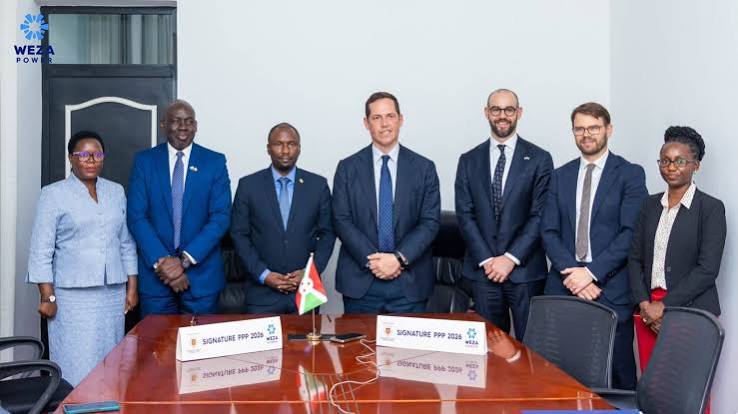
Burundi has signed a $1.4 billion, 25-year public-private partnership with Weza Power to expand and operate its electricity distribution network, targeting new or improved access for approximately 8 million people by 2030 in one of Africa’s least electrified countries. The agreement places private investment and development finance at the centre of the country’s effort to extend grid connections to households and businesses while supporting economic growth.
Signed in October 2026, the agreement provides for the construction or upgrading of 52,000 kilometres of distribution lines and more than 1.2 million new household and business connections. Weza Power, developed by Anzana Electric Group, will manage distribution across roughly half the country, while the state-owned utility REGIDESO will retain responsibility for the remaining distribution area and the national electricity transmission network. Gridworks, an investor in Anzana and a subsidiary of British International Investment, is supporting the project.
The scale of the planned expansion reflects Burundi’s longstanding electricity access gap. Gridworks puts current national access at around 15%, with rural access particularly limited. Other estimates cited in reporting vary according to the data source and the definition of access used. Under the new partnership, the government and its private-sector partners aim to raise electricity access to more than 50% by 2030, although achieving that target will depend on construction, financing, generation availability and the affordability of connections for households and businesses.

President Évariste Ndayishimiye said the partnership would expand opportunities for citizens, strengthen industry and create conditions for investment, employment and long-term prosperity. The government’s case for the agreement is that broader access to reliable electricity can support productive activity across sectors including agriculture, manufacturing, mining, tourism, education and healthcare.
The distribution focus is significant because expanding electricity generation alone does not guarantee that power reaches consumers. New and existing generation must be connected to a functioning network, with sufficient lines, transformers, metering systems and local connections to deliver electricity reliably. In Burundi, the proposed 52,000 kilometres of new and upgraded distribution infrastructure is intended to address this last-mile challenge by bringing the network closer to underserved communities.
Under the agreed structure, Weza Power will invest in and operate the distribution network within its concession area. REGIDESO will continue to supply electricity through the national transmission network and manage distribution in the other part of the country. This division creates a new operating model for the sector, while requiring coordination between the private concessionaire and the public utility on power supply, network planning, technical standards and service quality.
The agreement is backed by a blended-finance structure designed to combine commercial investment with concessional capital and development finance. Partners associated with the programme include the World Bank Group, the International Finance Corporation (IFC), the Multilateral Investment Guarantee Agency (MIGA), the African Development Bank (AfDB), the US International Development Finance Corporation and other development partners. The structure is intended to reduce investment risks and help mobilise the capital required for a project whose scale would be difficult to finance through private equity alone.
The headline investment figure represents the financing the partnership aims to mobilise over its development and implementation, rather than evidence that the full amount has already been disbursed. The distinction matters because large infrastructure commitments typically require capital to be released in stages as projects meet financing, construction and operational milestones. The pace of network expansion will depend on the availability of funds, procurement, technical capacity and the ability to complete installations across widely dispersed communities.
For Gridworks, the agreement extends a regional strategy focused on electricity transmission and distribution infrastructure. The company has investments across several African markets, including projects in Uganda, Ethiopia, the Democratic Republic of Congo and Zambia. In Burundi, it already has exposure to power generation through Anzana Electric Group and its subsidiary Songa Energy, which commissioned the 1.65-megawatt Upper Ruvyironza hydropower plant in 2025. A second hydropower facility, with a planned capacity of 9 MW at Upper Mulembwe, is under development.
Gridworks’ wider portfolio includes the $50 million Amari project in Uganda, which reached financial close in March 2026 to upgrade four substations, and a planned investment of approximately $400 million in two transmission lines in Ethiopia. In the Democratic Republic of Congo, the company is involved in the $340 million Moyi Power project, combining solar generation and electricity distribution in three isolated towns. It also signed agreements in October 2026 to become the lead equity investor in a 200-kilometre electricity interconnector between Zambia and the DRC.
These projects illustrate the growing role of private investors and development finance institutions in building power infrastructure across African markets. They also show that electricity access requires investment across the energy value chain: generation to produce power, transmission to transport it over long distances, and distribution networks to connect homes and businesses. Weakness in any one part can constrain the benefits of investment elsewhere.
For Burundi, the economic implications of expanding distribution could be substantial if new connections are accompanied by reliable supply and affordable service. Electricity can enable small businesses to operate equipment, help agricultural enterprises process and store produce, support digital services and improve the functioning of clinics and schools. More dependable power can also reduce reliance on costly alternatives such as diesel generators, although the benefits will vary according to local demand and household purchasing power.
The project nevertheless faces practical challenges. Extending lines across rural areas requires land access, construction capacity, equipment and ongoing maintenance. New customers must be able to afford connection charges and electricity bills, while the system needs sufficient generation to meet the demand created by additional connections. If supply remains constrained or tariffs are unaffordable, physical access alone may not translate into sustained use or meaningful gains in productivity.

The operating relationship between Weza Power and REGIDESO will also be important. Clear responsibilities for network maintenance, service standards, metering, billing and technical coordination will be necessary to ensure that the concession improves reliability rather than creating fragmented service. Transparency over progress, connection costs and service performance will help households, businesses and investors assess whether the programme is delivering its intended outcomes.
The agreement aligns with Mission 300, the joint initiative led by the World Bank Group and the African Development Bank to connect 300 million people across sub-Saharan Africa to electricity by 2030. Burundi’s partnership demonstrates how national energy plans can use private capital, public institutions and concessional finance to pursue large-scale access targets.
The central test will be implementation. The $1.4 billion commitment and the planned 1.2 million connections set an ambitious direction, but their impact will ultimately be measured by the number of households and businesses that receive reliable and affordable electricity. For Burundi, extending the distribution network is a necessary step towards broader economic participation; delivering the infrastructure on time and ensuring that power can be used productively will determine whether the agreement translates into lasting development gains.


