


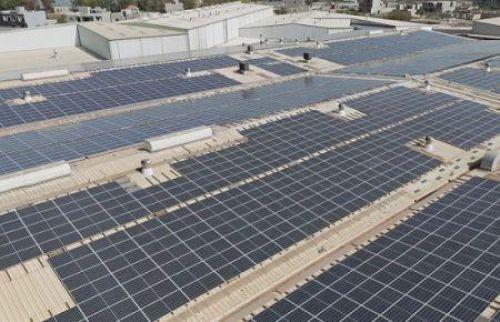
Afreenergy Solar has secured a €12 million senior debt facility from the Renewable Energy Performance Platform 2 (REPP 2) to expand its commercial and industrial solar portfolio in Senegal from 2.7 megawatts peak (MWp) to 14.9 MWp, adding battery storage as businesses seek alternatives to high electricity costs and improve the reliability of their power supply.
The financing, announced on 21 October 2026, will support the construction of new rooftop solar installations, refinance existing facilities and add 5.7 megawatt-hours (MWh) of battery energy storage. REPP 2 is managed by Camco, a climate and impact fund manager that finances renewable energy projects in emerging markets. The facility builds on a €4.3 million commitment made earlier in 2026 by the Private Infrastructure Development Group (PIDG) through its project development arm, InfraCo.
Afreenergy Solar develops, owns and operates solar installations for commercial and industrial customers, including businesses in retail, food manufacturing, agro-industry and infrastructure. Under its power supply model, the company retains ownership and operational responsibility for the installations, while customers purchase the electricity under long-term agreements rather than financing and owning the equipment themselves.

According to Camco, the contracted portfolio and growing pipeline of projects provide a basis for expanding the business. Benjamin Hugues, a director at Camco, said the financing would strengthen Afreenergy Solar’s capacity to deploy projects in Senegal and establish a platform for larger industrial and mining customers across Africa.
The transaction comes as electricity costs remain a concern for Senegalese businesses. The country’s energy system has historically depended heavily on thermal generation, including imported petroleum products, exposing power costs to fuel prices and supply conditions. The US Department of Commerce’s 2026 Senegal energy guide identifies diversification of generation, lower energy costs and improved access as priorities for the country’s energy sector.
For businesses with substantial daytime electricity demand, rooftop solar can reduce purchases from the grid by supplying part of their consumption directly. This can be relevant for food processing, warehousing, retail and agro-industrial operations, where electricity is needed for refrigeration, machinery, lighting and other equipment. The actual savings depend on a customer’s consumption profile, the tariff structure, the terms of its electricity agreement and the proportion of demand that solar generation can meet.
Afreenergy Solar estimates that participating customers could reduce electricity costs by approximately 30%. That figure is a projected benefit rather than a guaranteed saving for every customer. Outcomes will vary according to individual site conditions, the volume of electricity consumed, contractual pricing and the extent to which solar generation aligns with operating hours.
The addition of 5.7 MWh of battery storage is intended to complement the expanded solar portfolio. Batteries can store surplus electricity generated during periods of strong sunlight and make it available later, helping customers use more of their on-site generation when demand continues after solar output declines. Depending on the system design, storage can also support power management and reduce exposure to interruptions.
Battery capacity, however, is measured in megawatt-hours, while the rate at which a battery can deliver electricity is measured in megawatts. The amount of backup a business receives will therefore depend not only on the 5.7 MWh of storage planned across the portfolio, but also on the power rating of individual systems, their configuration and the loads they are designed to support. The announced storage capacity should not be interpreted as a guarantee of uninterrupted electricity for every customer.
The financing structure also illustrates how distributed renewable energy projects can attract capital without requiring each customer to purchase and maintain its own equipment. By aggregating several sites and long-term electricity contracts into a single portfolio, Afreenergy Solar can seek financing against a broader base of contracted revenues. This can help distribute development and operating risks across multiple customers rather than relying on one large installation.
For customers, the model can reduce the upfront investment associated with installing solar equipment. Businesses pay for electricity under an agreed contract, while the developer is responsible for the system’s ownership and operation. The arrangement can be particularly relevant to companies that want to manage electricity expenditure but prefer to allocate capital to their core operations.
The approach also creates requirements for both the developer and its financiers. Projects need creditworthy customers, reliable demand forecasts, appropriately structured contracts and systems that perform over the duration of the agreements. Refinancing existing installations alongside new construction can help create a larger portfolio, but the financial performance of the expanded business will depend on continued customer payments, equipment reliability and the successful completion of projects under development.
Afreenergy Solar’s expansion follows its acquisition in July 2024 of three rooftop solar plants from GreenYellow, with a combined capacity of 2.6 MWp. The acquisition provided an operating base for the company’s subsequent growth. In March 2026, PIDG committed €4.3 million through InfraCo to support Afreenergy Solar’s development, with an initial focus on Senegal and ambitions to expand into selected markets in West and Central Africa.
PIDG’s project description identifies a potential wider pipeline of commercial and industrial projects, including solar installations and battery systems for agro-industry, logistics and other energy-intensive sectors. The €12 million senior loan adds a debt component to that earlier development financing, helping the company move from project development towards a larger operating and construction portfolio.
Senegal’s broader energy strategy provides additional context for the investment. The government has committed to increasing the share of renewable energy in its electricity mix to 40% by 2030 under its Just Energy Transition Partnership with international partners. The country is also pursuing diversification of energy sources, expansion of generation capacity and improved electricity access, including in rural areas.
Official Senegalese energy-sector figures show that the national electrification rate reached 86.2% in 2024, with a significant difference between urban and rural access. While the Afreenergy Solar portfolio is directed primarily at businesses rather than underserved households, distributed solar can contribute to a more diversified electricity system by supplying demand at the point of use and reducing some customers’ reliance on grid electricity.

The scale of that contribution will depend on implementation. The increase from 2.7 MWp to 14.9 MWp represents an expansion of more than fivefold in the company’s solar portfolio, but it should not be confused with capacity already operating. The financing is intended to support both existing assets and projects that still need to be constructed. The additional battery storage will likewise need to be installed and commissioned before it can deliver the intended benefits.
For Senegalese businesses, the central question is whether long-term solar contracts can provide predictable electricity costs while meeting operational requirements. For investors, the transaction tests whether a portfolio of smaller commercial installations can be financed at scale through aggregated contracts. For the wider energy transition, it demonstrates one route for mobilising private capital into distributed generation alongside investment in the national power system.
Afreenergy Solar’s next phase will depend on converting the financing into operational projects, maintaining the performance of existing installations and securing customers able to support long-term contracts. If delivered as planned, the expansion would increase the availability of on-site solar and storage for businesses in Senegal and strengthen the company’s platform for potential regional growth. The broader test will be whether the model can continue to attract capital while delivering measurable cost savings and reliable power for its customers.


