


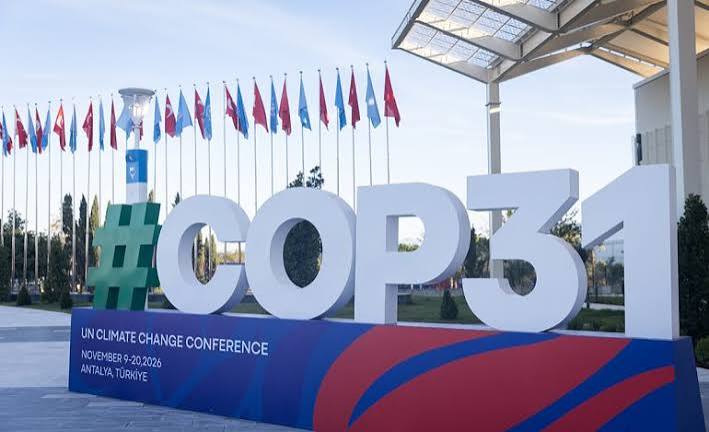
The COP31 climate summit opened in Antalya, Türkiye, on Monday, November 9, with nearly 200 countries facing pressure to turn climate commitments into implementation amid financing disputes, geopolitical tensions and rising climate risks. Running until November 20, the conference is expected to test whether its “implementation COP” agenda can deliver the investment needed to expand electricity access, strengthen climate resilience and reduce the financial burden on African economies.
For Africa, the negotiations carry significant economic and fiscal implications. The continent contributes relatively little to global greenhouse gas emissions but faces growing exposure to droughts, floods, water insecurity and extreme weather. According to the International Energy Agency (IEA), almost 600 million people in Africa lack access to electricity, while around 1 billion lack clean cooking. The central question for African governments is whether international climate commitments will translate into affordable financing for the infrastructure and services needed to address these gaps.

More than 100,000 people are expected to attend the summit at the Antalya Expo Center, according to AFP, with negotiations taking place against a backdrop of energy market uncertainty and geopolitical strain linked to the United States’ war with Iran and Russia’s conflict in Ukraine. The United Nations warned in September that global temperatures were on course to exceed the 1.5°C threshold above pre-industrial levels. A strong El Niño is also expected to develop, potentially making 2026 or 2027 the hottest year on record, AFP reported.
The geopolitical pressures are relevant to Africa because disruptions in global energy markets can affect fuel import costs, inflation, government budgets and the financing available for infrastructure. For countries already managing high debt-service obligations, higher energy costs could further narrow fiscal space for climate adaptation and public investment.
Türkiye is presiding over the conference, while Australia leads the negotiations under an arrangement reached after a dispute over the host country. One of the summit’s central initiatives is the 35-by-35 Global Electrification Pledge, which seeks to increase electricity’s share of final energy consumption to 35% by 2035. The pledge’s text recognises the need for accessible and affordable finance for grids and energy storage, particularly in least developed and other developing economies, while allowing participating countries to determine their own electrification policies.
The initiative reflects a wider effort to shift energy systems towards electricity, but its implications for Africa depend on whether countries can expand generation, transmission and distribution infrastructure at a pace that matches demand. The IEA estimates that African energy investment will reach $110 billion in 2026, equivalent to about 3.3% of global investment, despite the continent accounting for approximately 20% of the world’s population.
That imbalance highlights the scale of the financing challenge. Electricity access depends not only on new generation capacity but also on transmission lines, distribution networks, storage and connections to households and businesses. In many African markets, unreliable supply raises operating costs for manufacturers, small businesses and public institutions, while limiting the economic returns from investments in renewable energy.
According to the IEA, annual grid investment globally must increase by about 50% from its current level of $400 billion to meet electricity demand through 2030. The United Nations launched a Global Grids Accelerator in September to mobilise funding for electricity networks, including in Africa and Southeast Asia. For African countries, the initiative could support infrastructure development, but its effectiveness will depend on how financing is allocated, the terms on which it is provided and whether projects address national and regional network constraints.
The electrification pledge has also exposed differences over the definition of clean energy. The European Union has called for clean electrification, a formulation that could reopen debate over the role of fossil fuels in countries seeking to expand electricity access while managing energy security. According to ODI, 18 countries had submitted voluntary fossil fuel roadmaps by the start of COP31, while Türkiye was not among them.
For African governments, the debate intersects with development strategies that include gas production, renewable energy expansion and regional electricity trade. The challenge is to balance energy access, affordability, industrial development and emissions reduction while avoiding investments that could become financially or technologically difficult to sustain.
The more immediate dispute at COP31, however, concerns climate finance. African Group of Negotiators Chair Nana Antwi-Boasiako Amoah has questioned whether developed countries will provide the funding required to implement climate commitments, according to Africa Brief. The African group has called for adaptation finance to be tripled and for the Green Climate Fund to be replenished, while seeking additional negotiating agenda items covering adaptation finance, trade and the fund’s financing arrangements.
Those demands could complicate negotiations. At COP30, governments agreed to at least triple adaptation finance by 2035, but the agreement did not establish a baseline year, a specific funding amount, a clear division of responsibility among contributors or a detailed delivery mechanism. Climate Home News reported that African negotiators had sought to bring these unresolved questions into the formal COP31 agenda.
The financing gap is substantial. The United Nations Environment Programme’s 2026 Adaptation Gap Report found that developed countries provided $28.2 billion in adaptation finance in 2024, less than one-tenth of the estimated annual amount required by 2035. The shortfall leaves African governments facing difficult choices over how to finance climate resilience alongside other public spending priorities.
The structure of climate finance is another concern. Research presented by the African Group and reported by MyJoyOnline indicates that more than two thirds of low income countries cannot meet their sovereign debt obligations or face a high risk of debt distress. Roughly two thirds of climate finance from developed countries is provided as loans, increasing the importance of financing terms for countries with limited fiscal capacity.
ActionAid research published in September found that the most climate-vulnerable countries spend nearly 25 times more on debt repayments than on climate action, with debt servicing absorbing about 65% of their combined government revenue. For finance ministries, the figures underline the tension between borrowing to build resilience and maintaining spending on health, education and essential infrastructure.
The implications extend to countries whose economies remain heavily exposed to fossil fuel exports. Figures presented to African negotiators showed that fossil fuels accounted for almost 90% of Nigeria’s export value in 2024. A transition in such economies involves not only energy investment but also export earnings, public revenue, foreign exchange and the capacity to finance economic diversification.
Adaptation remains equally important for communities facing climate-related disruptions. The Ghana Meteorological Agency has warned that a very strong El Niño is developing and could influence West African weather into the first half of 2027, according to Africa Climate Reports. The expected conditions increase the importance of reliable forecasts, water management, agricultural planning and early warning systems.
The African Union Commission and the African Centre of Meteorological Applications for Development are convening Africa Day sessions on November 12 and 14 focused on water investment and early warning. World Meteorological Organization Secretary-General Celeste Saulo has also emphasised the need for reliable climate data and early warning systems across Africa, Kenya Today reported.
For agricultural economies, these systems can influence when farmers plant, how water is allocated and whether communities receive warnings before floods or other extreme events. Their value also depends on whether information reaches local authorities, farmers and infrastructure operators in time to support decisions. Adaptation finance therefore has practical links to agricultural productivity, food supply chains, rural roads and public service delivery.
The negotiations will also be accompanied by efforts to mobilise investment outside the formal climate talks. The inaugural Africa Climate Implementation Summit is scheduled for November 13 in Antalya. Lagos State is expected to present a climate investment opportunity estimated at between $25 billion and $50 billion across more than 300 projects, according to organisers.
The scale of the proposed portfolio highlights the potential demand for climate-related investment in African cities, but announced opportunities do not necessarily translate into financed projects. Their implementation will depend on project preparation, credible revenue models, institutional capacity and access to capital on terms that governments and private investors can sustain.
COP31’s outcome for Africa will therefore depend on more than the adoption of new targets. The summit’s financing decisions, the treatment of adaptation and the availability of investment for electricity networks will shape whether climate commitments can be incorporated into national development plans without adding unsustainable pressure to public finances.

For African governments, the test is whether the conference can move from broad commitments to funding arrangements that support infrastructure, strengthen resilience and reflect the fiscal constraints facing vulnerable economies. Without clearer financing mechanisms, the implementation agenda risks leaving countries with growing climate-related needs but limited resources to meet them.


