


Twenty years ago, Sustainable Seas Trust (SST) was founded with a simple but ambitious purpose: to protect and conserve Africa’s marine environment. Like many organisations working in conservation at the time, our focus was largely on the environment itself. We asked how we could better understand marine ecosystems, educate communities, build scientific knowledge and protect our oceans for future generations.
Over the past two decades, however, our understanding of the challenge has fundamentally changed. Today, I no longer see plastic pollution – or really waste more broadly – as primarily an environmental problem. It is a systems problem. And systems problems demand systems solutions.
This realisation did not happen overnight. It emerged gradually through twenty years of research, partnerships, implementation, setbacks, pausing, reflection and learning. It is a direct result not only of the evolution of SST, but also the growing recognition across Africa that lasting environmental change cannot be achieved through isolated projects, however successful they may appear to be.
If there is one lesson our journey has taught us, it is this: systems change is not achieved by simply scaling projects that appear to be working at a grassroots level. It is achieved by deliberately stress-testing interventions across different contexts, raising our expectations of partnerships so that they align with the ambition of the mission, solidifying the evidence and learning systems as the datasets grow and, ultimately, evolving the organisations capable of transforming the system itself. Everything else we have learned stems from that.
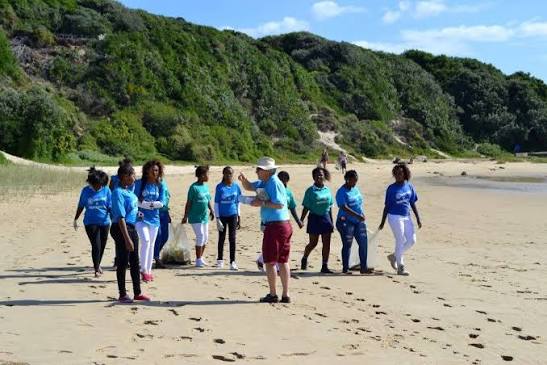
When people think about marine pollution, they often picture littered coastlines. (These are, in fact, the stories I am most often told about when sitting around a dinner table.) But beaches are not where the problem begins. Plastic enters rivers long before it reaches estuaries. Rivers merely reflect what is happening in communities. Communities reflect municipal systems, economic realities, consumer behaviour, education, infrastructure, markets and policy. In other words, the litter we find on a beach is simply the visible symptom of a much larger system. And it certainly doesn’t mean that, if we clean the beaches, we will fix the system.
So, as our understanding deepened, so too did our work. Our focus shifted from protecting the ocean to preventing pollution from reaching it in the first place. Today, our work spans the entire waste value chain – from research and monitoring to education, behaviour change, community participation, informal sector inclusion, municipal collaboration and policy engagement. This was never about organisational growth for its own sake. It was the inevitable consequence of understanding the problem more deeply. Once you begin viewing waste as a system, you realise that every part of that system matters, and that every decision either strengthens or weakens that system.
Development organisations often talk about scaling successful projects. I’m increasingly convinced this is the wrong conversation. Projects matter, but only if they are designed to bolster the wider system around them. They need to draw on local wisdom, be owned by communities, and create conditions that continue long after the initial investment has ended.
SST’s Operation Clean Spot (OCS) was built around this philosophy. It is not simply a collection of projects. It is an integrated delivery model that deliberately combines existing interventions because each performs a different function within the waste system. Research generates evidence that informs decision-making. Education builds understanding. Community programmes ensure local ownership. Municipal engagement improves governance. Capacity building enables implementation. Behaviour change creates lasting impact.
None of these interventions is sufficient on its own. Together, however, they support and reinforce one another, tightening the efficiency of the entire system.
The same is true of Munch, our school-focused behaviour change programme within OCS. Many view it simply as an education initiative, yet we at SST know that education is only one part of its purpose and design. We deliberately chose schools because they are trusted, already established community institutions. Behaviour learned in schools underpins not only the choices made later in life, but also influences surrounding households; households influence communities, and communities ultimately influence the waste system itself. The classroom is therefore a sustained entry point into broader systems change, not an end in itself.
Over time, three principles have consistently emerged as the foundations of every intervention we design.
First, good data. We cannot solve problems we do not properly understand.
Second, local ownership. Sustainable change cannot simply be delivered to communities. It must be built with and for them.
Third, capacity. Without the skills, institutions and confidence to act, even the best-designed interventions eventually fail and fade.
These are not separate priorities. They are mutually reinforcing elements of the same system.
People often say collaboration is essential. I agree. But collaboration, in and of itself, is not enough.
SST has always believed in partnerships. What has changed is how we think about them. Rather than simply asking who wants to work with us, we now ask who needs to be part of the system if meaningful change is to occur. Our Theory of Change has helped us become much more deliberate about identifying the role each stakeholder is uniquely positioned to play, understanding what value we create for one another, and building partnerships around those complementary roles.
Municipalities create enabling environments. Researchers generate evidence. Communities provide local leadership. Businesses influence production and consumption. Educators shape future behaviour. Civil society connects people, knowledge and action.
Our objective is no longer simply to collaborate. It is to enhance the contribution each actor makes to the functioning of the system as a whole. This shift has fundamentally changed the way we work, not only within South Africa but increasingly across Africa through partnerships with regional organisations such as WIOMSA, the Nairobi Convention and others, where practical and transferable implementation experience is becoming just as valuable as policy dialogue.
The biggest surprise for me over the past five years has been this: as our understanding of the waste system evolved, our organisation had to evolve with it. Looking back now, this seems rather obvious. Living through it was anything but.
When I joined SST five years ago, we were a passionate organisation filled with talented people doing meaningful work. At the time I assumed passion and technical competence would naturally translate into organisational excellence. I was wrong.
As our ambition grew, I realised that asking people to solve increasingly complex societal challenges required much more than commitment to the mission. It required investing properly in the people delivering it. One of the first decisions we made was to benchmark salaries and build fair remuneration into our long-term funding model. Passion should never be an excuse for expecting people to carry extraordinary responsibility without appropriate recognition and support.
I still remember sitting with spreadsheets open while preparing the second phase of our Norwegian funding proposal. Every instinct told me to keep salaries modest. I worried that asking for more would jeopardise our chances of securing core funding, and that every additional dollar invested in people would be a dollar less invested in programmes. Yet the more I reflected on what we were asking of people, the more I knew I had to be brave and ask for (and justify!) what I believed we needed. We were asking our people to solve increasingly complex societal challenges while expecting personal sacrifice to make up for organisational shortcomings. That was the moment I realised investing in people was as much a part of the mission as the change we wanted to see in society.
Yet remuneration turned out to be only one piece of a much bigger puzzle. So, I was wrong again.
As our work became more integrated and systems-focused, we also had to rethink leadership, accountability, organisational design, monitoring and evaluation, data governance and culture. We had to move beyond building programmes and begin building an organisation capable of sustaining those programmes over time.
Perhaps the hardest lesson of all was recognising that technical excellence alone is not enough. Working across complex systems requires a strong sense of self, intellectual humility, emotional maturity, professional discipline, a commitment to continual learning, and the ability to collaborate across cultures, disciplines, sectors and institutions. Those capabilities are every bit as important as scientific expertise.
Building this kind of organisation is difficult. It requires uncomfortable conversations, difficult decisions and a willingness to sometimes pause but always adapt. But I have come to believe that organisations cannot transform complex systems unless they are equally willing to transform themselves.
Earlier this year I attended the Our Ocean Conference in Mombasa, where governments, researchers, development agencies and civil society organisations came together to discuss the future of our oceans. One reflection stayed with me long after I returned home: Africa is not short of ideas, expertise or implementation experience. What we need are partnerships that recognise and reinforce these skills and assets.
Many of the systems-based approaches now attracting international attention are already being developed, tested and refined across Africa. Every day, African organisations are generating evidence, building local ownership, boosting capacity and demonstrating practical implementation models that respond to African realities. We are not waiting for solutions to arrive from elsewhere.
At SST, we have seen this ourselves. Our African Waste Academy now delivers training in multiple languages, including English, French, Portuguese, isiZulu and isiXhosa, while our partnerships across Africa continue to facilitate the transfer of knowledge and implementation experience across countries and regions. These are not simply knowledge-sharing initiatives; they are part of building Africa’s own capacity to solve African challenges.
Africa is not simply implementing global ideas. Increasingly, it is generating, testing and refining them. That should give us confidence. Not because we have solved the problem, but because we have accumulated something equally valuable: practical, transferable experience.
I often reflect on how much SST has changed over the past two decades. In truth, the organisation has never abandoned its original purpose. We are still working towards healthier oceans and healthier communities in Africa. What has changed is our understanding of how that future is achieved, and what has tightened is our unique value proposition within that.
We have learned that environmental challenges are rarely environmental alone; they are social, economic, behavioural and institutional. The more deeply we understood the waste system, the less our work became about waste itself, and the more it became about people, institutions, partnerships, evidence and leadership.
This is therefore my own single biggest learning of the last twenty years: If we are serious about transforming waste systems across Africa, we have to be just as deliberate in designing our organisations as we are in designing our interventions. Because ultimately, systems change is not something we do to the world around us. It is something we must first become capable of delivering within our own organisations. The mission demands it.


