


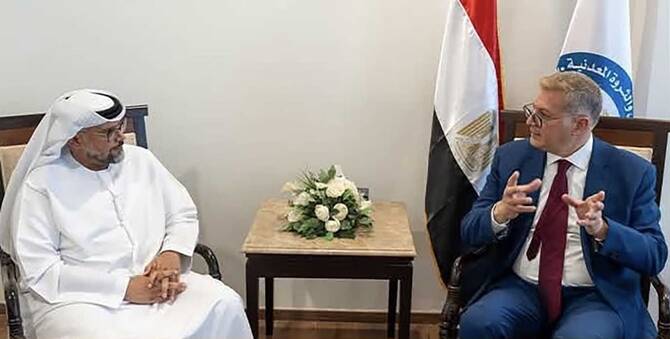
Abu Dhabi National Oil Company’s drilling unit, ADNOC Drilling, is exploring a larger role in Egypt’s upstream oil and gas sector as Cairo accelerates a five-year programme to drill about 480 exploration wells and attract more investment into domestic production, with technical discussions expected to determine how the UAE company could participate alongside Egyptian state-owned drilling entities.
ADNOC Drilling chief executive Abdullah Ateya Al Messabi met Egypt’s Petroleum and Mineral Resources Minister Karim Badawi in Cairo on Aug. 23 to discuss strategic cooperation and the company’s potential participation in an expanded onshore and offshore well-drilling programme. No contract has been announced, and the scope, commercial structure and timing of any potential agreement remain under discussion. Egypt and ADNOC Drilling are expected to hold specialised technical meetings to identify possible areas of cooperation.
The discussions come as Egypt is attempting to reverse declining domestic oil and gas production while reducing its growing dependence on imported natural gas. The government announced in October 2025 a five-year exploration programme involving roughly 480 wells and more than $5.7 billion in investment. For 2026, the programme initially targeted 101 wells, including 67 in the Western Desert, 14 in the Mediterranean, nine in the Gulf of Suez and six in the Nile Delta.
The scale of the programme reflects the pressure on Egypt’s energy balance. Domestic gas production has fallen from its 2021 peak while electricity demand and industrial consumption remain significant. The resulting supply gap has forced Egypt to increase LNG imports, exposing public finances and foreign-exchange reserves to international energy prices. The pressure intensified in 2026 after disruptions associated with the conflict involving the United States, Israel and Iran and the closure of the Strait of Hormuz. Prime Minister Mostafa Madbouly said Egypt’s monthly natural-gas import bill had risen from about $560 million to $1.65 billion. Reuters reported that the broader increase in energy costs was placing additional pressure on an economy already dealing with high debt and inflation.
That makes the drilling programme more than an upstream investment drive. For Egypt, increasing domestic production has become closely linked to energy security, the foreign-exchange position and the government’s ability to contain the cost of supplying power stations and industrial users. The potential involvement of ADNOC Drilling comes against that backdrop. The company is one of the region’s largest drilling contractors and provides onshore and offshore drilling and well-services solutions. Its participation would give Egypt access to a major regional drilling operator at a time when the government is seeking to increase drilling rates and deploy more advanced technologies.
Badawi has repeatedly identified higher drilling activity, faster development of discoveries and the adoption of advanced technologies as central elements of Egypt’s five-year production strategy. In June, the minister said expanding horizontal drilling and hydraulic fracturing would be important for increasing productivity and supporting efforts to raise crude production.
The potential cooperation also has a domestic industry dimension. Al Messabi highlighted the importance of working with the Egyptian Drilling Company, or EDC, an EGPC subsidiary with experience in drilling wells in Egypt and overseas. Rather than replacing local capacity, any partnership could therefore involve cooperation between ADNOC Drilling and Egyptian drilling institutions, although the final commercial framework has yet to be established.
For Egypt, such cooperation could help address one of the constraints facing the country’s exploration ambitions: the ability to execute a large number of wells within a relatively compressed period. Drilling capacity, equipment availability, technical expertise and project execution will all influence whether the government can translate acreage awards into discoveries and, eventually, additional production.
The opportunity is also expanding beyond the 480-well programme. Egypt opened its 2026 international oil and gas bid round on Aug. 11, offering 14 exploration areas to international and Egyptian companies. Eight blocks are being offered by the Egyptian Natural Gas Holding Company, EGAS, covering parts of the Mediterranean, Nile Delta and North Sinai, while six areas offered by the Egyptian General Petroleum Corporation, EGPC, are located in the Gulf of Suez, Sinai and Western Desert.
The EGPC blocks have a submission deadline of Nov. 11, 2026, while the EGAS blocks close on Dec. 14. The areas are being offered digitally through Egypt’s Egypt Upstream Gateway under a production-sharing framework. According to the petroleum ministry, several of the blocks are located close to existing fields and infrastructure, including pipelines, processing facilities and export infrastructure, potentially reducing development costs and shortening the time between discovery and production.
That proximity is particularly important for Egypt because the commercial value of a discovery depends not only on the size of the resource but also on how quickly and cheaply it can be developed. Existing pipelines, processing plants and export terminals can reduce the capital required to bring new production online. The latest licensing round also indicates that Egypt is attempting to broaden its upstream investor base. The government has sought to make the sector more attractive by addressing arrears owed to international oil companies, which had previously constrained exploration and development activity.
In May 2026, the petroleum ministry said outstanding arrears to international partners had fallen from $6.1 billion in June 2024 to $714 million by April, with the government targeting full settlement by the end of June. That financial repair is important to the credibility of Egypt’s exploration strategy. International oil companies and drilling contractors need confidence that contractual payments and cost-recovery arrangements will be honoured if they are to commit capital to technically complex and long-cycle projects.
The United Arab Emirates has already played a significant role in Egypt’s recent financial and energy relationship. In 2024, an Emirati-backed $35 billion development agreement involving the Ras El-Hekma coastal project provided Egypt with substantial foreign exchange and helped the government clear billions of dollars in arrears owed to oil companies. The subsequent improvement in payment conditions has helped create a more favourable environment for upstream investment.
ADNOC’s involvement in Egypt extends beyond drilling services. Arcius Energy, a joint venture between ADNOC’s international investment arm XRG and BP, is developing opportunities in Egypt’s gas sector, including the Harmattan gas development and the Atoll West exploration well in the Mediterranean. The presence of ADNOC-related companies across different parts of the upstream value chain gives the UAE group an expanding position in Egypt’s energy market.
The distinction between ADNOC Drilling and Arcius Energy is nevertheless important. ADNOC Drilling is primarily a drilling and well-services business, while Arcius Energy is focused on upstream exploration and production. A drilling contract would therefore represent a different form of participation from the production interests already being developed by ADNOC and its partners.
The financial performance of ADNOC Drilling also gives some indication of the company’s capacity to pursue regional expansion. The company has projected approximately $5 billion in 2026 revenue, with around $2 billion expected from onshore operations, $1.5 billion from offshore activities and another $1.5 billion from oilfield services. It is also targeting deployment of approximately 70 integrated drilling services rigs by the end of 2026. That regional capacity could be relevant to Egypt’s growing demand for drilling services. But the economics of any agreement will depend on the number and type of rigs required, contract duration, day rates, local-content requirements and the allocation of operational and financial risks between the Egyptian entities and ADNOC Drilling.
Egypt’s upstream strategy also comes with wider implications for Africa’s energy market. The country is one of the continent’s major gas producers and has historically served as both a domestic energy supplier and an LNG exporter. A sustained recovery in domestic production could reduce the pressure created by imports and potentially improve the availability of gas for domestic industries and power generation. Conversely, delays in exploration, weak drilling performance or insufficient new discoveries could leave Egypt dependent on imported LNG for longer. That would expose the economy to international gas prices, shipping costs and geopolitical disruptions affecting major energy routes.
The urgency is particularly clear in the electricity sector. Natural gas remains central to Egypt’s power generation system, meaning shortages in domestic supply can quickly become an electricity-sector problem. Higher LNG imports therefore affect not only the petroleum ministry but also power-generation costs, industrial competitiveness and government spending.
Egypt’s current strategy attempts to address this through several channels simultaneously: increasing exploration, accelerating field development, using advanced drilling techniques, improving the financial relationship with international partners and offering new acreage through competitive licensing rounds. The approach is not without risks. Exploration is inherently uncertain, and drilling hundreds of wells does not guarantee commercially viable discoveries. Higher drilling activity also requires substantial capital, specialised equipment and reliable infrastructure. Even successful discoveries can take years to develop, meaning additional production may not arrive quickly enough to eliminate near-term import requirements.
The government must therefore manage the transition between immediate energy needs and longer-term upstream investment. Egypt is already negotiating longer-term LNG supply arrangements with major international energy companies as it seeks to secure imports while domestic production recovers. Reuters reported in July that Egypt was discussing multi-year LNG supply contracts with companies including Shell, TotalEnergies, BP and Hartree Partners.
This creates a two-track energy strategy: secure imported gas to meet immediate demand while increasing domestic exploration and production to reduce exposure over the longer term. For investors and oilfield-service companies, the strategy is creating a larger market for drilling, seismic services, well completion, field development and associated infrastructure. For Egypt, the central question is whether the resulting investment can produce enough new supply to justify the scale of spending and reduce the fiscal pressure created by imported energy.
ADNOC Drilling’s discussions therefore provide an indication of how Egypt’s upstream recovery is beginning to attract regional service providers as well as international exploration companies. The absence of a signed agreement means the commercial significance should not yet be overstated. The next stage will be the technical discussions between ADNOC Drilling, EGPC and Egyptian drilling entities.
Those discussions will determine whether the UAE company’s interest develops into a formal contract and, if so, how much drilling capacity it could bring into Egypt’s five-year programme. For Egypt, however, the broader objective is already clear. The country is trying to convert new exploration investment into domestic barrels and molecules quickly enough to reduce its dependence on costly imports. With 480 wells planned over five years and 14 additional exploration areas now open to bidders, the government is building a much larger upstream pipeline.
For Africa’s energy markets, the outcome matters because Egypt’s production trajectory affects regional gas trade, LNG availability, industrial energy costs and investment flows. A successful upstream recovery could strengthen Egypt’s position as an energy hub, while prolonged production declines would leave the country more exposed to global energy-price volatility.
The potential ADNOC Drilling partnership is therefore one piece of a much larger restructuring of Egypt’s petroleum sector. Its significance will ultimately be measured not by the announcement of talks, but by whether drilling activity translates into commercially viable discoveries, faster field development and a sustained increase in domestic production.


