


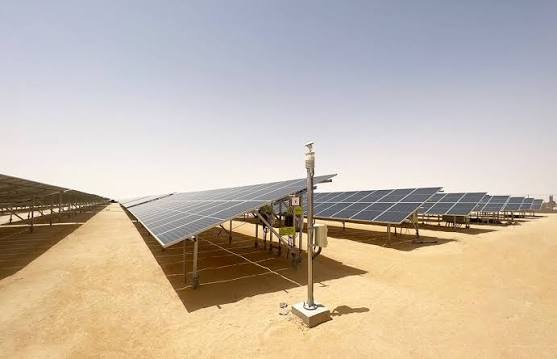
Niger has signed a 126.1 billion CFA franc public-private partnership agreement with Niger Electricity Power Production (NEPP) to develop a 200 MWc solar photovoltaic plant equipped with battery storage, a project intended to increase domestic electricity supply, reduce reliance on imported power and support the country’s longer-term push to expand renewable generation. The agreement was signed in Niamey on Aug. 20 by Energy Minister Amadou Haoua and NEPP chief executive Adamou Amadou Daouda, under the chairmanship of Foreign Affairs Minister Bakary Yaou Sangare.
The project will be implemented under a Build-Operate-Transfer model. According to the agreement, the facility is expected to be completed within 24 months, including additional studies and resource mobilisation. Electricity generated will be sold to Niger’s state-owned utility, Société Nigérienne d’Électricité (NIGELEC), at 35 CFA francs per kilowatt-hour, with ownership eventually transferred to the Nigerien state. Local reports describe the contractual value as about $225 million, although the CFA franc’s euro peg would imply a lower dollar equivalent at the official fixed exchange rate.
The addition of battery storage is one of the more significant features of the project. Niger is seeking to expand solar generation in a power system where supply reliability and access remain major constraints. Solar photovoltaic output falls when daylight ends and can fluctuate with weather conditions, creating a need for balancing resources if large amounts of solar generation are connected to the grid. Battery storage can shift part of daytime production into higher-demand periods and provide additional flexibility to grid operators.

That matters because Niger’s electricity challenge is not simply a question of generating more megawatts. The country also needs electricity that can be delivered reliably to households, businesses, health facilities, schools and productive industries. The World Bank says its partnership with Niger is mobilising $1.2 billion across national and regional projects, including the Kandadji Dam programme, with the aim of providing electricity to more than 4.5 million people. Niger’s 2025 national energy compact under the Mission 300 initiative also commits the country to reaching at least 60% electricity access by 2030.
The solar project therefore enters a market where access expansion and system reliability are being pursued simultaneously. Earlier World Bank-backed investments under the Niger Solar Electricity Access Project helped establish solar power plants in rural and peri-urban areas. By July 2023, 12 of 15 plants developed under the programme were operational, with the facilities implemented by NIGELEC and intended to improve electricity services in underserved areas.
Niger’s longer-term policy framework also places renewable energy at the centre of its electricity-access strategy. The country’s National Strategy for Electricity Access targets an electricity-access rate of at least 80% by 2035 and envisages greater use of private-sector investment to meet rising demand. The African Development Bank’s Desert-to-Power roadmap for Niger has similarly identified grid-connected solar as a priority, with an objective of increasing national generation capacity substantially and raising the renewable share of electricity production.
The new agreement fits into that policy direction by placing private capital and private-sector execution alongside state ownership. Under a BOT structure, the government does not have to finance and operate the entire asset from the outset. The private partner assumes responsibility for development and operation during the contracted period, while the state retains an eventual ownership interest.
For Niger’s public finances, however, the arrangement also creates obligations that will need to be managed carefully. NIGELEC will be responsible for purchasing the electricity under the agreed tariff, making the utility’s financial health an important factor in the project’s long-term bankability. The World Bank has previously identified NIGELEC as central to Niger’s electricity-access agenda while noting pressures on the utility’s financial position and the importance of private investment and sector reform.
This is a wider issue for African power markets. Independent power projects can mobilise investment that governments may struggle to provide directly, but their success depends on credible off-takers, sustainable tariffs, foreign-exchange arrangements, transparent contracts and adequate transmission infrastructure. Where utilities have weak balance sheets, governments or development-finance institutions may need to provide guarantees or other forms of credit enhancement to make projects financeable.
The project’s 35 CFA franc per kWh electricity price will consequently be important beyond the immediate contract. Its affordability to NIGELEC and the wider power system will depend on the final financing structure, generation performance, storage costs, transmission requirements and the terms governing the transfer of the plant. NEPP’s role also deserves attention because the company is relatively new. Corporate registration records show that Niger Electricity Power Production was established in October 2024 and is managed by Adamou Amadou Daouda. The scale of the project means that financing capacity, technical partners, equipment procurement and the ability to mobilise the required capital will be important implementation issues as the agreement moves from signature to financial close and construction.
The project developers have said that the construction phase is expected to follow a six-month period for additional studies and mobilisation of resources, with the broader delivery period estimated at 24 months. The agreement also incorporates performance requirements, skills transfer, local employment and infrastructure sustainability.
Employment is one of the immediate economic effects expected from the investment. NEPP estimates that the project could create around 1,300 direct and indirect jobs, including permanent and non-permanent positions. Construction is likely to generate the largest short-term demand for labour, while engineering, operations, maintenance and related services could create longer-term opportunities for technical workers and local businesses. The wider economic effect could be more important if the additional electricity improves the operating environment for businesses. Reliable power can reduce the need for diesel generators and other backup systems, lower some operating costs and improve the ability of enterprises to maintain production. In agriculture, electricity can support irrigation, cold storage, processing and other productive uses. For public institutions, reliable supply can improve the functioning of schools, health facilities and water infrastructure.
The relationship between energy access and economic development is particularly important in Niger because electricity constraints intersect with broader development challenges. The World Bank has linked improved electricity access to agriculture, rural development, public-service delivery and economic opportunities. Its current country programme is supporting energy, infrastructure, agriculture and human-capital investments as part of a wider development strategy.
The solar-plus-storage model also reflects a broader change in African energy investment. Solar power has become increasingly competitive in markets with strong solar resources, while battery costs and technology have improved enough to make storage a more common component of utility-scale projects. For countries with weak grids, however, the value of storage depends on the quality of system planning and the ability of utilities to operate and maintain the technology.
Niger’s geography makes solar particularly relevant. The country has extensive solar resources across the Sahel, creating conditions for large-scale photovoltaic development. The African Development Bank’s Desert-to-Power initiative has identified Niger as one of 11 Sahel countries where large-scale solar deployment could contribute to economic development and electricity access. The regional dimension is also important. Niger operates within a West African electricity system where cross-border power trade has historically complemented domestic generation. Increasing domestic renewable capacity could reduce the country’s exposure to supply disruptions affecting imported electricity, while still allowing regional power trading to play a balancing role.
The project also comes at a time when African governments are attempting to attract more private capital into infrastructure while facing constrained public budgets. Public-private partnerships offer one route, but they require careful allocation of construction, operational, currency, demand and payment risks. The financial structure of the Niger project will therefore be as important as the physical construction of the solar plant. The government’s decision to eventually take ownership of the facility is also significant. If the project performs as intended, the state would ultimately acquire a major renewable-energy asset while gaining experience in managing utility-scale solar and battery infrastructure. That makes technology transfer and local technical capacity particularly important to the project’s long-term value.
Niger is not starting from zero. The country has already used public and development-finance programmes to deploy smaller solar systems, expand rural access and strengthen NIGELEC’s infrastructure. The new 200 MWc project represents a shift towards much larger utility-scale generation combined with storage. The challenge will be translating the signed agreement into a bankable, operational project. The additional studies must be completed, financing mobilised and construction delivered within the stated timetable. Transmission connections must also be sufficient to absorb the new capacity, while NIGELEC needs the financial and operational capability to purchase and distribute the electricity.
The investment is consequently significant for Niger’s energy policy, but its development implications will depend on execution. If the plant is completed and integrated effectively, it could add a sizeable block of renewable generation, improve the flexibility of the national power system, create jobs and reduce the country’s dependence on imported electricity. For Africa more broadly, the project illustrates the increasingly practical role of renewable energy in addressing economic and infrastructure constraints. Solar power is no longer being considered only through the lens of emissions reduction. In countries such as Niger, it is also an instrument for energy security, industrial development, public-service delivery and reducing exposure to external power-supply risks.
The 200 MWc project will therefore test more than Niger’s ability to build a solar plant. It will test whether a public-private model can mobilise capital at scale, whether battery storage can improve reliability in a constrained grid, and whether the resulting electricity can be delivered at a cost that is sustainable for the national utility and consumers. For the government, the immediate task is implementation. For investors, the project will provide a test of Niger’s capacity to structure and execute large renewable-energy transactions. For communities and businesses, its ultimate measure will be more practical: whether additional electricity is available when it is needed and whether that power supports economic activity beyond the generation site.
If those conditions are met, the project could become an important component of Niger’s effort to expand electricity access while increasing the share of renewable energy in its power system. It would also reinforce the broader Sahelian case for pairing abundant solar resources with storage and stronger electricity networks as African economies seek to expand access without locking future infrastructure into higher-cost and more carbon-intensive generation.


