
A nationwide university tour in Kenya, supported by the African Development Bank, is challenging students to rethink the kind of work they will pursue in a country navigating the twin pressures of youth unemployment and climate change.
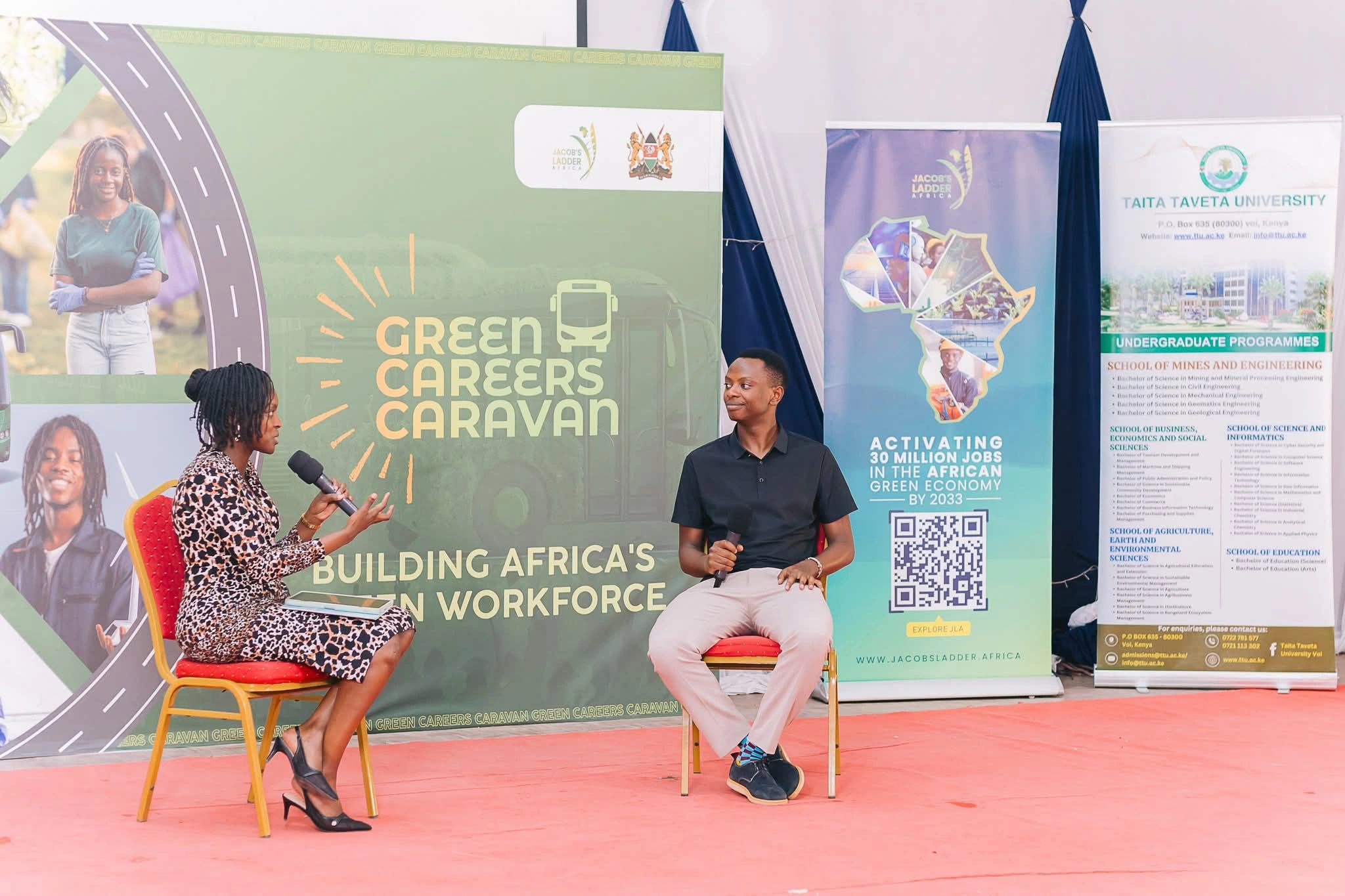
The Green Careers Caravan, an initiative by Jacob’s Ladder Africa, has been travelling from campus to campus, bringing discussions about the green economy to life and showing students how emerging sectors, from renewable energy to regenerative agriculture, are creating opportunities for those equipped with the right skills.

The Caravan, which made its third stop at the University of Embu just a week after visiting Taita Taveta University, is part of a broader movement using the hashtag #GreenCareersCaravan to engage young Africans with climate-focused jobs across sectors such as sustainable agriculture, electric mobility, and clean energy.
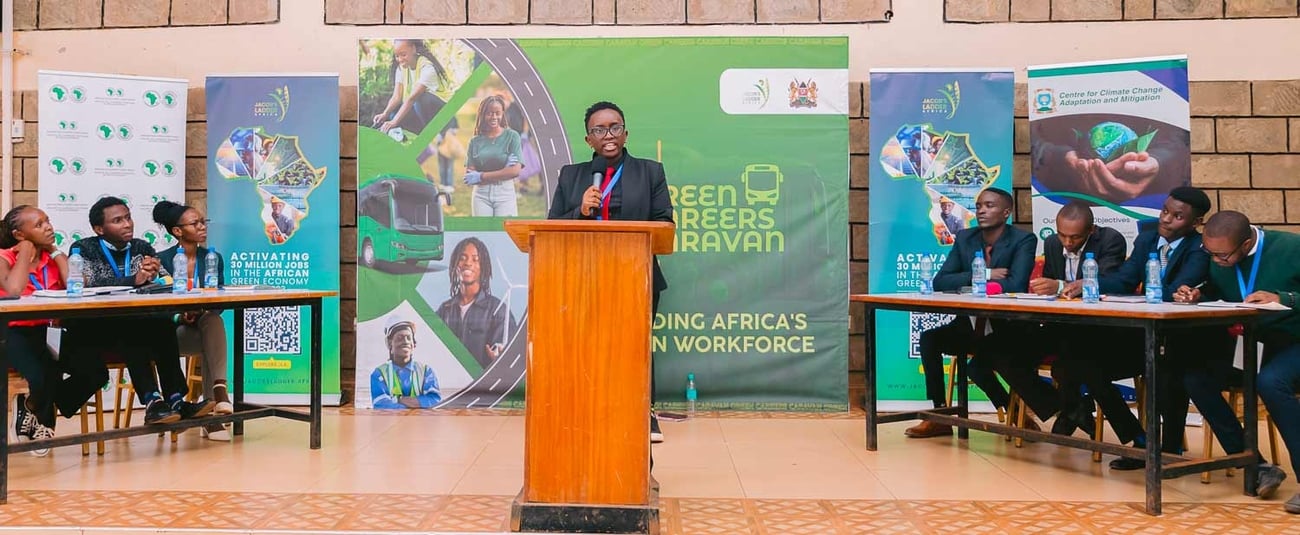
Hundreds of students packed lecture halls and open spaces, asking pointed questions about how carbon markets operate, what skills employers in renewable energy and environmental management are seeking, and how small initiatives can scale into businesses that contribute meaningfully to the low-carbon transition.
The timing of the initiative is critical. Kenya already produces more than 70 percent of its electricity from renewable sources, yet the supply of trained professionals in areas like project management, carbon accounting, data analysis, and climate-smart agriculture remains insufficient.
Read also: African Cities Innovation Fund launches to drive smart, climate-resilient urban solutions
Across sub-Saharan Africa, the International Labour Organization projects that green and sustainability-linked sectors could generate millions of jobs by 2030, but only if education systems adapt rapidly to provide students with relevant skills. For many campuses, that adaptation is lagging, leaving students with degrees that do not yet connect to emerging opportunities in the green economy.
The African Development Bank, which supports the Caravan as part of its broader investment in education and innovation, highlights the mismatch between demand and awareness. According to the Bank, 67 percent of students in Kenya are unaware of green job opportunities, even as industries increasingly seek expertise in renewable infrastructure, climate finance, and nature-based solutions.
The Caravan aims to close this gap by combining mentorship, case studies, and interactive workshops to give students a practical view of how careers in sustainability can be both meaningful and financially viable.
For many students, the Caravan altered how they see their role in Kenya’s sustainability transition. Participants cited learning that environmental work can support real livelihoods, particularly in regions recovering degraded soils or adapting agricultural practices to withstand climate impacts.

Others recognized that ideas developed in classrooms can evolve into viable enterprises when paired with networks and organizations already working in sustainability—a signal that entrepreneurship and innovation are as vital to the green economy as technical skills.
Universities themselves are under pressure to respond. Across Africa, from Nigeria to Morocco and Rwanda, higher education institutions face a common challenge: a rapidly evolving green economy and a talent pipeline that remains fragmented. Kenya’s Vice-Chancellor at the University of Embu emphasized that meeting the country’s climate and development targets requires graduates who understand both the scientific and economic dimensions of sustainability.
This challenge extends continent-wide, as governments and institutions strive to balance traditional employment pathways with the emerging demand for climate-smart solutions.
Jacob’s Ladder Africa estimates that activating 30 million green jobs by 2033 could harness Africa’s demographic wave, with more than 400 million young people entering the workforce in the coming decade.
If even a fraction are trained in renewable energy infrastructure, nature restoration, electric mobility, sustainable manufacturing, or climate-smart agriculture, Africa could transform a demographic challenge into an economic opportunity. Without such preparation, however, the continent risks leaving its most populous generation underemployed and disconnected from sectors crucial for climate resilience.
The Caravan complements other African Development Bank initiatives such as the Higher Education, Science and Technology II Programme (HEST II), which seeks to enhance universities’ capacity to produce graduates suited to both existing and emerging industries.
According to the Bank, it is no longer enough to train graduates in conventional disciplines; institutions must nurture innovators and entrepreneurs capable of creating new green jobs and solutions, particularly as climate shocks already impose measurable economic costs. Kenya’s recurring droughts over the past five years, for example, have wiped out billions of shillings in crop and livestock losses, highlighting the urgency of building local adaptation expertise.
Read also: New Kenya youth environmental awards open to support grassroots climate solutions
Since September, the Caravan has visited the University of Embu, Kisii University, and Taita Taveta University, engaging thousands of students. Phase one aims to reach 15 universities across eight regions by April 2026, with a longer-term plan to extend to all 42 public universities by 2030. Beyond Kenya, the initiative represents a model that could be scaled across Africa, demonstrating how targeted education interventions, combined with public and private sector partnerships, can equip youth to lead the continent’s green transition.
Engage with us on LinkedIn: Africa Sustainability Matters
Engage with us on LinkedIn: Africa Sustainability Matters