


Africa’s climate-finance challenge is increasingly shifting from a question of how much money is available to whether that capital is structured in a form that farmers and small businesses can actually use. Discussions in Lagos and Kigali this week highlighted the gap, with financial-sector leaders calling for greater use of adaptation finance, insurance, guarantees and blended capital while agricultural investors examined how renewable-energy and climate technologies could be turned into bankable investments. The discussions come as African farmers and agribusinesses face rising exposure to drought, floods, unreliable energy and other climate risks, while commercial lenders continue to view much of the agricultural sector as difficult to finance.
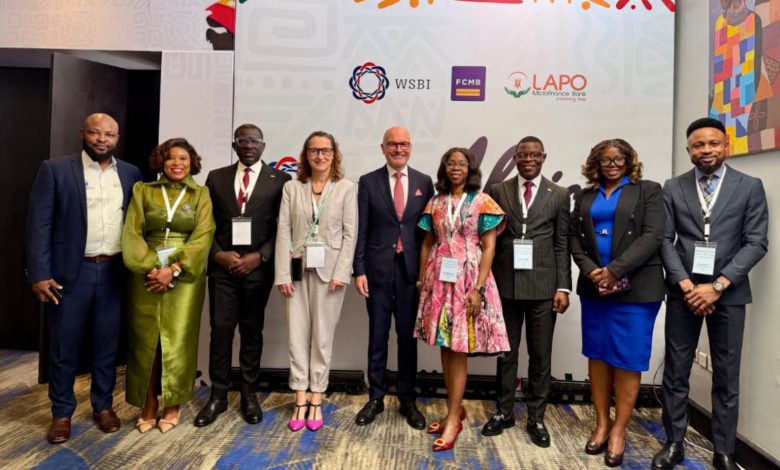
The Lagos meeting, the Africa Inclusive Climate Finance Conference hosted by LAPO Microfinance Bank in partnership with the World Savings and Retail Banking Institute (WSBI), focused on the relationship between financial inclusion, climate resilience, gender-smart finance and small-business development. In Kigali, the Climate Finance Nexus Forum, convened by Heifer International during the Africa Food Systems Forum 2026, examined how renewable energy, agriculture, finance and risk mitigation could be combined to make climate solutions more attractive to commercial investors.
The meetings were separate, but they pointed to the same structural problem. Africa has many of the technologies and agricultural practices required to reduce exposure to climate shocks. The constraint is increasingly the financial architecture surrounding those investments. Kola Masha, managing director of Babban Gona, estimated the potential market for climate-adaptation financing across Africa at about $200 billion, arguing that financial institutions should reconsider the assumption that agricultural lending is inherently too risky. The issue, he said, is partly that farmers have historically been denied the financing that would allow them to become more productive and resilient.
Irrigation provides a clear example. Masha said only about 6% of Africa’s farmland is irrigated, compared with about 37% in Asia. Expanding irrigation, alongside better seeds, planting practices and soil management, could reduce farmers’ dependence on increasingly unpredictable rainfall. The financing implications are substantial. Irrigation equipment, water-storage systems and improved agricultural inputs require upfront capital, while the benefits are realised over several production cycles. A farmer whose income depends on seasonal harvests may therefore struggle to service a conventional loan whose repayment schedule does not reflect agricultural cash flows.
Babban Gona’s experience was presented as evidence that the perceived risk of smallholder finance can change when lending is embedded within a structured agricultural business model. Masha said the organisation has cumulatively served more than 500,000 smallholder farmers, deployed more than $250 million in financing and recorded a reported repayment rate of 99%. The implication is important for African financial institutions. If farmers lack capital, they may be unable to invest in irrigation, improved inputs, machinery or climate-resilient practices. Low investment then contributes to low productivity and unstable incomes, reinforcing lenders’ perception that agricultural borrowers are high risk.
Climate finance therefore has to address both sides of that equation. Peter Simon, chief executive of WSBI, said more than 80% of Nigerian farmers are smallholders and account for about 90% of the country’s food production, while four out of five smallholder farmers are financially vulnerable to climate-change consequences. Those figures illustrate why the climate-finance debate cannot be confined to large infrastructure projects or national renewable-energy programmes.
Africa’s food systems depend heavily on millions of small farms and small and medium-sized enterprises operating between farms and consumers. Their ability to withstand climate shocks can determine whether food reaches markets at predictable prices and whether households retain income after a failed season. The WSBI and LAPO pilot illustrates one attempt to bring climate risk directly into retail lending. The initiative, supported by development partners, is designed to deploy $20 million in credit over three years, reach 20,000 smallholder farmers and support 5,000 small and medium-sized enterprises each year. The model incorporates climate-risk assessment, capacity building and gender-inclusive lending approaches. WSBI says loan officers have been trained to use the FAO’s Agriculture and Climate Change Mapping Tool to incorporate long-term rainfall and temperature trends into lending decisions.
That is a significant change from treating climate as an external environmental issue. For a bank, climate risk can become a credit-risk variable: rainfall patterns can influence crop selection, water availability can affect yields, and flood exposure can affect the value of productive assets. But lending alone does not eliminate the underlying risk. Angela Omeiza, ESG board chairperson at LAPO Microfinance Bank, argued that insurance and other risk-sharing instruments need to form part of climate-inclusive finance. A farmer who borrows to acquire livestock, plant crops or purchase productive equipment can lose the underlying asset to drought or flooding while retaining the debt. Without insurance or another form of protection, the financial consequences of a climate shock are transferred almost entirely to the borrower.
That creates a design problem for financial institutions. A loan can be affordable on paper but unsuitable in practice if it assumes stable agricultural income in a sector where climate volatility is increasing. Insurance can help address that mismatch, but premiums can also make agricultural finance more expensive for low-income borrowers. This is where public finance, development institutions and private insurers can play a role in sharing risk and reducing the cost of coverage.
The Kigali discussions approached the same issue from the investment side: how can a climate solution become sufficiently bankable for commercial finance? The Climate Finance Nexus Forum, convened by Heifer International during the Africa Food Systems Forum, focused on the connection between renewable energy, agriculture and finance. The forum examined how technologies such as solar irrigation and renewable-powered cooling could be integrated into agricultural businesses rather than financed as standalone climate projects.
Uganda’s dairy sector provided a practical example. At Migina Milk Collection Centre, solar-powered cooling has been associated with the elimination of milk losses. The centre now chills about 197,321 litres of milk each month, while the number of milk suppliers has increased by 22.6%, according to information presented at the Kigali forum.
Heifer’s documentation of the project says the solar system has reduced milk losses at the centre to zero and helped reduce power costs, while farmers supplying the facility have benefited from improved milk-market conditions. The significance of the project is not simply that solar power replaced another energy source. The investment sits within a wider agricultural value chain involving the dairy cooperative, farmers, technology providers, processors, finance and insurance. That structure can make a climate investment easier to assess commercially. A solar cooling system financed in isolation may appear to a lender as an equipment loan. When the equipment reduces spoilage, lowers energy costs, strengthens the cooperative’s cash flow and supports a predictable relationship with milk buyers, the underlying credit proposition changes.
This is where blended finance becomes relevant. Safia Boly, senior vice-president for Africa at Heifer International, has argued that climate finance needs to reach farmers and agricultural businesses as usable credit rather than remain concentrated in grant-funded projects. She has also called for concessional capital to absorb part of the risk that prevents commercial lenders from financing climate-smart agricultural investments.
The distinction matters. A grant can finance a demonstration project, but a guarantee, insurance facility or concessional loan can potentially help establish a financing structure that commercial banks can eventually replicate. That is particularly relevant to Africa’s adaptation needs because many investments required by farmers are relatively small individually. Irrigation equipment, water-storage systems, solar-powered cold rooms and efficient processing machinery may not attract institutional investors as standalone assets. Aggregating those investments into portfolios can create a larger and potentially more diversified financing opportunity.
The challenge is building the systems needed to aggregate them. Kenya’s financial sector is moving in that direction. On September 3, the Kenya Bankers Association and the Global Green Growth Institute signed a five-year memorandum of understanding focused on sustainable finance, green investment and inclusive green growth. The partnership includes work on de-risking green lending, developing bankable investment opportunities and exploring instruments such as green loans and sustainability-linked bonds.
The agreement also acknowledges a familiar problem: businesses often say banks are not lending, while banks say there are not enough investment-ready green projects. GGGI and KBA intend to address that disconnect through technical assistance, investment facilitation, capacity building and development of sustainable-finance instruments. For Kenya, the practical test will be whether those institutional frameworks eventually change the experience of a farmer or small agro-processor seeking capital.
A bank can establish a green-finance policy, but the borrower still faces questions about collateral, repayment periods, insurance, cash-flow volatility and the economic return from a climate investment. A farmer seeking irrigation finance needs a product aligned with harvest cycles. An agro-processor purchasing solar equipment needs financing that recognises both the upfront investment and the expected reduction in energy costs.
This is why the concept of bankability is becoming increasingly important in African climate finance. GGGI’s Kenya programme identifies project-pipeline development, green lending frameworks and private-sector engagement as key components of its climate-finance work. Its LIFT project is designed to strengthen Kenya’s capacity to access and mobilise climate finance while supporting commercial banks and private investors to develop high-impact projects.
The broader challenge is continental. Africa’s adaptation finance needs remain far above current flows. The UNFCCC’s latest adaptation-finance gap assessment found that sub-Saharan Africa received $32.1 billion in adaptation-specific finance in 2021, accounting for 37% of adaptation finance to developing countries, but flows had declined from the previous year. The issue is not simply the absolute volume of money. The structure of finance matters because adaptation investments often produce benefits that are difficult to capture through conventional project-finance models. An irrigation system can protect farm income but may not generate a new revenue stream in the way a power plant does. A drainage system can prevent crop losses but may have no obvious standalone cash flow. A solar milk cooler can reduce losses and operating costs, but the lender must understand the cooperative’s supply arrangements, milk prices and relationship with processors.
This makes technical assistance and risk-sharing central to the financing architecture. The strongest models emerging from the Lagos and Kigali discussions therefore share several characteristics: financial institutions understand the underlying climate risk, insurers protect productive assets, development partners provide catalytic or concessional capital, technology providers offer viable solutions, and agricultural enterprises have predictable market relationships.
That combination can shift climate finance from project funding towards business finance. It also changes the role of development institutions. Rather than financing every climate-resilience investment directly, they can use limited concessional resources to reduce risks that prevent commercial capital from entering. A guarantee that enables a bank to lend to hundreds of farmers may have a larger systemic effect than a grant that finances a single adaptation project.
For governments, the policy challenge is to create the regulatory and market conditions that make those structures possible. This includes improving agricultural data, strengthening insurance markets, developing credit guarantees, supporting climate-risk information systems and creating reliable infrastructure around agricultural value chains. For banks, the challenge is more operational: understanding agricultural cash flows and climate exposure well enough to design products that are commercially viable without transferring all the risk to borrowers. For farmers and MSMEs, the outcome is much more immediate. Climate finance only becomes adaptation finance when it allows a business to invest before the shock occurs rather than receive assistance after the damage has already been done.
The Uganda dairy example illustrates the distinction. Solar cooling was not financed merely because it was renewable energy. Its value lies in what the technology does within the business: reducing losses, lowering energy costs, supporting farmers and strengthening the economics of the milk-collection operation. Similarly, irrigation should not be treated solely as a climate project. It is productive infrastructure that can affect yields, farm incomes, loan repayment capacity and food supply. That framing could become increasingly important as African governments and financial institutions seek to mobilise private capital for adaptation. The investment opportunity is potentially large, but the market will develop only if climate resilience can be translated into measurable business outcomes.
The message from Lagos and Kigali is therefore less about finding another source of climate capital than about changing how existing capital is structured. Africa already has farmers investing in adaptation, businesses deploying renewable technologies and financial institutions testing new lending models. What remains difficult is connecting these pieces at sufficient scale, with insurance, guarantees, technical assistance and patient capital absorbing risks that individual farmers and small businesses cannot carry alone.
For Kenya and the wider African market, the measure of progress will ultimately be practical. It will be whether a farmer can secure affordable irrigation finance before drought destroys a harvest, whether a dairy cooperative can finance reliable cooling without exposing itself to unsustainable debt, and whether a small enterprise can recover from a climate shock without losing the assets that generate its income. Until that happens, the continent’s climate-finance challenge will remain partly a problem of access and partly a problem of design. The capital may exist, but its development impact will depend on whether it reaches the first mile in a form that farmers and businesses can actually use.


