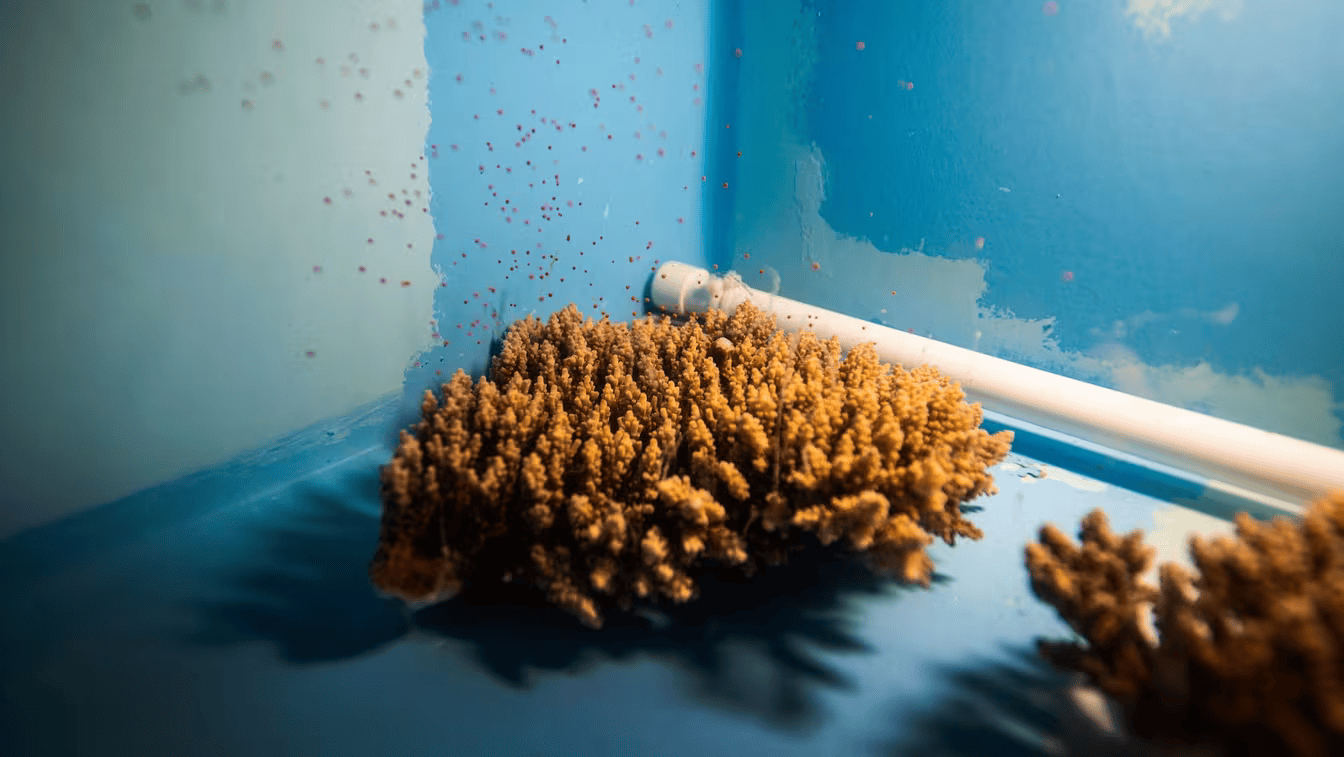

On the island of Praslin in the Seychelles, a land-based coral breeding laboratory has recorded its first successful spawning event, marking what scientists describe as a significant step in reef restoration efforts in the Western Indian Ocean. The facility, established in late 2025 by Nature Seychelles in partnership with Coral Spawning International and supported by imaging technology from Canon EMEA, is the first on-land coral spawning lab in Africa and the wider region to focus on controlled sexual reproduction of corals as a climate resilience strategy.
Since becoming operational in November, the lab has produced approximately 800,000 coral embryos from 14 colonies of the species Acropora tenuis cf. macrostoma. According to Nature Seychelles, around 65,000 juvenile corals have successfully settled, an early survival rate researchers consider encouraging given the fragility of coral larvae in their initial growth stages. The corals were bred through controlled spawning processes designed to replicate natural environmental cues, including temperature and lunar cycles.
Read also: Historic Argungu Fishing Festival 2026 revives 92-year peace tradition in Northern Nigeria
Coral reefs underpin a significant share of the Seychelles’ economy. Tourism accounts for roughly two-thirds of foreign exchange earnings, while fisheries remain central to food security and employment. Reef degradation, driven by warming seas and repeated bleaching events, has therefore translated into tangible economic risk.
The 2016 mass bleaching event in the Western Indian Ocean, linked to elevated sea surface temperatures, caused extensive coral mortality across parts of the Seychelles, affecting reef-dependent fisheries and coastal protection functions.
Traditional reef restoration in the region has largely relied on “coral gardening”, a method involving the fragmentation and transplantation of existing corals. While effective for short-term cover restoration, this technique produces genetically identical colonies, limiting adaptive capacity in warming waters.
The Praslin facility seeks to address this constraint by enabling sexual reproduction, thereby increasing genetic diversity among restored corals. Greater genetic variation is considered essential to improving thermal tolerance and disease resistance.
According to Coral Spawning International, the controlled spawning system allows researchers to observe reproductive processes in detail and gather data on timing, fertilisation rates and early growth patterns. Canon’s imaging equipment has been integrated into the facility to document these processes, providing visual and analytical data that researchers say will inform species selection and scaling strategies. The next phase will involve outplanting juvenile corals onto degraded reef sites and monitoring post-transplant survival rates.

For small island states such as the Seychelles, reef resilience is not solely an environmental concern but a fiscal and infrastructure issue. Healthy reefs function as natural breakwaters, reducing coastal erosion and storm surge damage.
The World Bank has previously estimated that coral reefs globally provide coastal protection services valued in the billions of dollars annually. In island economies with limited fiscal space, the degradation of such natural infrastructure can increase reliance on public expenditure for artificial coastal defences.
The lab also reflects a broader shift in marine conservation financing, where private sector partnerships increasingly complement public and philanthropic funding. While financial details of the investment were not disclosed, technology-backed restoration initiatives may signal new blended financing models in ocean conservation, particularly in regions where climate adaptation funding remains constrained.
According to the United Nations Environment Programme, African coastal countries face rising adaptation costs linked to sea level rise and marine ecosystem loss, yet marine restoration projects have historically struggled to attract large-scale capital.
The success of the initial spawning event does not guarantee long-term reef recovery. Coral survival rates following outplanting can vary widely depending on water quality, temperature stress and local ecological conditions. Researchers involved in the project have indicated that scaling production and building local technical capacity will be critical to moving beyond proof of concept.
Nonetheless, the establishment of a functioning coral spawning facility in the Western Indian Ocean introduces a new technical capability into Africa’s climate adaptation landscape. If survival rates remain stable and genetic diversity enhances resilience, the model could inform similar facilities along the East African coast and in other island states.
For the Seychelles, Reef regeneration is directly linked to sustaining tourism revenues, protecting fisheries livelihoods and preserving coastal infrastructure. In an era of accelerating ocean warming, the ability to actively breed and restore climate-resilient coral species may become less a conservation experiment and more a component of national economic risk management.
Engage with us on LinkedIn: Africa Sustainability Matters