


Africa’s transition towards lower carbon economies is increasingly facing a labour-market test as governments adopt net-zero strategies and attract climate investment without yet ensuring that young people can access the jobs, skills and businesses emerging from the transition. A virtual discussion convened by the Africa Policy Research Institute (APRI) on October 1 is examining that gap, bringing researchers and practitioners together to assess whether climate policies, investment programmes and green-economy initiatives are translating into meaningful employment and entrepreneurship opportunities for Africa’s young population.
The discussion comes as African governments attempt to balance climate commitments with the need to generate productive employment in economies where millions of young people enter the labour market each year. The African Union and International Labour Organization’s Youth Employment Strategy for Africa estimates that 26% of young people on the continent are neither in employment, education nor training, highlighting the scale of the employment challenge alongside the opportunity presented by structural economic transformation.

For the green transition, the question is not simply how many jobs can be described as “green”. It is whether investment in renewable energy, sustainable agriculture, waste management, construction, transport, manufacturing and environmental services is creating decent and accessible employment, particularly for young people with limited access to capital, technical training and formal labour markets.
APRI’s event identifies this disconnect as a central policy concern. Its programme asks what climate finance has delivered so far, how much is reaching youth-led green sectors, and whether national policy frameworks are sufficiently coherent to support young people entering green technology and innovation. It also examines urban construction and youth-focused green jobs programmes as practical tests of whether net-zero strategies are producing employment beyond policy documents.
The distinction matters because climate investment can generate economic activity without necessarily generating broad-based employment. Renewable-energy projects, for example, can require substantial capital while creating relatively limited permanent employment once construction is complete. The wider employment effect depends on whether countries develop local manufacturing, installation, maintenance, engineering, finance, logistics and service industries around those assets.
The same principle applies to sustainable agriculture. Green jobs can emerge through climate-smart farming, irrigation, agricultural processing, renewable-powered cold chains, waste-to-resource enterprises and digital services, but young entrepreneurs still require access to land, finance, technology and markets. The International Labour Organization and International Fund for Agricultural Development have highlighted skills development, finance, technology and market integration as important components of creating decent employment for rural youth in African agrifood systems.
Kenya provides an example of how governments are beginning to connect climate policy with labour-market planning. The country has been developing a National Strategy on Green Skills and Green Jobs, with the framework covering green governance, skills, research and technology, green enterprises, labour markets and financing. The strategy is intended to align workforce development with emerging opportunities in renewable energy, sustainable agriculture, ecotourism and the circular economy.
The Kenyan case also illustrates the scale of the challenge. The government and its partners have identified a youth population of about 18.4 million as a potential workforce for the emerging green economy. The strategy’s emphasis on identifying jobs available now, over the next two to four years and over longer periods reflects a practical problem facing policymakers: training systems need to anticipate changes in demand rather than simply respond after new industries have already emerged.
Across Africa, that alignment between education and labour demand is becoming increasingly important. The ILO’s research on green employment shows that green-oriented vacancies can require a combination of technical, cognitive, socio-emotional and manual competencies, rather than a narrow set of environmental qualifications. In some countries and occupations, green vacancies have also been associated with better wages and employment characteristics, although the benefits vary across labour markets.
This suggests that the green transition could reshape skills demand well beyond specialised environmental professions. Electricians working on solar systems, engineers designing efficient buildings, technicians maintaining electric transport systems, farmers adopting climate-smart technologies, waste workers operating circular-economy businesses and financial professionals assessing climate risks can all form part of a broader green labour market.
But access remains a significant constraint. Young people frequently operate in informal economies where access to finance, social protection, formal contracts and professional training is limited. The transition from informal to formal employment therefore becomes part of the sustainability question. The AU-ILO youth employment strategy warns that moving towards green and digital economies needs to be managed in ways that do not disadvantage informal businesses and workers while creating pathways towards more productive and decent employment.
Climate change itself adds another layer of complexity. Agriculture, construction, tourism and other sectors that employ large numbers of Africans are exposed to heat, droughts, floods and changing weather patterns. A green employment strategy therefore has to address not only new jobs created by climate investment but also the resilience of existing livelihoods.
This is particularly important in rural economies. The ILO has documented green-jobs initiatives in countries including Kenya, Mali, Benin, Burkina Faso, Zimbabwe, South Africa, Tanzania, Uganda and Zambia, covering areas such as organic waste recycling, forest management and skills development for youth and rural communities.
Northern Côte d’Ivoire provides another example of how environmental pressures and employment needs can intersect. An ILO programme supported by Japan has been developing green jobs around biochar production from agricultural waste, targeting young people, women and refugees in a region where climate pressures on agriculture and limited employment opportunities are already affecting vulnerable communities.
The economic case for such approaches extends beyond employment statistics. Productive green enterprises can expand local value chains, increase household incomes and reduce dependence on imported technologies or services where domestic capabilities can be developed. For governments, this can also broaden the tax base over time and reduce pressure on social-support systems, although those outcomes depend on businesses achieving sufficient scale and remaining commercially viable.
Climate finance is therefore closely linked to the jobs question. Africa continues to face a substantial gap between the financing required for its climate commitments and the capital reaching projects on the ground. If financing remains concentrated in large infrastructure assets without mechanisms for local enterprise participation and skills development, some of the employment benefits of the transition may remain limited.
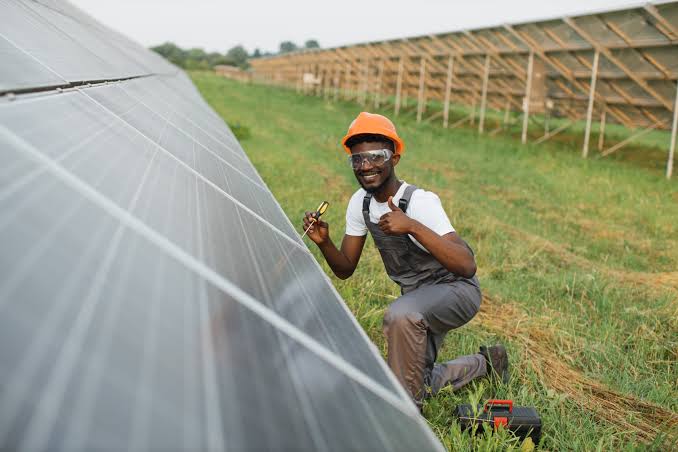
The problem is not necessarily that young Africans lack interest in the green economy. It is that many of the supporting systems required to turn interest into livelihoods remain fragmented. Training institutions, employers, financial institutions, government agencies and investors often operate on different timelines and with different measures of success. A solar technician may complete training without access to equipment or finance, while an energy company may struggle to find workers with the specific technical skills required for installation and maintenance.
The financing of youth-led green businesses presents another challenge. Early stage enterprises in areas such as recycling, sustainable agriculture, clean cooking, renewable energy and climate services can struggle to meet conventional lending requirements. Blended finance, guarantees, targeted credit facilities and business-development support can potentially address some of these constraints, but their effectiveness depends on whether financing reaches commercially viable enterprises rather than remaining concentrated among larger established companies.
For policymakers, the implications reach into industrial strategy. If African countries are to capture more value from the green transition, the focus will need to extend beyond deploying imported solar panels, batteries, electric vehicles and other technologies. Local assembly, maintenance, software, engineering, recycling and component manufacturing can create additional employment opportunities, provided that markets, infrastructure and investment conditions support them.
The AU-ILO Youth Employment Strategy places structural transformation, economic integration and the transition to inclusive green and digital economies within the same employment framework. It also points to the African Continental Free Trade Area as an opportunity to connect investment and trade policies with employment creation.
That regional dimension could become increasingly important as green industries develop unevenly across the continent. Countries with stronger renewable-energy resources, mineral deposits, manufacturing capacity or technology ecosystems could develop specialised industries, while regional trade could expand the market available to businesses operating beyond their domestic economies.
Yet a larger green economy will not automatically produce a more inclusive one. The distribution of jobs, wages, finance and ownership will depend on policy choices, investment structures and labour-market institutions. The ILO’s framework for green employment diagnostics consequently treats climate change and environmental transitions as issues affecting economies, labour markets, poverty and inequality simultaneously.
For Africa, the stakes are particularly high because the continent’s climate transition is unfolding alongside rapid population growth, urbanisation and pressure to create productive employment. Net-zero strategies that focus primarily on emissions targets and investment volumes risk overlooking the economic systems needed to connect those investments to households, workers and enterprises.
The emerging green economy will therefore be judged not only by installed renewable capacity, emissions reductions or volumes of climate finance mobilised, but also by whether African economies can develop the skills, businesses and institutions needed to participate in the transition. The central challenge identified by APRI is ultimately a question of implementation: how climate commitments can move from national strategies and investment frameworks into employment opportunities that young Africans can realistically access.

As governments refine their climate and industrial policies, the connection between green investment and employment is likely to become an increasingly important measure of transition readiness. For Africa, where youth employment remains a structural economic priority, the success of the green transition will depend in part on whether young people become participants in emerging low-carbon industries rather than simply beneficiaries of policies designed elsewhere.


