


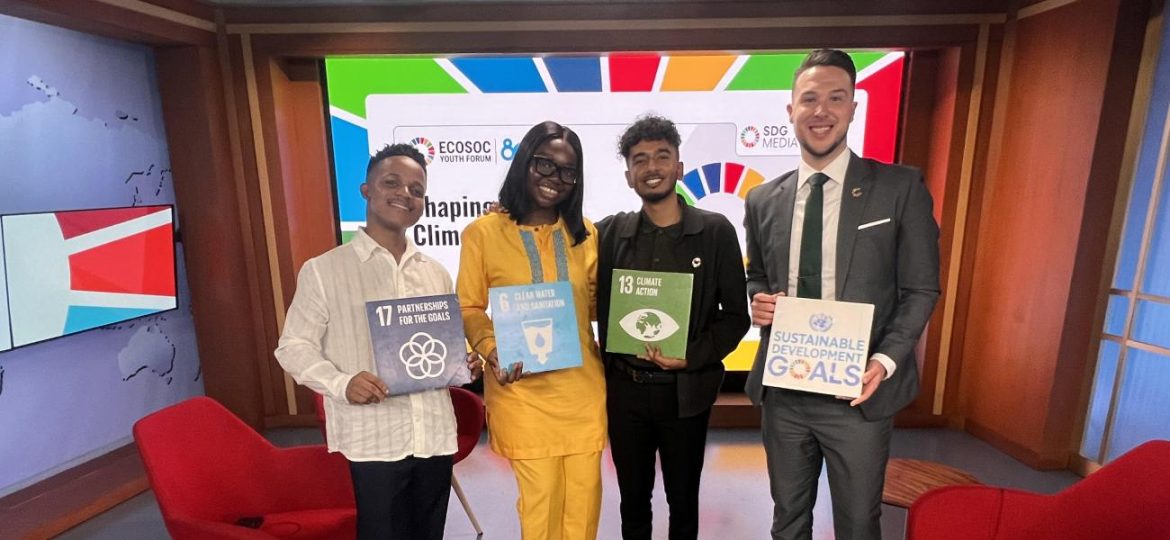
Africa stands at a stark climate crossroads. The continent is warming faster than the global average, facing disproportionate climate impacts despite contributing the least to global greenhouse gas emissions. These realities were brought into sharp focus this week at the 2026 ECOSOC youth forum , the largest annual UN gathering of young people where four african climate youth leaders took centre stage to demand real action.
Held under the theme “innovate, unite and transform: youth shaping the road to 2030,” the forum convened from april 14 to 16 at UN headquarters in new york, with side conversations continuing into may. The african voices in that room were not background noise, they were the headline.
The four leaders sibusiso mazomba of south africa, jabri ibrahim of kenya, eugenia boateng of the african diaspora youth hub, and damon hamman of nyu’s centre for global affairs led a dynamic panel discussion at the SDG media zone spotlighting the critical role young africans are playing in driving climate solutions across the continent. Their discussion zeroed in on water security a thread connecting agriculture, livelihoods, energy production and ecosystems. As climate stress deepens, water-related impacts are widening africa’s inequalities and threatening its development trajectory.
Mazomba, a member of the UN secretary-general’s youth advisory group on climate change, is no stranger to turning advocacy into policy wins. He leads youth advocacy at the african climate alliance and was instrumental in the #cancelcoal campaign, which successfully blocked new coal procurement in south africa’s energy plans in 2024. His kenyan counterpart jabri ibrahim brings deep expertise in climate and energy policy across africa, having previously worked with the UNFCCC secretariat and the africa climate energy nexus. Together, they represent a generation of africans who are refusing to wait for global leaders to act.
The urgency of their message is backed by hard evidence. A landmark study published this april in scientific reports revealed that africa’s forests once a critical carbon sink have flipped into a net carbon source since 2010, largely driven by deforestation in the democratic republic of congo, madagascar, and west africa. The continent lost approximately 106 billion kilograms of forest biomass per year between 2010 and 2017. Meanwhile, the 2026 africa sustainable development report by the UN economic commission for africa released this week confirms that mounting climate pressures are intersecting with fiscal strain and demographic shifts to put africa’s development goals at serious risk.
The youth leaders’ advocacy comes at a moment when the continent’s adaptation finance gap remains dangerously wide. According to the 2025 adaptation gap report, developing countries will need between $310 billion and $365 billion annually by 2035 for climate adaptation yet international public adaptation finance actually fell from $28 billion in 2022 to $26 billion in 2023. African countries are being asked to do more with less, at precisely the moment when climate extremes are accelerating. Ongoing floods in southern africa across mozambique, zimbabwe, south africa and botswana have displaced thousands in recent months, underscoring that this is no longer a future risk. It is a present emergency.
What makes this ECOSOC moment notable is not simply that young africans showed up, it is that they arrived with solutions. Eugenia boateng, founder of the african diaspora youth hub (FABA institute), has spent years building systems to make african economies more visible and investable to the diaspora, creating finance pathways that bypass the bottlenecks of traditional development institutions. On the ground in zambia, initiatives like COMACO ltd are merging wildlife conservation with smallholder farmer livelihoods. In kenya, organisations like sidai africa are delivering last-mile climate resilience services to farmers who have long been left out of global climate finance frameworks.
The african youth climate movement understands something that many global negotiators are still catching up to: adaptation and development cannot be separated. As the ISS africa 2026 climate outlook notes, the key test in 2026 is whether ambition accumulated over years of climate summitry from the africa climate summit 2025 to COP30 in brazil can be converted into credible, funded implementation before the window closes.
For the young leaders who spoke at the ECOSOC forum, that is not an abstract policy question. It is the question that shapes whether their communities have safe water, viable farms, and stable futures. Africa’s youth are not waiting for the answer. They are writing it themselves. To follow their work, visit the african youth initiative on climate change (AYICC).


