


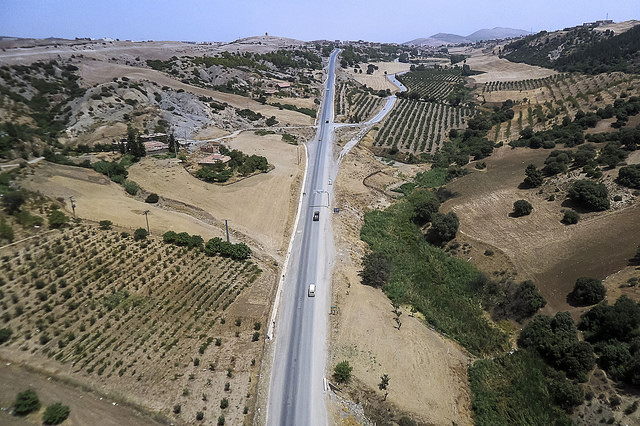
Algeria has unveiled a nationwide road rehabilitation and maintenance programme aimed at upgrading critical transport infrastructure, improving road safety and strengthening economic connectivity across the country, as authorities seek to protect decades of public investment while supporting long-term development objectives. The initiative, announced by Public Works and Basic Infrastructure Minister Abdelkader Djellaoui during a session of the National People’s Assembly, will focus on the systematic restoration of roads, motorways and strategic transport assets, with implementation guided by technical assessments and infrastructure priorities.
The programme marks a significant step in Algeria’s broader infrastructure strategy at a time when many African countries are shifting attention from new construction towards the maintenance and resilience of existing assets. According to Djellaoui, road maintenance has become a national priority as increasing traffic volumes, ageing infrastructure and growing economic demands place greater pressure on transport networks that serve as critical arteries for commerce, mobility and regional integration.
 Central to the initiative is the rehabilitation of Algeria’s motorway network, including sections of the East-West Highway, one of North Africa’s most important transport corridors. Stretching across the country and linking major economic centres, the highway facilitates the movement of goods, services and people between coastal regions and inland markets. Technical assessments have identified sections requiring urgent intervention, reflecting the challenges associated with maintaining large-scale infrastructure systems under rising traffic demand.
The government’s approach reflects a broader recognition that infrastructure maintenance delivers economic returns comparable to, and often exceeding, new construction. Well-maintained roads reduce vehicle operating costs, minimise travel delays and lower the financial burden associated with freight transport. For businesses, improved logistics can enhance competitiveness by reducing supply chain disruptions and improving access to domestic and regional markets.
Across Africa, transport infrastructure remains one of the most important enablers of economic growth. According to the African Development Bank, inadequate transport systems continue to increase the cost of doing business across the continent, affecting trade competitiveness and limiting access to economic opportunities. In this context, Algeria’s decision to prioritise maintenance highlights an increasingly important policy shift towards preserving infrastructure value and maximising the efficiency of public expenditure.
The rehabilitation programme builds upon previous road maintenance campaigns that saw the restoration of thousands of kilometres of national and provincial roads, alongside repairs to bridges, motorway sections and other engineering structures. Authorities have also intensified efforts to identify and address accident-prone locations, commonly referred to as “black spots”, as part of a broader strategy to improve road safety outcomes.
Read also: https://afri-res.uneca.org/algeria/transport-and-infrastructure
Road safety remains a significant development challenge across Africa. Traffic accidents impose substantial economic costs through healthcare expenditure, productivity losses and damage to infrastructure and vehicles. Improvements in road quality, signage and engineering standards can therefore generate benefits that extend beyond transport efficiency, contributing to public health and reducing fiscal pressures on governments.
Beyond physical rehabilitation, Algeria is also moving to strengthen the institutional foundations of infrastructure management. The Ministry of Public Works and Basic Infrastructure is preparing a draft executive decree that will establish harmonised technical standards governing the design, construction and maintenance of roads, motorways, railways, ports and other strategic infrastructure assets. The proposed framework is intended to improve project quality, strengthen accountability and increase the lifespan of public infrastructure investments.
According to ministry officials, national laboratories, industrial research institutions and higher education establishments will contribute to the development of these standards. The involvement of technical and academic institutions reflects a growing emphasis on evidence-based infrastructure planning and the integration of scientific expertise into public investment decisions.
The sustainability implications of the programme are equally significant. Deteriorating roads contribute to higher fuel consumption, increased vehicle emissions and greater maintenance costs for transport operators. Improving road conditions can enhance fuel efficiency, reduce congestion and lower emissions associated with inefficient transport systems. While transport infrastructure is often discussed primarily in economic terms, its condition also influences environmental performance and resource efficiency.
For Algeria, infrastructure resilience is becoming increasingly important as climate variability, population growth and urbanisation reshape development priorities. Investments in durable infrastructure help reduce future maintenance liabilities and improve the ability of transport systems to withstand environmental and economic shocks. Preventative maintenance strategies, widely recognised as international best practice, allow governments to address deterioration before costly reconstruction becomes necessary.
The programme also carries implications for regional development. Improved road connectivity can strengthen links between provinces, expand market access for rural producers and support more balanced economic growth across different regions of the country. Enhanced transport infrastructure often serves as a catalyst for investment by improving access to industrial zones, agricultural production areas and export corridors.
 As African economies continue to pursue industrialisation, trade integration and economic diversification, infrastructure quality is increasingly viewed as a determinant of competitiveness. Algeria’s latest initiative illustrates how maintaining existing assets can become as strategically important as building new ones, particularly in an environment of fiscal constraints and rising infrastructure demands.
By combining rehabilitation works, technical standardisation and institutional collaboration, Algeria is adopting a more systematic approach to infrastructure stewardship. The programme underscores a broader lesson for the continent: sustainable infrastructure development depends not only on expanding networks but also on preserving the assets that underpin economic activity, social mobility and long-term resilience.


