


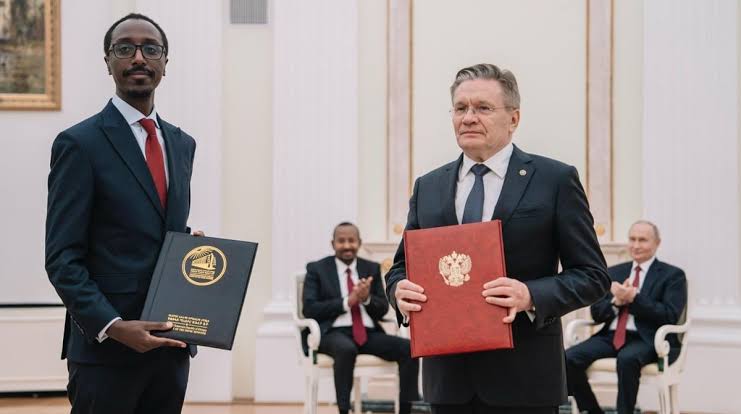
Ethiopia is moving to establish the regulatory and institutional foundations for its first civilian nuclear power programme, working with both Russia and the United States as it prepares rules governing nuclear facilities, safety, licensing and oversight. The Ethiopian Technology Authority (ETA) held a stakeholder consultation in Addis Ababa on August 4 to review draft nuclear regulations, with representatives linked to Russia’s nuclear regulator and the United States Nuclear Regulatory Commission participating alongside other international partners. The process comes as Ethiopia seeks to diversify an electricity system overwhelmingly dependent on hydropower and expand generation capacity to support industrialisation and rising demand.
The regulatory effort is an important stage in Ethiopia’s nuclear ambitions because building a reactor requires considerably more than selecting a technology and securing financing. Countries introducing nuclear power must establish independent regulatory capacity, develop licensing and inspection systems, prepare emergency-response mechanisms, manage radioactive materials and waste, train specialised personnel and establish arrangements for nuclear security and safeguards.
According to the Ethiopian News Agency, ETA Director General Solomon Getachew said Ethiopia was developing mechanisms for staffing, licensing, inspection and enforcement in line with standards established by the International Atomic Energy Agency (IAEA). The draft regulations are expected to be revised following the consultation before being formally adopted.
The IAEA’s framework for countries introducing nuclear power emphasises the need to develop national infrastructure progressively before construction and operation. Its “Milestones Approach” covers areas including legal and regulatory frameworks, nuclear safety, financing, human-resource development, radioactive waste management, emergency planning, security and public engagement. Ethiopia is already included in an IAEA technical-cooperation programme supporting countries developing the infrastructure required for safe and sustainable nuclear power.
Ethiopia’s decision to seek expertise from both Washington and Moscow is notable given the competitive nature of the international nuclear market. The U.S. Nuclear Regulatory Commission (NRC) is responsible for regulating civilian nuclear activities in the United States, while Russia’s Rostechnadzor oversees nuclear and industrial safety in Russia. The participation of regulators from both countries gives Ethiopia access to different areas of international regulatory experience while allowing Addis Ababa to develop a framework that ultimately needs to operate under Ethiopian law and international nuclear-safety obligations.
The US NRC is currently chaired by Ho K. Nieh, who was designated chairman in January 2026. The agency’s responsibilities include developing nuclear safety regulations, licensing activities and overseeing nuclear reactors and nuclear materials.
Russia, meanwhile, remains Ethiopia’s principal industrial partner for the planned nuclear power programme. Ethiopia and Russia signed a strategic roadmap for nuclear energy development in March 2026 covering areas including feasibility studies, site selection, regulatory preparation, technology transfer and workforce development. The programme envisages two reactors of approximately 1,200 megawatts each, with reports indicating potential commissioning between 2032 and 2034.
The proposed capacity would represent a major addition to Ethiopia’s electricity system. The country currently depends overwhelmingly on hydropower, with the Grand Ethiopian Renaissance Dam and other hydroelectric projects forming the backbone of its grid. While hydropower has allowed Ethiopia to generate relatively low-carbon electricity at scale, heavy dependence on rainfall and river flows exposes the power system to hydrological variability.
That vulnerability is becoming more important as climate variability affects water availability across Africa. Drought can reduce reservoir levels and electricity production at the same time that households, industries and businesses require reliable power. Diversifying the generation mix with nuclear, alongside solar, wind and geothermal resources, could therefore improve the system’s ability to maintain firm electricity supply during periods of reduced hydropower output.
The scale of Ethiopia’s electricity ambitions also explains the interest in nuclear power. The African Development Bank has previously identified a target of increasing Ethiopia’s installed generation capacity to 17.1 gigawatts by 2030, from about 6.1 GW in 2024. Earlier AfDB analysis also identified diversification towards solar, wind and geothermal as a means of reducing the country’s dependence on hydropower.
For an economy of more than 120 million people undergoing rapid industrialisation and urbanisation, reliable electricity is an economic constraint as much as an infrastructure issue. Manufacturing facilities, industrial parks, rail systems, digital infrastructure and commercial businesses all require increasingly dependable electricity. Additional baseload generation could therefore support industrial productivity if the associated transmission and distribution infrastructure develops at a comparable pace.
However, nuclear power introduces a different set of financial and institutional requirements. Large reactors typically involve substantial upfront capital expenditure, long construction periods and complex procurement arrangements. Governments must also account for decommissioning, spent-fuel management, nuclear security and long-term regulatory capacity. These costs are particularly relevant for developing economies where public finances are already under pressure from infrastructure needs, debt-service obligations and competing social expenditures.
Ethiopia’s regulatory approach will therefore be closely watched by investors and development institutions. A credible regulator needs sufficient technical independence, skilled personnel and financial resources to oversee nuclear operators throughout the lifetime of a plant. Building that capacity can take years, which explains why Ethiopia’s current emphasis on regulation and training is as important to the programme as the future reactor technology itself.
The country’s international cooperation has also extended beyond Russia and the United States. Ethiopia held discussions with French and Finnish representatives earlier in 2026 concerning nuclear regulation and radioactive-waste management, reflecting the government’s effort to draw on a broad range of international experience rather than relying exclusively on its prospective reactor supplier.
For the IAEA, Ethiopia’s progress illustrates the long institutional pathway facing African countries considering nuclear power. South Africa remains the continent’s only country with operating commercial nuclear reactors, while Egypt is developing the four-unit El Dabaa nuclear power plant with Russia’s Rosatom. Other African countries, including Kenya, Ghana, Nigeria and Rwanda, have also explored nuclear power or strengthened their nuclear institutions.
Rosatom’s role in Ethiopia is particularly significant because the Russian state-owned nuclear company is simultaneously constructing Egypt’s El Dabaa project, where four reactors of 1,200 MW each are planned. The Egyptian project provides a regional reference point for the Russian reactor technology Ethiopia is considering, although Ethiopia’s programme remains at a much earlier institutional and developmental stage.
For Africa, the significance of Ethiopia’s nuclear plans extends beyond electricity generation. If successfully implemented, the programme could create demand for specialised engineering, nuclear science, technical education, construction and regulatory expertise. It could also encourage the development of domestic scientific institutions and a skilled workforce capable of supporting a wider high-technology industrial base.
Yet the economics will ultimately determine whether the ambition becomes a functioning power project. Ethiopia will need to reconcile reactor financing with grid expansion, transmission investment, renewable-energy development and broader fiscal priorities. The country will also have to maintain public confidence through transparent safety standards, credible environmental assessments and clear arrangements for radioactive waste.
The immediate priority, therefore, is not the reactor itself but the institutions required to govern it. Ethiopia’s work with Russia, the United States, the IAEA and other international partners indicates that Addis Ababa recognises the long lead time required to establish a credible nuclear programme. As the country seeks to reduce its exposure to hydrological risks while expanding electricity supply, the quality of that regulatory and institutional foundation will be as important as the technology eventually selected.
For Ethiopia, nuclear power is consequently becoming part of a broader strategy to build a more diversified and reliable electricity system. Whether the programme reaches its proposed 2032–2034 timeframe will depend on feasibility studies, financing, regulatory approvals, infrastructure development and workforce preparation. For Africa’s wider energy transition, the Ethiopian case will provide another test of whether nuclear power can be integrated into emerging economies as a complement to, rather than a substitute for, the continent’s expanding renewable-energy base.


