


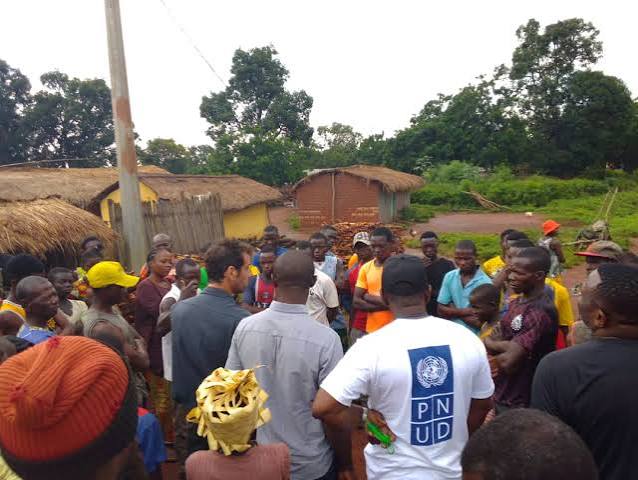
The Central African Republic has launched its first national Payments for Environmental Services programme, committing $10 million to a project around Bangui that will reward communities for verified forest protection and sustainable land management, in a move that puts performance-based nature finance at the centre of efforts to link environmental protection with rural incomes. The project, funded by the Central African Forest Initiative (CAFI) and implemented by the United Nations Development Programme (UNDP), was officially launched in Bangui on September 30 by Prime Minister Félix Moloua on behalf of President Faustin-Archange Touadéra.
Of the $10 million allocation, $1.913 million is earmarked for payments to beneficiaries based on measured environmental results. The wider project will establish the legal, institutional, social and land tenure conditions required for the mechanism before contracting environmental service providers and supporting activities including agroforestry, assisted natural regeneration and conservation in community forests. CAFI’s project documentation places the implementation period from July 2026 to July 2031.

The structure marks an important shift in how forest conservation is being financed in Central Africa. Rather than treating environmental protection solely as a public expenditure or development assistance programme, Payments for Environmental Services, or PES, creates a financial link between specified land-management outcomes and payments to those responsible for delivering them. In the Central African Republic, the model is being introduced around the capital before any broader expansion.
According to CAFI, the project will first address the institutional and social conditions needed for PES, including community governance, identification of environmental service providers, free, prior and informed consent, safeguards and municipal land use planning. These foundations are important because payments for environmental outcomes depend on clearly defined responsibilities, credible measurement and safeguards over land and community rights.
Read also: https://cafi.org/news/car-launches-payments-environmental-services-bangui/
For households around Bangui, the economic question is therefore as important as the environmental one. The programme is designed to support land users who undertake agroforestry, natural regeneration and conservation, potentially creating an additional income stream linked to how land is managed. The government has described the project as a pilot intended to test incentives for improved environmental practices while increasing household incomes.
That connection reflects a wider challenge across Africa, where many communities living close to forests depend directly on agriculture, fuelwood, forest products and other natural resources. Conservation policies that impose costs on land users without creating alternative economic opportunities can face implementation difficulties. Performance-based payments offer one way of attempting to align local economic incentives with broader environmental objectives, although their effectiveness will depend on reliable verification, predictable payments and clear land governance.
The Central African Republic’s experiment also sits within a broader regional effort by CAFI to develop PES as a financing instrument across Central Africa. CAFI says it has developed a common regional framework and tools for PES and is preparing a regional scale-up involving the Democratic Republic of Congo, the Republic of Congo and the Central African Republic, with up to $100 million in CAFI funding alongside potential co-financing from national sources.
The regional dimension matters because the Congo Basin’s forests operate across national borders while the economic and environmental pressures affecting them are often shared. CAFI estimates that the Congo Basin contains about 233 million hectares of tropical forest, while its wider programme covers six Central African countries. The organisation says Central Africa’s forests directly support more than 40 million people and play a significant role in regulating local and regional rainfall.
The financial architecture behind PES is consequently becoming an important part of the region’s climate and development debate. International climate finance has historically struggled to reach communities and local land users in forms that directly reward measurable environmental outcomes. A system that links payments to verified results could provide another channel for directing international finance towards activities that simultaneously affect forests, agriculture, livelihoods and climate resilience.
But performance-based finance also introduces its own requirements. Results must be measured and independently verified, beneficiaries must be identifiable, payment systems must be transparent and land use rights must be sufficiently clear to prevent disputes. CAFI’s project design explicitly includes safeguards, community governance and independent assessment within the preparatory framework.
These institutional requirements are particularly relevant in countries where land administration and public sector capacity remain constrained. If verification is weak or payments are delayed, the economic incentive underpinning PES can be undermined. Conversely, credible measurement can provide governments and external financiers with evidence that funding is producing defined environmental outcomes.
The model also differs from conventional carbon credit projects. While carbon markets can generate revenue from measured emissions reductions, PES can reward a wider set of environmental services and land management outcomes. CAFI’s regional framework includes individual results such as agroforestry, reforestation, natural regeneration and deforestation-free agriculture, as well as collective results linked to community forest conservation and management.
That distinction could matter for African countries whose environmental finance strategies are still developing. Not every community-level conservation activity will necessarily generate a commercially viable carbon credit project, particularly where measurement and transaction costs are high. A public or donor-backed PES mechanism can therefore operate alongside carbon markets and other forms of nature finance rather than depending entirely on carbon-market revenues.
For the Central African Republic, the programme also intersects with food security and land use pressures. CAFI’s rationale for developing PES in the region includes the persistent challenge of forest loss alongside food security, suggesting that the financial mechanism is intended to influence how agricultural land and forests are managed rather than simply compensate communities for conservation.
That balance will be important. Agriculture remains a central source of livelihoods across Central Africa, while expanding food production can place pressure on forests when productivity is low and land use planning is weak. Incentives for agroforestry and improved land management could therefore have implications for both environmental resilience and agricultural productivity, although the project itself will need to demonstrate these outcomes over time.
The programme also illustrates the changing role of development finance in Africa’s environmental transition. CAFI’s model combines international funding with national institutions, local authorities, implementing organisations and communities rather than relying on a single source of finance. UNDP is responsible for implementation, while the Central African government’s environment and finance institutions are among the national partners.
For public finances, such arrangements can help governments access international environmental finance without having to fund the full cost of conservation from constrained domestic budgets. However, the longer term question is whether successful pilots can be integrated into national planning and eventually attract additional sources of finance without creating dependence on short term donor programmes.
The issue is particularly relevant as African countries seek to expand the economic value assigned to forests and other natural assets. Nature-related finance is increasingly being discussed alongside climate finance, biodiversity finance, carbon markets and sustainable commodity supply chains. Yet the ability to translate these concepts into reliable income for communities remains a practical challenge.
The Central African Republic’s project is therefore significant less because of its $10 million size than because of the mechanism it is testing. If environmental performance can be measured credibly and payments can reach the people managing landscapes, the approach could provide an additional instrument for connecting international finance with local development priorities. If implementation is weak, the programme could instead illustrate the institutional difficulties involved in converting environmental commitments into functioning financial systems.
CAFI’s decision to develop a regional PES programme indicates that the Central African Republic is not being treated as an isolated case. The organisation has already approved other PES initiatives in the region, including a $20 million project in Cameroon’s Grand Mbam landscape and a $24.5 million project targeting small and medium-sized enterprises, while preparing a potential $100 million regional scale-up for the Central African Republic, Democratic Republic of Congo and Republic of Congo.
For Africa’s broader sustainability finance agenda, the experiment places a familiar question in a more practical setting: how can international environmental finance create economic value for the people whose land management decisions determine whether forests are protected or degraded? In Bangui and its surrounding areas, the answer is now being tested through a financial mechanism that links verified environmental performance with direct payments.

The outcome will depend on governance as much as funding. Transparent beneficiary selection, secure land rights, independent verification and timely payments will determine whether the scheme can establish the trust required for a functioning environmental services market. For the Central African Republic and potentially other forest countries, that institutional capacity may prove as important as the financing itself.


