


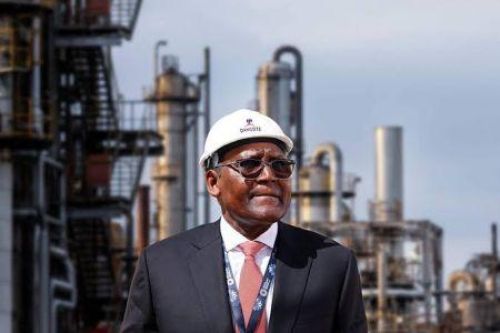
Nigeria’s drive to strengthen domestic refining and reduce dependence on imported petroleum products has encountered a significant challenge after Dangote Petroleum Refinery announced that it would begin pricing gasoline, diesel and aviation fuel sold within the country in U.S. dollars. The policy, which took effect on July 13, reflects persistent shortages of locally supplied crude oil under the government’s “naira-for-crude” programme and raises fresh questions about the sustainability of Nigeria’s broader energy reform agenda.
The new pricing structure applies to refinery gate sales and coastal deliveries, with gasoline priced at $0.779 per litre, diesel at $1.087 per litre and jet fuel at $0.942 per litre. Liquefied petroleum gas (LPG) has been excluded from the revised pricing policy. The move effectively marks the suspension of the pricing model established under the “naira-for-crude” initiative introduced by the Nigerian government in October 2024. The programme was designed to allow domestic refiners to purchase locally produced crude oil using the national currency, reducing demand for foreign exchange while strengthening Nigeria’s refining industry and improving fuel security.
According to Dangote Refinery, the decision reflects the financial pressures created by an imbalance between the currencies used to purchase crude oil and those used to sell refined petroleum products. While part of the refinery’s crude supplies continued to be purchased in U.S. dollars, a significant share of refined products had been sold in naira. Edwin Devakumar, Vice President of Dangote Group, said the refinery had absorbed the exchange-rate mismatch for some time. However, the limited availability of locally priced crude eventually made the arrangement financially difficult to sustain.
At the centre of the challenge is crude oil supply rather than refining capacity. The 650,000-barrel-per-day Lekki refinery requires between 13 and 15 crude cargoes each month to maintain efficient operations. According to the company, deliveries from the Nigerian National Petroleum Company Limited (NNPC) have remained below these requirements despite improvements in recent months. Allocations reportedly increased from approximately five cargoes per month to seven cargoes in May 2026, but the refinery has continued to source additional crude from international suppliers. Those purchases are denominated in U.S. dollars, exposing the refinery to fluctuations in global crude prices and movements in Nigeria’s exchange rate.
The development highlights one of the structural challenges facing Africa’s largest oil producer. Nigeria remains one of the continent’s leading crude exporters, yet ensuring sufficient domestic crude supply for local refining has proven more complex than expanding refining infrastructure. The Dangote Refinery has transformed Nigeria’s downstream petroleum sector since commencing operations, significantly reducing the country’s reliance on imported transportation fuels. According to the Nigerian Midstream and Downstream Petroleum Regulatory Authority (NMDPRA), domestic refineries supplied more than 44% of Nigeria’s gasoline demand by September 2025, compared with just 17% one year earlier.
That improvement has strengthened domestic fuel availability and reduced import requirements. However, the refinery’s latest pricing decision illustrates that refining capacity alone does not guarantee energy security if upstream supply chains remain constrained. According to data published by the Central Bank of Nigeria, Dangote Refinery imported approximately $3.74 billion worth of foreign crude oil during 2025. The continued reliance on imported feedstock reduces some of the economic benefits originally expected from the “naira-for-crude” programme, which sought to create stronger linkages between Nigeria’s upstream and downstream petroleum industries.
The government’s strategy envisioned a circular model in which locally produced crude would supply domestic refineries, refined products would be sold in the national currency, and reduced demand for foreign exchange would strengthen macroeconomic stability. By increasing domestic refining, policymakers also aimed to improve energy security while reducing exposure to international fuel supply disruptions. The refinery’s transition to dollar-denominated pricing suggests that achieving these objectives will depend as much on crude supply management as on refining infrastructure.
The implications extend beyond the refinery itself. Fuel marketers purchasing products from Dangote will now face greater exposure to exchange-rate volatility. Their costs will increasingly reflect movements in both international crude prices and the value of the naira against the U.S. dollar. For consumers, the eventual impact on retail fuel prices will depend on several factors, including exchange rates, transportation costs, taxes, distribution margins and regulatory pricing decisions. While the immediate effect remains uncertain, the change introduces an additional foreign exchange component into Nigeria’s domestic fuel market. More broadly, the development underscores the importance of policy coordination across the petroleum value chain. Investments in refining capacity require complementary reforms in crude allocation systems, production efficiency, infrastructure and regulatory oversight to maximise their economic impact.

The experience also carries wider significance for African energy markets. Several oil-producing countries are investing in new refineries to reduce dependence on imported fuels and retain more value from domestic hydrocarbon resources. Nigeria’s experience demonstrates that downstream industrialisation depends not only on constructing refining facilities but also on maintaining reliable and commercially sustainable crude supply arrangements. As African governments pursue energy security and industrial development, balancing upstream production, refining capacity, foreign exchange management and domestic market stability will remain a central policy challenge. Dangote Refinery’s decision reflects these interconnected realities, highlighting that successful energy transformation requires integrated management of the entire petroleum value chain rather than investment in refining infrastructure alone.


