


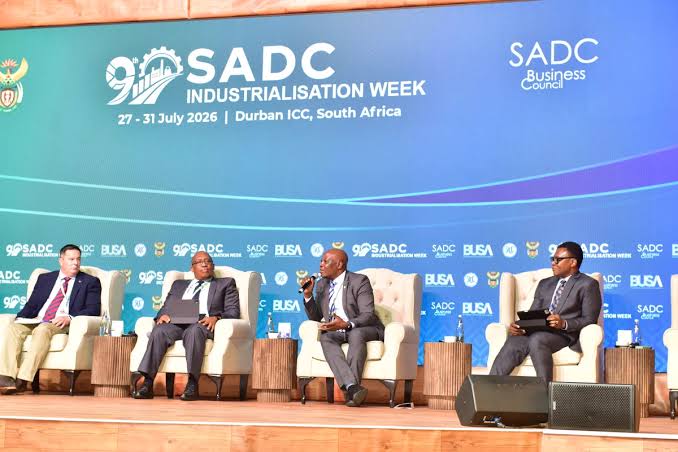
Southern African policymakers, business leaders, development institutions and industry representatives concluded the 9th Southern African Development Community (SADC) Industrialisation Week and Exhibition in Durban on 31 July with renewed commitments to accelerate regional industrialisation through infrastructure investment, agricultural transformation and critical minerals value addition, as member states seek to strengthen economic resilience and deepen regional integration ahead of the 46th SADC Summit of Heads of State and Government.
Held at the Durban International Convention Centre from 27 to 31 July under the theme, “Resilient, Sustainable and Inclusive Industrialisation through Infrastructure Development, Agricultural and Critical Minerals Transformation in Pursuit of a Just World,” the gathering served as a strategic platform for governments, private sector actors and development partners to examine how Southern Africa can move beyond commodity exports towards higher-value manufacturing and integrated regional production systems. According to participants, the discussions were intended to generate practical recommendations that will be submitted to the SADC Ministerial Task Force on Regional Economic Integration before consideration by the SADC Council of Ministers.
The meeting comes at a time when African economies are under increasing pressure to diversify production, strengthen domestic industries and reduce exposure to external commodity price shocks. While Southern Africa possesses some of the world’s largest reserves of platinum group metals, lithium, manganese, copper, cobalt and rare earth minerals, much of the region continues to export raw materials with limited domestic processing. This has constrained industrial employment, technology transfer and fiscal revenues while leaving member states vulnerable to fluctuations in global commodity markets.
Delegates argued that the transition towards cleaner energy technologies presents Southern Africa with an opportunity to reposition itself within emerging global supply chains. Rather than exporting unprocessed critical minerals, participants advocated for greater regional investment in beneficiation, mineral processing and downstream manufacturing capable of supplying components for batteries, renewable energy technologies and electric mobility. According to discussions during the forum, expanding domestic processing capacity would increase industrial output, retain greater economic value within the region and improve long-term competitiveness.
Agricultural transformation featured prominently throughout the week as governments examined opportunities to strengthen agro-processing industries and improve food security. Despite the region’s considerable agricultural potential, significant volumes of agricultural commodities continue to leave Southern Africa without value addition, limiting export earnings and rural industrial development. Participants identified investment in storage facilities, processing infrastructure, logistics and cross-border value chains as priorities capable of reducing post-harvest losses while supporting higher-value exports.
Infrastructure development was repeatedly identified as the foundation for industrial expansion. According to participants, persistent electricity shortages, transport bottlenecks, port congestion and limited digital infrastructure continue to increase production costs and weaken the competitiveness of regional manufacturers. Expanding energy generation, improving regional transport corridors and modernising logistics systems were presented as essential measures for enabling industrial investment and facilitating intra-African trade under the African Continental Free Trade Area (AfCFTA).
The discussions also highlighted the importance of strengthening regional value chains rather than pursuing isolated national industrial strategies. SADC’s integrated market offers opportunities for member states to specialise across different stages of production, allowing industries to benefit from economies of scale while reducing dependence on imported intermediate goods. According to delegates, deeper industrial cooperation could improve supply chain resilience and position Southern African manufacturers to compete more effectively in global markets.
Industrialisation also featured prominently within broader sustainability and climate discussions. Participants acknowledged that future manufacturing growth will increasingly depend on resource efficiency, cleaner production technologies and responsible management of environmental and social risks. As international markets adopt more stringent sustainability standards, industries capable of demonstrating lower carbon emissions, improved resource management and stronger governance practices are expected to enjoy greater access to export markets and sustainable finance.
 For Southern Africa, these considerations extend beyond environmental objectives to questions of economic competitiveness. Global investors are increasingly directing capital towards projects aligned with climate resilience, responsible mineral production and sustainable infrastructure. Countries able to develop transparent regulatory frameworks and invest in modern industrial ecosystems may therefore be better positioned to attract long-term investment while supporting employment and industrial diversification.
The declaration adopted at the conclusion of the week reflects a broader recognition that industrialisation remains central to achieving sustainable economic transformation across Southern Africa. By prioritising infrastructure development, agricultural value addition, critical minerals beneficiation and stronger regional value chains, SADC member states are seeking to build more diversified economies capable of generating higher-value exports, expanding productive employment and strengthening resilience against future economic and climate-related shocks.


