


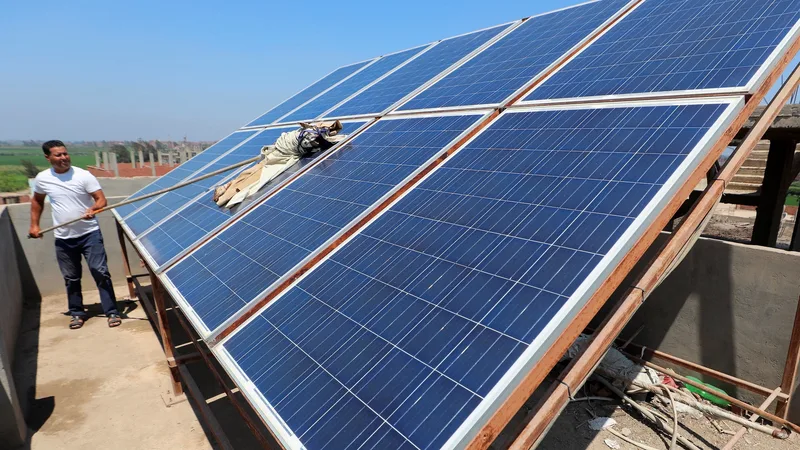
Egypt is accelerating the development of large-scale wind and solar projects as it seeks to expand renewable electricity, reduce pressure on gas-fired generation and position the country as a regional clean-energy hub. The push, which includes new power purchase agreements and a growing pipeline of utility-scale projects, is reshaping Egypt’s electricity market while placing greater emphasis on transmission capacity, private investment, storage and the financial sustainability of the power system.
The latest phase builds on Egypt’s decision to move towards larger, privately financed renewable projects rather than relying predominantly on state-led generation investment. African Energy reported that two power purchase agreements had been concluded under what Egypt described as an accelerated renewable energy initiative, alongside a broader series of wind and solar agreements. The approach has kept offtake arrangements relatively open while relying on established investor-developers to advance projects.
The scale of the programme is significant. Egypt is targeting a renewable share of at least 42% of its electricity needs by 2030, while government planning has identified further expansion beyond that horizon. In 2026, the government said it expected to add about 2,500MW of renewable capacity to the national grid, with solar and wind forming the core of the expansion.
The investment pipeline already illustrates the direction of travel. Norwegian renewable energy company Scatec said in June that it planned to invest up to $5 billion in Egypt over two years across renewable-powered desalination, solar and wind projects, battery storage and green-transition infrastructure. Its portfolio includes the Obelisk Project in Upper Egypt, which combines large-scale solar generation with battery storage.
Egypt’s strategy reflects a broader economic calculation. The country has experienced periods of pressure on its electricity system and foreign-exchange position, while natural gas has historically played a central role in power generation. Increasing renewable generation can reduce exposure to fuel requirements and potentially free gas for higher-value domestic or export uses. But achieving those benefits depends on whether renewable electricity can be integrated into the grid at sufficient scale and at a cost compatible with the wider economy.
The shift towards utility-scale renewables also changes the financing requirements of the electricity sector. Large solar and wind projects require substantial upfront capital, long-term contracts and credible payment arrangements. Egypt’s ability to attract international developers and lenders therefore depends partly on the credibility of its regulatory framework, the financial position of state-owned utilities and the predictability of power-purchase arrangements.
The country has been experimenting with new approaches to electricity procurement. According to an IMF assessment, Egypt introduced private-to-private renewable electricity trading through the national grid in 2025 as an initial step towards a more open electricity market. Four solar and wind projects totalling 400MW had been approved to sell electricity directly to industrial off-takers, indicating a gradual shift away from a system in which state-linked entities are the sole channel between generators and consumers.
That reform has implications for industrial competitiveness. Energy-intensive manufacturers increasingly face pressure from customers and international markets to reduce the carbon intensity of their products. Direct access to renewable electricity could allow Egyptian exporters to manage emissions exposure while also improving the credibility of sustainability claims. This becomes particularly relevant as international carbon-accounting requirements and mechanisms such as the European Union’s Carbon Border Adjustment Mechanism increase the importance of emissions data in cross-border trade.
The economics of Egypt’s renewable expansion also depend on the country’s ability to manage intermittency. Solar and wind generation fluctuate according to weather and time of day, making storage and transmission increasingly important as their share of the electricity mix rises. Egypt commissioned its first utility-scale battery energy storage system in 2025, with a capacity of 300MWh, providing an early example of how storage is being incorporated into the country’s renewable strategy.
The Obelisk Project illustrates the direction of this infrastructure model. The African Development Bank has committed $184.1 million to the project, which combines 1GW of solar PV with a 600MWh battery system. The project is expected to generate about 2,772GWh of electricity annually, while the storage component is intended to help shift renewable electricity towards periods of higher demand and reduce the impact of solar variability.
Transmission is likely to become an equally important constraint. Building renewable generation in areas with strong solar and wind resources does not guarantee that the electricity can reach major centres of demand. Egypt therefore needs to expand and reinforce transmission infrastructure alongside generation, particularly as projects become concentrated in resource-rich areas such as Upper Egypt and the Red Sea region.
This is one reason the country’s renewable strategy matters beyond individual projects. A large project pipeline can attract investment and reduce generation costs, but the broader economic return depends on whether electricity can be moved efficiently across the country and whether the grid can accommodate increasingly variable supply.
Egypt’s experience also illustrates a wider African challenge. The continent has significant renewable resources but remains constrained by inadequate transmission networks, high financing costs, weak utility balance sheets and limited access to long-term capital. The question is increasingly shifting from whether Africa has enough renewable resources to whether its power systems can mobilise and absorb investment at the required scale.
The financing model being developed in Egypt is consequently important. Recent projects have increasingly relied on build-own-operate structures, private developers and blended finance rather than solely on public expenditure. An assessment by the Egyptian Center for Economic Studies found that Egypt’s renewable sector has shifted from earlier donor-supported projects towards larger investment-driven developments supported by private capital and blended-finance structures.
For public finances, this approach can reduce the immediate burden of funding new generation, but it does not eliminate fiscal risk. Long-term power purchase agreements create future payment obligations, while currency movements can affect projects financed in foreign currencies but generating revenue in Egyptian pounds. The sustainability of the model therefore depends on how risks are distributed between government entities, utilities, developers and consumers.
Egypt is also attempting to create mechanisms that allow renewable energy attributes to acquire financial value. The government has been developing a framework for Guarantees of Origin and renewable-energy certification, which could eventually allow companies to demonstrate the renewable origin of electricity consumed in production. Such systems could become increasingly relevant to exporters seeking to meet international environmental requirements.
The industrial dimension is particularly important. Egypt is not pursuing renewable energy solely to decarbonise its electricity system. It is also seeking to use relatively abundant solar and wind resources to strengthen industrial competitiveness, support green hydrogen and clean-fuel projects, and potentially attract new investment in sectors where access to low-carbon electricity is becoming commercially relevant.
The government has simultaneously been promoting Egypt’s potential as a regional energy hub linking Africa, Europe and Asia. Renewable electricity could support emerging industries such as green hydrogen, renewable-powered desalination and low-carbon data infrastructure, while Egypt’s geographical position provides access to major international trade routes.
For Africa, Egypt’s experience provides a useful case study in the interaction between renewable energy, industrial policy and infrastructure finance. Countries across the continent are attempting to attract private capital into power generation while facing similar constraints around currency risk, transmission investment and the financial health of utilities.
There is also a competitive dimension. As Egypt, Morocco, South Africa, Namibia and other African markets develop increasingly large renewable projects, investors are likely to compare countries on the basis of more than natural-resource potential. Bankable contracts, access to transmission, regulatory certainty, foreign-exchange arrangements and the ability to secure long-term electricity buyers can determine where large pools of capital are ultimately deployed.
The pace of Egypt’s expansion therefore needs to be assessed against the quality of the underlying electricity system. Faster project development can increase renewable capacity, but poorly coordinated generation and grid investment could create congestion, curtailment or additional costs. The country’s move towards storage and more flexible electricity-market arrangements suggests that policymakers are increasingly addressing these system-level questions.

The wider economic test is whether the renewable build-out can improve energy security while supporting industrial production without creating unsustainable costs for consumers or public institutions. Egypt’s experience demonstrates that large renewable projects can attract international capital when policy, procurement and financing structures are sufficiently developed. The more difficult task is ensuring that those projects operate as part of a financially sustainable electricity system.
For African economies seeking to replicate Egypt’s renewable investment model, that distinction is important. Giga-scale solar and wind projects can provide significant additions to generation capacity, but their development needs to be accompanied by transmission, storage, market reform and credible financial structures. Egypt’s accelerating pipeline therefore represents not simply a renewable-energy expansion, but a test of whether large-scale clean power can be integrated into an emerging-market electricity system while supporting industrial growth and reducing exposure to fossil-fuel volatility.


