


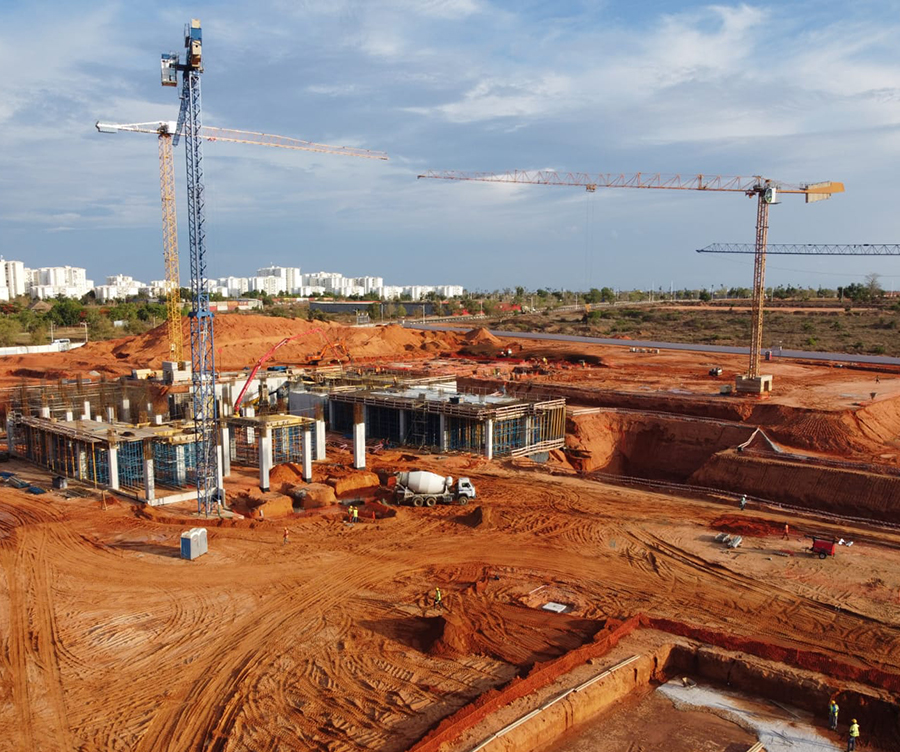
Angola has secured €538 million in international financing for Phase 2 of the Quilonga Grande Water Supply Project, a major infrastructure programme designed to expand reliable access to treated water for about five million people across Luanda and Icolo e Bengo, as the government seeks to address persistent water shortages while supporting rapid urban and industrial growth around the capital.
The financing has been arranged by Standard Chartered, acting as export credit agency coordinator, structuring bank, sole bookrunner and mandated lead arranger, with backing from the French state through Bpifrance Assurance Export and refinancing support from French public development bank Sfil. The project is being implemented for Empresa Pública de Águas de Luanda (EPAL) under Angola’s Ministry of Energy and Water, with Opaia Group participating through its construction arm, OPAIA Construction.
The scale of the financing reflects the capital-intensive nature of urban water infrastructure. Quilonga Grande is being developed to produce and transmit up to 518,000 cubic metres of treated water per day, with a network of more than 100 kilometres of transmission pipelines and multiple distribution centres. Angola’s Ministry of Energy and Water says the project has reached about 55% physical completion and is expected to begin supplying water by the end of 2026.

The project is designed to provide approximately 350,000 new household connections and serve municipalities across the rapidly expanding metropolitan area, including Cacuaco, Viana, Mulenvos, Calumbo, Cabiri, Sequele, Bom Jesus and Catete. The government has identified the system as strategically important because population growth and industrial expansion around Luanda have increased pressure on existing water infrastructure.
For Angola, the financing comes against a wider infrastructure deficit in water and sanitation. World Bank analysis shows that access to basic drinking water in Angola improved from 41% in 2000 to 58% in 2022, but the country continued to lag behind structural peers and sub-Saharan African and lower-middle-income averages. Rapid and largely unplanned urbanisation has further complicated the expansion of water networks. By 2022, about 4.5 million urban residents lacked access to improved water, according to the World Bank.
The concentration of population and economic activity around Luanda makes the water challenge particularly important. As residential areas expand into peripheral municipalities, existing systems have to serve more consumers across larger distances. That increases the cost of water abstraction, treatment, pumping, transmission and distribution, while inadequate network coverage can leave communities dependent on informal or less reliable sources.
Quilonga Grande is intended to address part of that gap by bringing production capacity closer to the scale of demand. Its water source will be the Kwanza River, while the project includes abstraction infrastructure, treatment facilities, reservoirs, transmission pipelines and distribution centres. The Ministry of Energy and Water has said the system will increase the availability and reliability of treated water in areas experiencing rapid population and industrial growth.
The financing structure is also notable because it illustrates how African public infrastructure projects increasingly depend on international export-credit and development-finance mechanisms. Rather than relying entirely on Angola’s domestic fiscal resources, the project is supported by a combination of commercial banking, French state-backed export credit and public-sector refinancing.
Bpifrance Assurance Export’s involvement reflects the role export credit agencies can play in supporting international infrastructure transactions while assessing environmental, social and climate considerations. Bpifrance says its export insurance activities evaluate environmental and social impacts, including human-rights considerations, as part of the guarantee process.
Sfil’s participation adds another layer to the financing structure. The French public development bank has extensive experience in long-term public-sector financing and export-credit refinancing. In 2025, Sfil reported €3.6 billion in export-credit financing across four transactions, highlighting the institution’s growing role in financing strategic international projects involving French exporters.
For Angola, access to long-term international financing can help spread the cost of infrastructure with long economic lives over an appropriate financing period. Water systems are not short-term investments: treatment plants, pipelines, reservoirs and pumping infrastructure can operate for decades. Their economic value therefore depends not only on construction costs but also on the ability of public utilities to maintain assets, recover operating costs and continuously extend distribution networks.
This is where the next phase of Quilonga Grande’s development becomes important. Increasing treatment capacity does not automatically mean that every household receives reliable piped water. Angola will also need to expand secondary and tertiary distribution infrastructure, connect households, manage non-revenue water, maintain equipment and ensure that the utility has sufficient operational capacity.
The government’s own planning recognises this distinction. The Ministry of Energy and Water has said that some rapidly growing neighbourhoods around Luanda still lack water networks and that additional distribution extensions will be needed around areas including Zango, Caop, Mulenvos and Calumbo. The experience also points to the importance of efficiency within the existing system. Angola is simultaneously rehabilitating and expanding other water-treatment and distribution facilities around Luanda. The government has instructed Empresa Pública de Águas de Luanda to increase operational efficiency and gradually raise production from existing facilities while larger projects are completed.
Quilonga Grande is consequently part of a wider attempt to build a more integrated water-supply system rather than a standalone treatment plant. The economic implications extend beyond household access. Reliable water is an input into manufacturing, construction, food processing, agriculture, hospitality and other businesses. Where companies have to rely on private water sources or irregular supplies, operating costs can rise and investment decisions can be affected. A more predictable public water supply can therefore support economic activity in areas where Angola is seeking greater diversification away from oil.
The project is also expected to create more than 1,500 direct construction jobs, according to the financing announcement. Government data indicate that the wider project has already employed hundreds of Angolan workers during construction. Opaia Construction is participating alongside Casais Construction, CNT Bau and GAUFF Engineering. Its role includes construction works and coordination with EPAL, contractors, consultants and municipal administrations. The company has also highlighted its involvement in resettlement planning for affected communities.
That social dimension is important for large infrastructure projects. Water pipelines and treatment infrastructure require land and rights of way, potentially affecting households and businesses along construction corridors. The long-term development value of the project therefore depends partly on whether construction is accompanied by orderly resettlement, compensation where applicable and effective engagement with affected communities.
The financing also comes as Angola seeks to improve the quality of public infrastructure while managing fiscal pressures. Large infrastructure projects backed by external financing can accelerate investment, but they also create long-term obligations for the state. The economic return must therefore be measured against debt-service requirements, operational costs and the ability of the resulting infrastructure to generate public-service benefits.
For water infrastructure, the return is not captured only through direct financial revenues. Reliable access can reduce the time households spend obtaining water, improve public-health conditions and support businesses that depend on predictable supplies. The World Bank has linked Angola’s water and sanitation deficits to wider urban development challenges, reinforcing the economic importance of improving basic services alongside physical infrastructure.
Climate resilience is another consideration. Angola’s water infrastructure will need to operate amid changing rainfall patterns, drought risks and episodes of flooding. Reliance on the Kwanza River makes catchment management and long-term water-resource planning relevant to the project’s sustainability. The infrastructure will also require reliable electricity for abstraction, treatment and pumping, creating an intersection between water and energy security.
The scale of Quilonga Grande also demonstrates the growing importance of water infrastructure in Africa’s urban transition. African cities are expanding rapidly, but infrastructure investment has frequently lagged behind population growth. Water systems are particularly difficult to build because they require large upfront capital expenditure, extensive networks and sustained maintenance after construction.
The €538 million financing therefore represents more than a funding milestone for one Angolan project. It illustrates the type of international capital mobilisation required to close Africa’s infrastructure gaps in essential services. The central question now moves from financing to delivery. Angola has secured the capital and the project is substantially under construction. The next test will be whether the system reaches completion on schedule, whether the planned 518,000 cubic metres of daily production translates into actual household connections, and whether EPAL can operate and maintain the expanded network efficiently.
If those elements are achieved, Quilonga Grande could materially alter the water-supply equation in Luanda and Icolo e Bengo. The Angolan government says the project, together with the Bita water system, will more than double water-supply capacity in the two provinces and progressively serve around eight million people as the projects enter operation from the end of 2026.
For a country where urbanisation is putting increasing pressure on basic infrastructure, the significance of Quilonga Grande ultimately lies in whether international financing can be converted into a dependable public service. The project will test Angola’s capacity not only to build large infrastructure, but to operate it sustainably, extend networks to underserved communities and ensure that rising urban demand does not continue to outpace water supply.


