


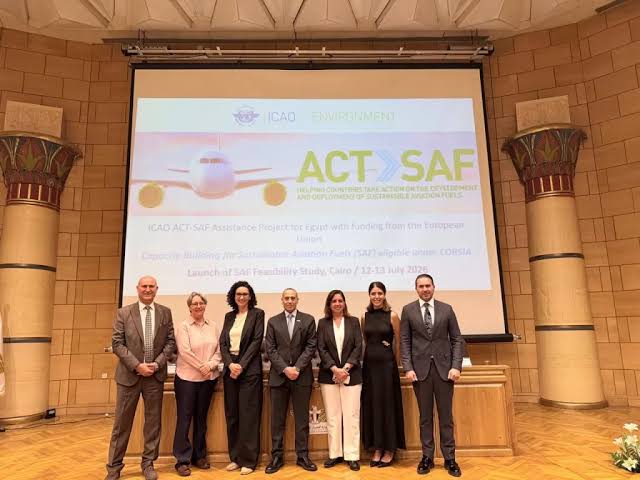
Egypt has launched its first national feasibility study on the production and use of sustainable aviation fuel (SAF), marking a significant step in the country’s efforts to position itself within the emerging global low-carbon aviation economy. The initiative, led by Egypt’s Ministry of Civil Aviation, aims to assess the country’s technical, economic and resource potential for developing a domestic SAF industry while creating a roadmap aligned with the International Civil Aviation Organization’s (ICAO) decarbonisation framework. The move comes as governments and investors worldwide intensify efforts to secure future aviation fuel supplies amid tightening climate regulations and growing pressure to reduce emissions from one of the world’s hardest-to-abate sectors.
The feasibility study was officially launched through a technical workshop convened by the Ministry of Civil Aviation, bringing together government agencies, aviation stakeholders and technical experts to define the scope of the assessment. According to the ministry, the exercise will evaluate Egypt’s feedstock availability, production capacity, infrastructure requirements, financing needs and market opportunities while identifying policy measures necessary to support commercial-scale SAF production.
The initiative reflects the growing recognition that sustainable aviation fuel will become an increasingly important component of global aviation over the coming decades. Unlike conventional jet fuel derived from fossil resources, SAF is produced from renewable feedstocks including agricultural residues, municipal waste, used cooking oil, forestry by-products and synthetic fuels generated using renewable electricity. Depending on production pathways, SAF can reduce lifecycle greenhouse gas emissions by up to 80% compared to conventional aviation fuel, making it one of the aviation industry’s primary decarbonisation tools.
According to the International Civil Aviation Organization, international aviation currently contributes around 2% of global carbon dioxide emissions. While this proportion appears relatively modest, emissions are expected to increase significantly as passenger numbers continue to grow, particularly across developing regions including Africa. ICAO’s Long-Term Aspirational Goal seeks to achieve net-zero carbon emissions from international aviation by 2050, with SAF expected to account for the largest share of emissions reductions required to meet that objective.
According to the International Air Transport Association (IATA), global SAF production is projected to reach approximately 2.4 million metric tonnes in 2026. Despite representing a sharp increase compared to previous years, this would account for only about 0.8% of total global aviation fuel demand, highlighting the considerable supply gap facing airlines as regulatory requirements tighten.
For Egypt, developing a domestic SAF industry extends beyond climate commitments. It represents part of a broader economic diversification strategy aimed at strengthening industrial competitiveness, attracting foreign investment and positioning the country as a regional energy and logistics hub linking Africa, Europe and the Middle East. Egypt’s strategic geographic location, established refining capacity, extensive aviation infrastructure and growing renewable energy sector provide a foundation upon which a sustainable aviation fuel industry could potentially be built.
The initiative also aligns closely with Egypt Vision 2030, which identifies sustainable infrastructure, clean energy and industrial transformation as key pillars of national economic development. According to the Ministry of Civil Aviation, a successful SAF industry could diversify aviation energy supplies, reduce dependence on imported fossil fuels and enhance the competitiveness of Egypt’s aviation sector while supporting long-term climate objectives.
However, translating technical feasibility into commercial production will require overcoming significant economic and operational challenges. One of the most immediate constraints remains production cost. Industry estimates indicate that SAF currently costs between two and five times more than conventional jet fuel, creating financial pressures for airlines already operating under narrow profit margins and exposed to volatile energy markets.
Investment risk also remains considerable. Although global interest in SAF has expanded rapidly over the past decade, commercial deployment has lagged behind announcements. Industry data shows that of approximately 165 sustainable aviation fuel projects announced globally, only around 36 have progressed into active production. Many projects continue to face delays linked to financing constraints, technology readiness, feedstock availability and regulatory uncertainty.
These challenges are particularly relevant across Africa, where access to affordable finance, industrial infrastructure and specialised technologies remains uneven. While several African countries possess abundant biomass resources capable of supporting SAF production, converting those resources into commercially viable fuel requires substantial capital investment, long-term policy certainty and sophisticated supply chain development.
Egypt’s announcement also comes amid increasing competition across the continent. South Africa, Morocco, Kenya and Nigeria have each announced initiatives aimed at attracting investment into sustainable aviation fuel production as governments seek to capture emerging opportunities within the global energy transition.
South Africa benefits from an established synthetic fuels industry and advanced refining capabilities that could accelerate SAF deployment. Morocco is leveraging its rapidly expanding renewable energy sector to explore synthetic fuel production based on green hydrogen. Kenya is examining opportunities linked to agricultural waste and bio-based feedstocks, while Nigeria is evaluating how its existing petroleum infrastructure could support lower-carbon aviation fuels as part of broader energy transition strategies.
The emergence of multiple African SAF initiatives reflects a wider shift in how governments are approaching climate policy. Rather than viewing decarbonisation solely as an environmental obligation, policymakers increasingly regard clean energy industries as potential drivers of industrialisation, export growth, technology transfer and job creation.
For Africa, the implications extend beyond aviation itself. Establishing domestic SAF production could stimulate new agricultural value chains, encourage investment in waste management systems, strengthen renewable energy markets and create opportunities for regional manufacturing and logistics industries. Countries capable of producing internationally certified SAF may also improve their competitiveness as global airlines increasingly seek secure and diversified fuel supplies to comply with emerging emissions regulations.
At the same time, policymakers will need to balance export ambitions with domestic development priorities. Feedstock sustainability, land use considerations, water availability and food security will remain important policy considerations as governments evaluate different production pathways.
Financing will ultimately determine the pace at which Africa’s sustainable aviation fuel ambitions progress. According to industry analysts, scaling global SAF production sufficiently to meet future demand will require hundreds of billions of dollars in investment over the coming decades, alongside supportive public policies, carbon pricing mechanisms, production incentives and long-term offtake agreements between producers and airlines.
Egypt’s feasibility study therefore represents an important first step rather than a guarantee of commercial success. The findings will help determine whether the country’s resource base, industrial capabilities and investment climate can support a competitive SAF industry capable of serving domestic airlines while participating in rapidly expanding international markets.
As international aviation accelerates its transition toward lower-carbon fuels, the decisions made today by African governments could shape the continent’s position within one of the world’s fastest-growing clean energy industries. For Egypt, the study provides an opportunity to assess whether strategic planning, policy coordination and targeted investment can translate emerging global demand into long-term industrial and economic gains while supporting both national development objectives and international climate commitments.


