


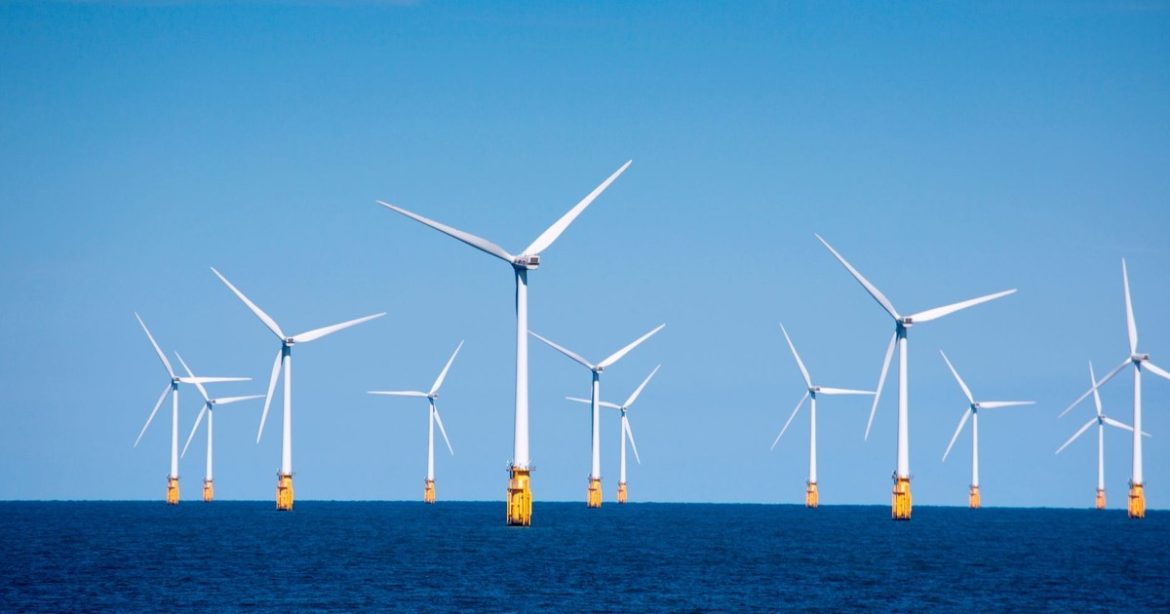
Egypt is expanding renewable-energy generation and water-reuse infrastructure as it seeks to strengthen energy and water security, attract investment and reduce exposure to climate and resource pressures, with wind-power capacity rising 16.3% to 2,199 megawatts in 2024 and water-treatment and reuse projects reaching annual capacity of about 4.8 billion cubic metres, according to a new Egyptian government report. The figures point to a transition increasingly tied to infrastructure, industrial competitiveness and public-resource management rather than environmental policy alone.
The increase in wind capacity represents an addition of 309MW from 1,890MW in 2023, according to the Cabinet Media Centre’s report, Prospects for Green Development in Egypt: Challenges and Solutions. Egypt has set a target of raising renewable energy’s share of electricity generation to more than 42% by 2030 and above 60% by 2040.
 The expansion comes as Egypt faces a more complex energy equation. Electricity demand is rising alongside population growth and industrial activity, while the government is seeking to reduce the fiscal and economic pressures associated with energy imports and improve the reliability of domestic supply. Renewable generation offers a route to diversify the power mix, but its expansion requires significant investment in generation, transmission and grid management.
Egypt has already established a substantial renewable-energy base through projects such as the Benban Solar Complex in Aswan, which became operational in 2019. The country has also attracted international capital into large wind projects, including a 1.1GW Gulf of Suez project that secured $275 million in financing from international financial institutions in 2024.
The scale of the investment pipeline illustrates the role that private and development finance can play in Africa’s energy transition. Large renewable projects require significant upfront capital and long repayment periods, making financing conditions as important as the underlying availability of wind and solar resources. Egypt’s experience therefore reflects a broader continental challenge: renewable resources may be abundant, but converting them into reliable electricity requires bankable projects, transmission infrastructure, appropriate regulation and access to affordable capital.
Water presents an even more immediate constraint for Egypt. The Cabinet report said the country’s annual per-capita water share has fallen below 500 cubic metres, less than half the 1,000-cubic-metre threshold commonly used to define water poverty. The government is responding through wastewater treatment, agricultural drainage reuse, desalination and more efficient irrigation.
The reported 4.8 billion cubic metres of annual treatment and reuse capacity is therefore not simply an environmental investment. It is part of an economic strategy aimed at protecting agricultural production, urban development and industrial activity in a country where water availability directly affects food security and public infrastructure. Egypt’s agricultural drainage network and major treatment facilities are increasingly being used to recycle water for productive purposes.
The water challenge also demonstrates why climate policy in Africa increasingly intersects with fiscal planning. Expanding water infrastructure requires substantial public and private investment, while failing to address shortages can impose higher costs through declining agricultural productivity, pressure on municipal systems and greater dependence on alternative sources such as desalination.
Egypt’s response is consequently based on a combination of infrastructure expansion and resource efficiency. The government has also spent about 4.2 billion Egyptian pounds protecting 210 kilometres of coastline from erosion and rising seas, according to the Cabinet report. Such expenditure reflects the growing costs of climate adaptation for coastal economies, particularly those with large urban populations and valuable tourism and industrial assets concentrated near the coast.
Read also: https://english.ahram.org.eg/UI/Front/Inner.aspx?NewsContentID=575303
The country’s green-transition programme extends beyond energy and water. Egypt has expanded electric public transport through metro, monorail, light rail, high-speed rail and bus rapid transit systems, while industrial programmes increasingly focus on pollution reduction, low-carbon hydrogen and the development of a regulated voluntary carbon market. Waste-management infrastructure has also expanded, with 29 sanitary landfills and 19 fixed transfer stations completed and delivered across several governorates in 2024.
For businesses, however, the transition is becoming increasingly connected to international market conditions. The European Union’s Carbon Border Adjustment Mechanism became fully operational in January 2026, creating additional pressure on exporters of carbon-intensive goods. Egypt’s Institute of National Planning has warned that carbon-border measures could affect the competitiveness of exports such as fertilisers unless producers improve energy efficiency, use cleaner electricity and establish reliable systems for measuring emissions.
That development is significant beyond Egypt because the EU is a major trading partner for many African economies. As carbon-related trade requirements become embedded in international markets, companies across the continent may increasingly need to demonstrate the emissions performance of their products. Sustainability data, energy efficiency and emissions measurement could therefore become commercial requirements rather than voluntary corporate disclosures.
Egypt’s response includes the development of a voluntary carbon market and a sustainable-finance framework. The Central Bank of Egypt began developing a sustainable-finance taxonomy in August 2025 to establish common criteria for identifying environmentally and socially sustainable activities. The objective is to give financial institutions and investors greater clarity about which activities qualify for sustainable finance and to improve the ability to channel international climate capital towards verified projects.
The financing challenge remains significant. According to the government report, many climate and sustainability projects require large initial investments and long repayment periods, while private-sector participation remains below what is needed to accelerate the transition. The government has therefore identified greater private investment, technology transfer and cooperation with international financial institutions as important components of the next phase.
This financing question is central to Africa’s broader transition. African governments face competing demands on public budgets, including debt servicing, infrastructure, healthcare, education and energy access. Climate and sustainability investments must therefore increasingly demonstrate economic value, whether through lower energy costs, improved water security, greater export competitiveness or reduced exposure to climate-related losses.
Egypt’s experience also highlights the importance of integrating policies that are often treated separately. Energy production affects water availability; water security affects agriculture; agriculture affects food imports and foreign exchange; and industrial energy use increasingly affects access to export markets. The government’s Nexus on Water, Food and Energy platform was established in 2022 partly to connect these areas and mobilise grants, concessional finance, debt instruments and private capital around investable projects.
The approach has relevance across Africa, where climate and development pressures frequently overlap. Countries facing electricity shortages may simultaneously be dealing with water stress, food insecurity, urbanisation and limited fiscal space. Treating these challenges as separate investment categories can make it harder to identify projects that deliver multiple economic benefits.
There are also limits to what renewable generation alone can achieve. Wind and solar capacity can increase electricity supply, but integrating variable generation into national grids requires transmission investment, storage, system balancing and effective electricity-market regulation. The development of large renewable projects therefore places additional demands on institutions responsible for planning and managing national power systems.
Technology and local capacity are another constraint. Egypt’s government report calls for faster technology transfer and localisation, more efficient use of natural resources and stronger institutional and human capacity to implement and monitor climate policies. For African economies, the ability to develop domestic engineering, manufacturing, project-management and technical capabilities could determine how much of the economic value generated by the green transition remains within national economies.
The same consideration applies to employment. Renewable-energy projects, water infrastructure, electric transport and waste management can create demand for construction, engineering and technical services, but the quality and durability of those economic benefits depend on local supply chains and workforce capabilities. Without domestic capacity, a significant proportion of investment can continue to flow towards imported equipment and external expertise.
For Egypt, the immediate challenge is therefore not simply increasing the number of green projects. The Cabinet report itself calls for a shift from a proliferation of individual initiatives towards greater integration and more systematic measurement of their economic and environmental impact.
That distinction is important for Africa’s wider sustainability agenda. Renewable-energy capacity, water-treatment facilities and green-finance instruments are useful indicators of transition, but their development value ultimately depends on whether they improve the resilience and productivity of the underlying economy.
Egypt’s experience shows how closely sustainability is becoming tied to economic security. Renewable power is being developed alongside water reuse, transport electrification, industrial decarbonisation and climate adaptation because each addresses a different source of economic exposure. The investments also show the increasing role of private capital and international financial institutions in sectors once dominated almost entirely by public spending.
 The country’s progress nonetheless comes with substantial financing, technology and implementation requirements. For Egypt and other African economies, the next stage of the green transition will depend less on announcing individual projects than on building financial systems, infrastructure networks and institutional capacity capable of sustaining them.
As Africa confronts rising energy demand, water stress and exposure to climate-related disruption, Egypt’s experience offers a practical illustration of the economics of transition: renewable energy can diversify power supply, water reuse can protect scarce resources, and cleaner industrial production can help preserve access to international markets. But delivering those outcomes at scale will require capital, credible regulation, stronger measurement systems and closer integration between climate policy and mainstream economic planning.


