


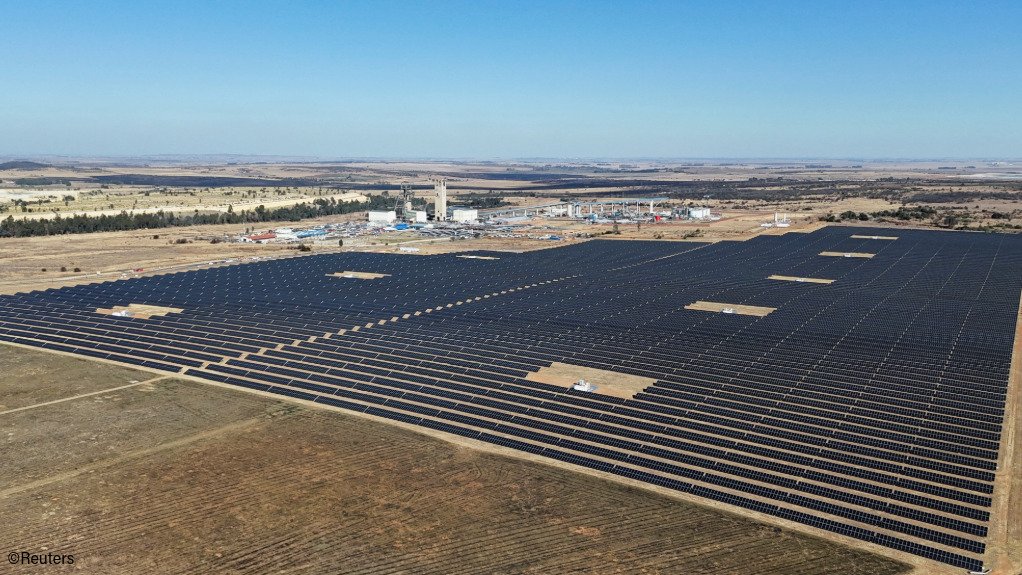
South Africa’s mining companies are accelerating investment in wind and solar power as they seek to reduce dependence on state utility Eskom, manage electricity costs and cut emissions, marking a shift in how one of the country’s most energy-intensive industries is managing both operational and climate risk. Anglo American, Sibanye-Stillwater and coal producer Exxaro are among companies expanding renewable-energy portfolios, while the broader move is being driven by persistent pressure on South Africa’s electricity system and the growing commercial importance of lower-carbon power.
The shift reflects a change in the economics of energy for mining companies. Eskom remains central to South Africa’s electricity system, but years of operational problems, ageing infrastructure and historically unreliable supply have encouraged large industrial users to seek alternatives. Reuters reported that Eskom still supplies more than 80% of South Africa’s electricity, most of it generated from coal, making the diversification of power supply a significant development for an industry whose operations depend heavily on continuous electricity.
 Anglo American has taken one of the more substantial approaches through Envusa Energy, its joint venture with EDF power solutions. The venture’s Koruson 2 cluster combines 240 megawatts of solar and 280MW of wind capacity, giving it 520MW of generation. The projects are being connected to the national grid and supplying renewable electricity to mining operations including Kumba Iron Ore, De Beers and Valterra Platinum. Envusa has said it is building towards between 3GW and 5GW of renewable capacity across Southern Africa, while its current pipeline stands at about 1.5GW.
The structure is significant because it demonstrates how private investment can use South Africa’s existing electricity network to connect renewable generation with large industrial consumers. Under the wheeling model, power generated in the Northern and Eastern Cape can be transmitted through Eskom’s grid to participating mines under long-term agreements. The Koruson projects are connected through a 400-kilovolt transmission substation capable of connecting up to 1.5GW of renewable generation.
For mining companies, the rationale extends beyond carbon accounting. Electricity is a major operating cost, particularly for deep underground mines where ventilation, pumping, processing and material handling require substantial and continuous power. The availability of renewable electricity can therefore influence operating margins, energy-security planning and exposure to future electricity-price increases.
Reuters reported that Envusa estimates wind and solar power could be between 20% and 30% cheaper than conventional electricity in some circumstances, while Sibanye-Stillwater expects its renewable-energy portfolio to deliver cost benefits alongside emissions reductions.
Sibanye has chosen a somewhat different model, relying primarily on power-purchase agreements rather than owning all of the generation assets itself. The company has contracted 835MW of renewable capacity, of which 164MW was operational at the time of Reuters’ report, and expects renewable sources to provide about 64% of electricity demand at its South African operations by 2028. Its platinum-group metals and gold operations remain heavily dependent on Eskom, making diversification a significant component of its energy strategy.
Coal producers are also entering the renewable-energy market, creating an unusual overlap between the country’s legacy energy economy and its emerging low-carbon system. Exxaro, one of South Africa’s major coal producers, operates renewable assets through its Cennergi subsidiary. Its renewable-energy capacity has grown to 297MW, with another 593MW in its near-term pipeline, while the company is targeting 1,600MW of net installed renewable capacity by 2030.
At its Grootegeluk Coal Mine in Limpopo, Exxaro has commissioned a 68MW solar facility as part of that strategy. The R1.7 billion project covers 185 hectares and is expected to generate about 176GWh of electricity annually, supplying roughly 30% of the mine’s electricity requirements. The company has said the project is expected to reduce grid dependence and lower electricity costs while supporting its longer-term decarbonisation strategy.
The significance of these investments is particularly clear in the context of South Africa’s industrial electricity system. Mining remains a major contributor to exports, foreign exchange earnings, employment and tax revenues, but its competitiveness depends partly on the reliability and cost of energy. Disruptions to electricity supply can reduce production, delay investment and increase operating costs, while higher tariffs can affect the economics of marginal mining operations.
Renewable generation therefore offers mining companies a way to address two risks simultaneously: the financial risk associated with electricity and the regulatory and market risks associated with carbon emissions. International mining companies increasingly face pressure from investors, customers and regulators to reduce emissions across their operations and supply chains. For exporters, lower-carbon production can also become relevant to market access as international buyers place greater emphasis on the emissions associated with raw materials.
The shift is also changing the relationship between mining companies and South Africa’s electricity infrastructure. Historically, large mines were major customers of the national utility. Increasingly, they are becoming investors, offtakers and participants in privately developed electricity infrastructure. This could provide additional capital for renewable generation and transmission, although the resulting system will still depend on the national grid for balancing and reliability.
That dependence remains an important constraint. Renewable power is variable, while mines often operate continuously. Solar generation declines after daylight hours and wind output fluctuates, creating a need for storage, grid balancing or other sources of firm power. Reuters reported that mining executives continue to regard Eskom’s baseload electricity as important while battery-storage technology develops.
This means that renewable investment should not be interpreted as an immediate replacement for South Africa’s existing electricity system. Instead, the emerging model is one of diversification, in which private renewable generation increasingly sits alongside grid electricity, storage and other technologies.
The development also exposes one of South Africa’s central energy-transition challenges: expanding renewable generation is only part of the task. Transmission infrastructure must be available to move electricity from areas with strong solar and wind resources to industrial centres. The private construction of the Koruson 400kV substation illustrates the scale of infrastructure required to connect new generation to demand. Envusa says the substation is designed to connect as much as 1.5GW of renewable capacity to the national grid.
Grid constraints could become increasingly important as more private developers compete for connection capacity. Exxaro’s 2026 results noted that South Africa has accelerated its renewable-energy transition through policy and market reforms, while private-sector offtake remains an important driver of new generation despite transmission constraints.
For government, the growing role of private industrial investment in electricity raises questions about how the benefits and costs of the transition are distributed. Mining companies can finance projects because they have relatively large and predictable electricity demand, but smaller manufacturers and businesses may have less capacity to negotiate long-term renewable-power agreements or finance their own generation.
There is also a regional dimension. South Africa’s mining industry is a significant source of demand for electricity and a major contributor to the economy, while the country possesses some of the continent’s strongest solar and wind resources. If private renewable projects can be developed at scale, they could create opportunities for new energy businesses, engineering services, construction, equipment supply and transmission infrastructure.
The local economic effects will depend on how projects are financed and implemented. Envusa says more than R70 million has been directed towards local economic activity and development initiatives around its projects, with community trusts also providing local participation in the assets. The broader question is whether such investment can generate durable economic opportunities in regions where mining and energy projects are changing the structure of local employment.
The transition also creates an important contradiction for coal producers. Companies such as Exxaro are investing in renewable energy while continuing to operate coal mines that supply South Africa’s power and industrial systems. Their approach reflects the practical difficulty of moving away from an energy source that remains economically important while building alternative revenue streams and electricity capacity.
For Africa more broadly, South Africa’s mining sector provides an example of how decarbonisation can increasingly be driven by commercial considerations rather than climate commitments alone. Across the continent, mines frequently operate in areas where national grids are weak or unreliable. Private generation, power-purchase agreements, mini-grids and renewable-storage systems could therefore become increasingly relevant to mining operations in countries where access to reliable electricity remains a constraint on production.
At the same time, the model requires substantial capital, bankable projects, predictable regulation and adequate transmission infrastructure. Without these conditions, renewable-energy ambitions can remain concentrated among the largest companies rather than becoming a wider source of industrial competitiveness.
South Africa’s mining sector is consequently becoming an important testing ground for the economics of the energy transition. The investments underway suggest that renewable electricity is increasingly being evaluated not simply as a means of reducing Scope 2 emissions, but as part of broader strategies for cost management, energy security and long-term competitiveness.
 The outcome will have implications beyond individual mining companies. If large industrial users can increasingly secure reliable power outside traditional utility structures, the model could help mobilise private capital into South Africa’s constrained electricity system. But it also reinforces the need for coordinated investment in transmission, storage and grid management so that private generation contributes to a more resilient electricity market rather than creating parallel systems accessible mainly to large corporate consumers.
For South Africa, the mining industry’s renewable shift is therefore both a corporate strategy and a signal of a wider structural change. The transition is beginning to reshape who generates electricity, who finances infrastructure and how industrial users manage energy risk. For an economy where mining remains closely linked to exports, employment and public revenue, the ability to make that transition without weakening industrial competitiveness will be an important measure of the country’s broader energy and economic transformation.


