


Ghana is expanding a government-backed cooperative mining model in an effort to formalise small-scale gold production and curb environmental damage, as authorities say about 8,900 hectares of forest reserves have been lost and 60% of the country’s water bodies are severely polluted, underscoring the economic and ecological cost of illegal mining in one of Africa’s largest gold-producing economies.
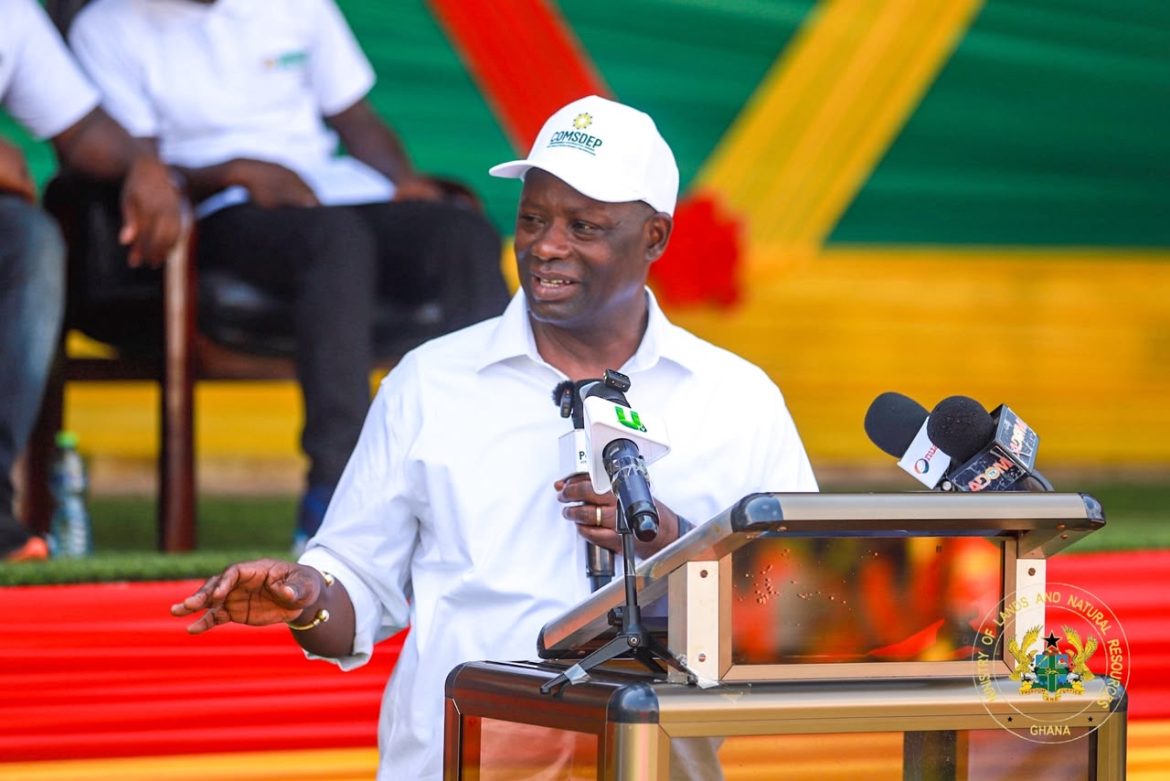
The government launched three responsible cooperative mining schemes in Kwahu West in the Eastern Region on November 26, with Lands and Natural Resources Minister Emmanuel Armah-Kofi Buah warning operators that mining in forest reserves and water bodies would not be tolerated. The initiative forms part of a broader attempt to move small-scale miners into regulated structures rather than relying primarily on enforcement against illegal operations.
According to the Ministry of Lands and Natural Resources, the government is not seeking to restrict mining itself but to contain illegal extraction and the associated destruction of forests and water resources. The cooperatives are expected to operate within designated concessions and comply with national mining and environmental requirements.
The approach is also being extended to Atiwa West, where newly established mining cooperatives received operating permits and were warned against expanding beyond approved concessions, particularly into forest reserves and water bodies. Authorities said the cooperatives would be monitored monthly for compliance.
The policy presents Ghana with a difficult test: whether formalization can reconcile the income and employment generated by small-scale gold mining with the mounting costs imposed by degraded forests, polluted rivers and weakened ecosystems.

Gold is central to Ghana’s economy, making a wholesale retreat from mining neither economically realistic nor fiscally straightforward. The challenge for policymakers is therefore increasingly one of governance: how to retain mining revenues, employment and local economic activity while preventing mineral extraction from imposing costs on water supply, agriculture, land restoration and communities.
The scale of reported environmental degradation makes that balance increasingly important. The government’s estimate that 60% of water bodies are severely polluted raises implications beyond biodiversity. Contaminated rivers can increase water-treatment requirements, constrain access to water for farming and households, and transfer part of the environmental cost of mining to utilities, public institutions and communities that are not directly benefiting from mineral extraction.
Forest degradation creates a parallel economic risk. Ghana’s reported loss of about 8,900 hectares of forest reserves linked to the broader mining challenge places additional pressure on ecosystems that support water catchments, agricultural landscapes and rural livelihoods.
The cooperative model attempts to address part of that problem by bringing miners into identifiable, licensed organizations whose operations can be monitored. In principle, concentrating activity within approved concessions can make enforcement of environmental standards easier than in a fragmented informal sector where operators may move between locations or work outside established regulatory systems.
Whether that produces better environmental outcomes will depend heavily on implementation. Monthly monitoring in Atiwa West provides authorities with a mechanism for identifying violations, but the effectiveness of the system will ultimately rest on inspection capacity, credible enforcement and the ability to prevent licensed operations from expanding into prohibited areas.
The government is also linking formalization with processing infrastructure. According to the ministry, Ghana is collaborating with the World Gold Council on plans for a mineral-processing facility intended to support the cooperatives in gold production.
That introduces a wider economic dimension. Formalizing production while improving access to processing could potentially allow more mineral value to pass through regulated domestic channels. But greater processing capacity without corresponding environmental controls could simply shift pressure elsewhere in the mining chain, particularly around water use, waste management and tailings.

Ghana’s experience has significance beyond its borders. Across Africa, artisanal and small-scale mining supports incomes and feeds international supply chains for gold and other minerals, while regulators face persistent difficulties controlling land degradation, water contamination and informal extraction.
Those tensions are likely to become more significant as international demand increases for African minerals used in energy, transport and digital infrastructure. Governments from the Democratic Republic of Congo and Zambia to Zimbabwe and Namibia are seeking to capture more value from mineral resources through domestic processing and industrial development. The development case for doing so is substantial, but so are the governance requirements when extraction overlaps with forests, river systems and agricultural communities.
For Ghana, the immediate question is therefore not simply whether mining cooperatives can replace illegal operations. It is whether formalisation can demonstrably change environmental outcomes while retaining the jobs, incomes and public revenues that make mining economically important.
The government’s figures on forest loss and water pollution show the cost of failing to make that transition. If cooperative mining is to provide a durable alternative, its measure of success will extend beyond the number of permits issued or miners registered to whether regulated production reduces encroachment into forests, improves protection of water bodies and makes environmental liabilities more visible and enforceable within Ghana’s gold economy.