


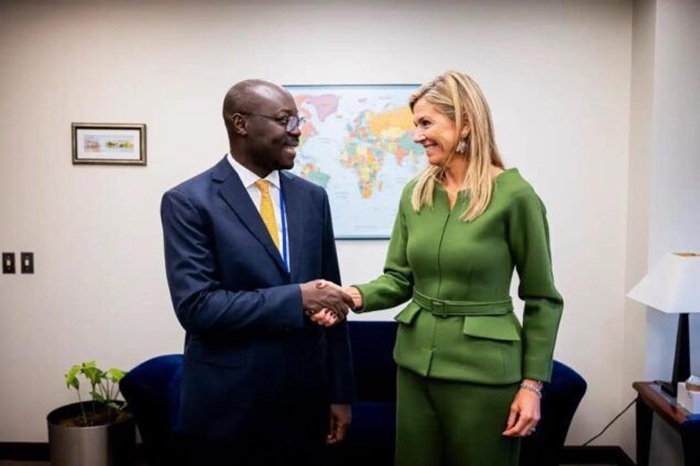
Ghana is repositioning financial health as a central component of its economic reform agenda, signalling a shift in development policy that seeks to measure economic progress not only through growth indicators but through the financial resilience and well-being of citizens. The approach was outlined by Finance Minister Dr. Cassiel Ato Forson following a high-level engagement in April 2026 with Queen Máxima of the Netherlands, the United Nations Secretary-General’s Special Advocate for Financial Health, as the government advanced its broader national economic reset strategy.
The discussions reflect an evolving policy direction in Ghana at a time when many African governments are reassessing how economic recovery, financial inclusion and social resilience intersect. According to Dr. Forson, the country’s reform agenda is increasingly focused on ensuring that macroeconomic stability translates into tangible improvements in household welfare, financial security and economic opportunity.
 The emphasis on financial health marks a departure from traditional approaches that have largely concentrated on expanding access to financial services. While financial inclusion remains an important objective, policymakers are increasingly recognising that access alone does not necessarily improve economic resilience. Citizens may hold bank accounts or access digital financial services while remaining vulnerable to income shocks, inflationary pressures, debt burdens or unexpected emergencies.
According to the Finance Minister, Ghana’s objective is to create an economic system that enables individuals and households to withstand financial disruptions, manage resources effectively and participate more fully in economic activity. The approach reflects a broader recognition that sustainable economic growth depends not only on national output and fiscal performance but also on the financial stability of citizens who drive consumption, entrepreneurship and investment.
The policy direction emerges against the backdrop of broader economic reforms aimed at restoring stability following periods of fiscal stress, debt restructuring and inflationary pressures that have affected several African economies in recent years. Across the continent, governments are increasingly confronting the challenge of translating macroeconomic recovery into improvements in living standards. In this context, financial health is gaining attention as a framework that links economic policy to household-level outcomes.
The engagement with Queen Máxima also highlights the growing international focus on financial well-being as a development priority. Financial health frameworks typically assess whether individuals can meet daily financial obligations, absorb economic shocks, pursue long-term goals and maintain confidence in their financial future. Such measures provide a more comprehensive assessment of economic inclusion than access-based indicators alone.
For Ghana, the implications extend beyond social policy. Stronger household financial resilience can support broader economic objectives by increasing savings, improving credit quality, encouraging productive investment and strengthening domestic demand. Financially secure households are generally better positioned to invest in education, health care and small businesses, creating multiplier effects that support economic growth and social stability.
The emphasis on human-centred economic policy also aligns with wider debates across Africa regarding the quality and inclusiveness of growth. Several African economies have recorded periods of robust economic expansion over the past two decades, yet challenges related to inequality, unemployment and financial vulnerability have persisted. Policymakers increasingly face pressure to ensure that economic gains are distributed more broadly and contribute to improved living standards.
According to Dr. Forson, economic performance should ultimately be evaluated through its impact on people’s lives rather than solely through aggregate indicators. This perspective reflects a growing policy trend that seeks to integrate social outcomes into economic planning and public finance management.
The strategy also carries implications for financial institutions. Banks, mobile money providers, insurers and other financial service providers may be expected to play a larger role in supporting financial resilience through products and services that are accessible, transparent and responsive to citizens’ needs. Strengthening financial literacy, consumer protection and digital financial infrastructure may become increasingly important components of the reform agenda.
From a development perspective, Ghana’s focus on financial health resonates with continental priorities under the African Union’s Agenda 2063, which emphasises inclusive growth, economic empowerment and resilient institutions. Building financial systems that support broad-based participation is increasingly viewed as essential to achieving sustainable development outcomes in a rapidly changing economic environment.
 The initiative also reflects a broader shift in how African governments are approaching economic transformation. As countries seek to build resilience against global economic shocks, climate-related disruptions and evolving labour market pressures, financial health is emerging as a governance and development issue rather than solely a banking or social policy concern.
For Ghana, the success of the reset agenda will depend not only on restoring macroeconomic stability but also on whether citizens experience greater financial security and economic opportunity. The growing emphasis on financial health suggests that future policy debates may increasingly focus on the relationship between economic growth, household resilience and long-term development outcomes, with implications that extend beyond Ghana to broader discussions on inclusive growth across Africa.


