


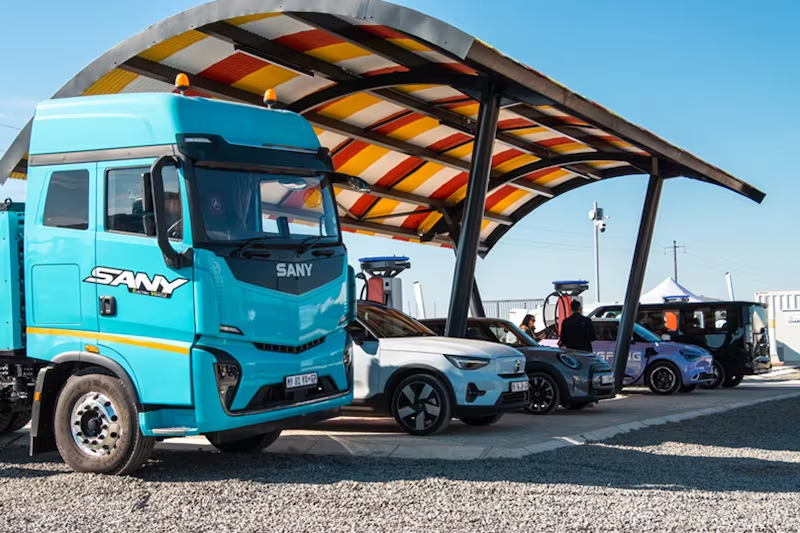
South Africa’s freight and commercial transport industry is moving toward a more operational approach to New Energy Vehicles (NEVs), with fleet operators increasingly assessing electric trucks and other low-carbon technologies on the basis of route economics, energy security, charging infrastructure and financing rather than emissions reductions alone. The shift, according to Andisiwe Nikelo, CEO of Fleet Management and Leasing at WesBank, reflects a broader change in how businesses are evaluating fleet decarbonisation as fuel-price volatility, electricity constraints and pressure to improve logistics efficiency reshape transport economics.
For South Africa, where road freight is central to the movement of goods between ports, industrial centres and inland markets, the implications extend beyond individual fleet decisions. The ability to electrify commercial transport at scale will depend on whether vehicle technology, charging networks, electricity supply, financing and operational data can develop together.
Fuel remains one of the largest operating costs for freight companies, making energy efficiency a significant consideration in fleet planning. Nikelo said NEVs could improve operating economics, particularly where vehicles are paired with renewable-energy systems that reduce exposure to electricity and fuel-price volatility.
The economics, however, differ substantially between short- and long-distance operations. Electric vehicles can be deployed more readily on predictable short-haul routes, while medium- and long-haul freight can involve journeys of between 500 and 2,000 kilometres. With many electric trucks currently offering ranges below 500 kilometres, charging requirements can affect vehicle utilisation and delivery schedules.
This has made charging time and infrastructure availability important commercial variables rather than simply technical considerations. Developments such as battery swapping are beginning to address some of the constraints by reducing the time vehicles spend stationary. Manufacturers including SANY have introduced battery-swapping technology, while Zero Carbon Charge has been developing charging infrastructure along major transport corridors such as the N3.
Some operators are also installing private charging facilities at depots and distribution centres, allowing charging schedules to be integrated into existing logistics operations. Such infrastructure can become particularly important for fleets with predictable routes and overnight dwell times, where vehicles can be charged without disrupting delivery cycles.
Renewable energy and battery storage are also emerging as part of the fleet transition. For businesses operating in an electricity system where reliability, availability and cost remain important considerations, combining charging infrastructure with alternative energy sources could influence the commercial viability of electrification.
Nikelo argues that the principal challenge is therefore less about whether electric vehicles can perform particular tasks and more about the complexity of redesigning fleet operations around them. Companies need to determine which vehicles are appropriate for specific duty cycles, how much charging capacity is required, whether their electricity supply can support that demand and how renewable generation or storage could alter the economics.
Operational data is becoming another component of this equation. Telematics can help fleet managers monitor vehicle performance, determine charging requirements and optimise routes and utilisation. This creates a more data-intensive approach to fleet management than the conventional vehicle-purchasing model, in which purchase price, payload, fuel consumption and maintenance costs have traditionally dominated decisions.
The financing model is also changing. Rather than treating an NEV as an isolated vehicle purchase, businesses are increasingly considering packages that combine vehicle finance with charging infrastructure, energy management, renewable generation and telematics. Financial institutions therefore have a role in assessing not only the value of the vehicle but also the operational risks surrounding its deployment.
Residual-value uncertainty is one such consideration as the commercial NEV market develops and battery technologies evolve. For fleet operators, uncertainty over the future value of vehicles can influence financing costs and replacement decisions. Specialist financing structures could therefore become an important mechanism for managing some of the risks associated with adopting relatively new technologies.
The infrastructure market faces a related challenge. Charging providers require sufficient vehicle volumes to justify investment, while fleet operators can be reluctant to commit to electric vehicles until adequate charging infrastructure exists. This creates a market coordination problem that could slow adoption if investment in vehicles and infrastructure does not develop at roughly the same pace.
Policy and regulatory certainty will also influence private investment. South Africa has made progress in establishing a framework for vehicle electrification and industrial development, but continued alignment between transport, energy and industrial policy will be important if private capital is to finance charging networks and associated infrastructure at scale.
The issue has wider implications for Africa’s logistics systems. Road freight is critical to regional trade, connecting ports with manufacturing centres, agricultural producers, mines and consumer markets. High transport costs and unreliable logistics can affect the competitiveness of African exports and raise the cost of goods across domestic markets. Improvements in fleet energy efficiency could therefore have economic effects beyond individual companies, particularly where they reduce exposure to volatile fuel costs.
At the same time, electrifying freight cannot be separated from the continent’s broader energy constraints. Commercial vehicles require reliable charging capacity, while charging networks require adequate electricity generation, transmission and distribution infrastructure. In markets where electricity supply remains constrained, the transition to electric freight could shift some energy costs from liquid fuels to the power system rather than eliminate them.
This makes renewable energy, battery storage and grid investment important components of transport policy. It also creates potential opportunities for collaboration between fleet operators, vehicle manufacturers, energy companies, infrastructure providers, financial institutions and governments.
Development finance institutions and public-private partnerships could play a role in reducing the initial risks associated with charging infrastructure and other enabling technologies. Blended finance could be particularly relevant where infrastructure has high upfront costs but wider economic benefits that are difficult for individual operators to capture.
For South Africa, the emerging NEV market also intersects with the country’s industrial policy ambitions. Greater demand for electric commercial vehicles, charging equipment, batteries and associated services could create opportunities for local manufacturing, technical skills development and new supply chains, provided the policy environment supports investment and competitiveness.
The transition is unlikely to follow a single model across the freight sector. Vehicle choice will depend on route length, payload, charging access, electricity costs, vehicle utilisation and financing conditions. In some applications, conventional vehicles may remain commercially appropriate, while electric or other new-energy technologies could be more viable in predictable, high-utilisation routes.
 That distinction is increasingly important as companies move from broad sustainability commitments toward decisions based on measurable operational and financial outcomes. For fleet operators, the question is no longer simply whether NEVs are environmentally preferable, but where they can improve the economics and resilience of the logistics system.
For South Africa and other African economies, that shift could make the transport transition more commercially grounded. But its success will depend on whether infrastructure, energy systems, finance, technology and regulation develop alongside vehicle adoption. The emerging lesson is that decarbonising freight is not solely a vehicle replacement exercise; it is an investment decision involving the wider architecture of Africa’s logistics and energy economies.


