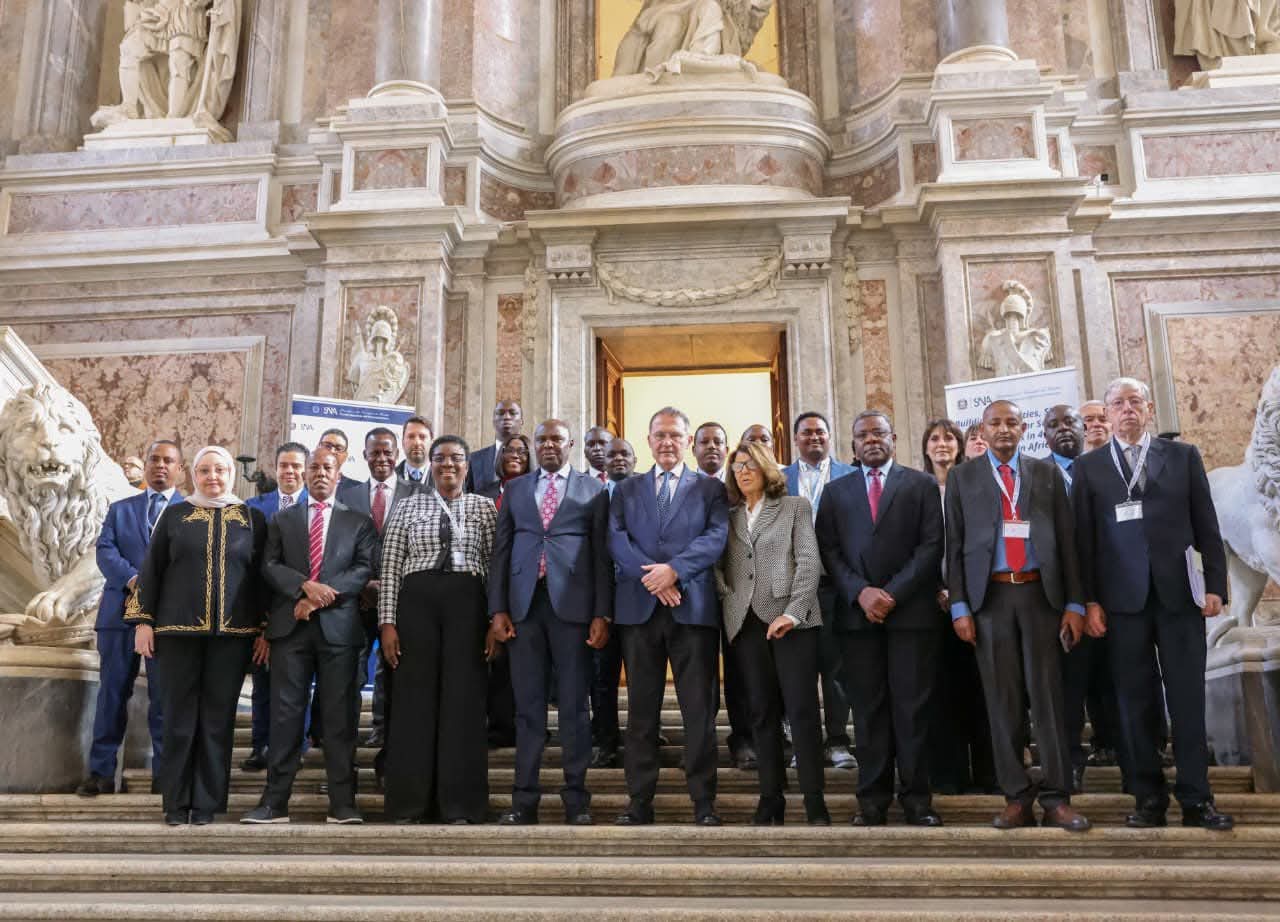

Kenya and Italy have formalised a cooperation framework to strengthen public service leadership, governance reform programming and institutional capacity building, bringing together the Kenya School of Government and the Italian National School of Administration under a structured partnership aligned with Rome’s Mattei Plan.
The initiative was announced by Kenya’s Head of Public Service Felix Koskei during a keynote address at the Royal Palace of Caserta, at the launch of a capacity-building programme for senior officials from Kenya, Côte d’Ivoire, Ethiopia and Tunisia.
The programme is designed to strengthen leadership competencies, policy-oriented research and institutional performance within public administrations, at a time when African governments are under pressure to deliver fiscal consolidation, manage debt burdens and implement complex climate and development reforms. According to officials involved in the discussions, the collaboration will focus on professional standards, ethics systems, performance management and administrative resilience.
Koskei used the forum to outline Kenya’s ongoing public service reform agenda, which places emphasis on integrity systems, professionalisation and embedding reforms within institutional culture rather than relying solely on policy pronouncements. He said Kenya was making deliberate investments to align administrative capacity with the demands of inclusive growth and public accountability.
For Kenya, the partnership comes against a backdrop of heightened scrutiny over public spending, debt sustainability and the efficiency of state institutions. Public service reform has become central to fiscal management, as weaknesses in procurement systems, project execution and regulatory oversight can translate directly into cost overruns, stalled infrastructure and erosion of investor confidence.
Strengthening leadership capacity at senior levels is therefore framed not as an abstract governance goal, but as a mechanism to improve budget credibility, service delivery and implementation of economic policy.
Italy’s Mattei Plan, under which the engagement is taking place, seeks to redefine Africa–Europe relations around structured institutional partnerships rather than short-term aid flows. The plan prioritises energy, infrastructure, education and institutional development. In practice, cooperation with African public administration schools signals an effort to build long-term state capacity that can underpin investment partnerships, including in energy transition and industrial development.
For African countries participating in the programme, the implications extend beyond training modules. According to governance specialists, institutional performance gaps remain a structural constraint on growth across parts of the continent. Weak coordination between ministries, limited policy continuity and gaps in technical expertise can slow the rollout of climate adaptation plans, digital transformation strategies and public–private partnership frameworks.
In countries seeking to expand renewable energy capacity or modernise transport systems, administrative bottlenecks can delay projects and increase financing costs.
Kenya’s own reform trajectory reflects these tensions. The government has committed to improving revenue mobilisation, digitising public services and strengthening anti-corruption frameworks. Each of these objectives depends on leadership capacity within ministries and agencies to translate policy into operational systems.
The Kenya School of Government has increasingly positioned itself as a vehicle for mainstreaming these competencies across national and county administrations.
Regionally, the inclusion of officials from Côte d’Ivoire, Ethiopia and Tunisia highlights a broader push to harmonise public sector standards across African economies engaging more deeply with European partners.
As trade, climate finance and investment frameworks grow more complex, governments are required to navigate regulatory alignment, ESG disclosure requirements and performance-based financing conditions. Administrative preparedness can influence access to concessional funding and blended finance instruments.
Read also: Ethiopia secures $130m EIB loan to expand rural finance and support small enterprises
The collaboration also carries diplomatic weight. Italy has sought to deepen its economic footprint in Africa, particularly in energy and infrastructure, while African governments have called for more balanced partnerships that emphasise skills transfer and institutional strengthening. Structured cooperation between public administration schools provides a platform for policy dialogue that may outlast electoral cycles and political shifts.
For Kenya, the partnership underscores an acknowledgement that governance capacity is central to economic resilience.
Engage with us on LinkedIn: Africa Sustainability Matters