


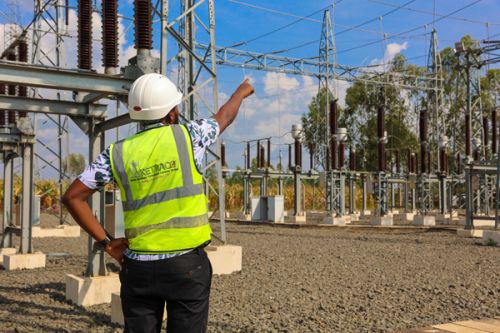
Kenya has opened a new phase in the expansion of its electricity transmission network after private investors submitted proposals for four high-voltage transmission projects valued at up to US$500 million, as the country seeks to strengthen grid reliability, support industrial development and meet rising electricity demand.
The proposals, submitted to the Kenya Electricity Transmission Company (KETRACO), represent a growing shift towards private-sector participation in large-scale energy infrastructure development. The projects are part of Kenya’s long-term transmission expansion strategy under the 2025-2044 Transmission Master Plan, which aims to modernise the national grid and improve electricity connectivity across key economic regions. KETRACO opened the proposals on 7 July 2026 during a mandatory public review process required under Kenya’s Public-Private Partnerships Act of 2021. The submitted consortium comprises Pabari Investment Limited, ENCOMM Power Rental Solutions Limited and AEE Power Ventures S.L.

The proposed projects would expand high-voltage transmission infrastructure in Mutomo and Voi in southeastern Kenya, Taveta near the Tanzanian border, Maralal in northern Kenya and Kilgoris in the southwest. The combined investment requirement is estimated at between 50 billion and 65 billion Kenyan shillings, equivalent to approximately US$385 million to US$500 million. However, KETRACO has emphasised that the publication of the proposals does not constitute final approval. The projects will undergo technical, financial and legal assessments, alongside stakeholder consultations and negotiations before any investment decisions are concluded.
The review process also remains open to competition, with KETRACO inviting additional private investors to submit expressions of interest within 21 days. The approach reflects Kenya’s broader effort to leverage private capital to accelerate infrastructure development while managing public financing constraints. The projects are expected to be completed between the 2028/29 and 2030/31 financial years, depending on approvals and implementation timelines. For Kenya, strengthening transmission infrastructure has become increasingly important as electricity demand rises alongside economic growth, urbanisation and industrial expansion. While the country has expanded generation capacity, particularly through geothermal, wind and solar energy investments, weaknesses in transmission infrastructure have limited the ability to efficiently deliver electricity to growing demand centres.
The challenge is highlighted in KETRACO’s Transmission Master Plan, which identifies significant gaps in the country’s electricity network. According to the plan, peak electricity demand reached 2,239 megawatts (MW), but existing transmission capacity remains under pressure, particularly in regions experiencing accelerated industrial activity. Reliable transmission networks are essential for ensuring that new generation capacity translates into economic benefits. Without sufficient grid infrastructure, electricity projects can face evacuation challenges, while businesses and industries may experience supply constraints that affect productivity and investment decisions.
The latest proposals come as Kenya continues to expand its electricity infrastructure through public-private partnerships. In December 2025, KETRACO signed its first PPP agreement, a US$311 million project with Africa50 and Power Grid Corporation of India to develop two high-voltage transmission lines. The agreement marked a significant milestone in Kenya’s efforts to attract private financing into electricity infrastructure, an area traditionally dominated by public investment. Kenya’s transmission expansion plans are closely linked to its broader economic development agenda, particularly Vision 2030, which identifies infrastructure development as a foundation for industrialisation and competitiveness.
A recent example of this strategy was the commissioning of the 400-kilovolt Isinya-Konza transmission line, which connects the national grid to Konza Technopolis, a flagship smart city project located approximately 60 kilometres southeast of Nairobi. During the commissioning ceremony in June, Acting KETRACO Managing Director Kipkemoi Kibias said the infrastructure would strengthen Kenya’s ability to attract investment, support industrial growth and advance the objectives of Vision 2030. The expansion of transmission capacity is also important as Kenya increases its renewable energy deployment. The country generates a significant share of its electricity from renewable sources, including geothermal, wind, hydro and solar. However, renewable resources are often located far from major demand centres, requiring stronger transmission networks to transport electricity efficiently.
Beyond national energy security, improved transmission infrastructure could strengthen regional electricity trade. Kenya is already involved in regional power integration initiatives, including the Ethiopia-Kenya-Tanzania electricity interconnection project, which aims to improve cross-border electricity exchange within East Africa. Regional power trading has been identified as an important pathway for reducing energy costs, improving reliability and allowing countries to utilise diverse generation resources more effectively. However, financing large-scale transmission infrastructure remains a challenge across Africa. Transmission projects typically require significant upfront investment, long development periods and strong regulatory frameworks. Private investors often seek clear revenue structures, reliable counterparties and government support mechanisms before committing capital.

https://www.aecweek-registration.com/2026/
Kenya’s increasing use of PPP models reflects an attempt to overcome these barriers by combining public oversight with private sector financing and expertise. According to KETRACO’s 2023-2042 development plan, Kenya requires nearly 5,700 kilometres of additional transmission lines over the next two decades, expanding the national grid to approximately 9,600 kilometres. Meeting this target will require sustained investment, effective project management and coordination between government agencies, utilities, investors and development partners.
The proposed US$500 million transmission pipeline represents another step in Kenya’s effort to build a more resilient electricity system capable of supporting economic growth. As demand continues to rise, the country’s ability to expand and modernise its grid will increasingly determine whether new energy investments can deliver their full economic impact. For Kenya’s industrial ambitions, the priority is shifting from simply generating more electricity to ensuring that power can move efficiently across the country to where businesses, communities and emerging economic centres need it most.


