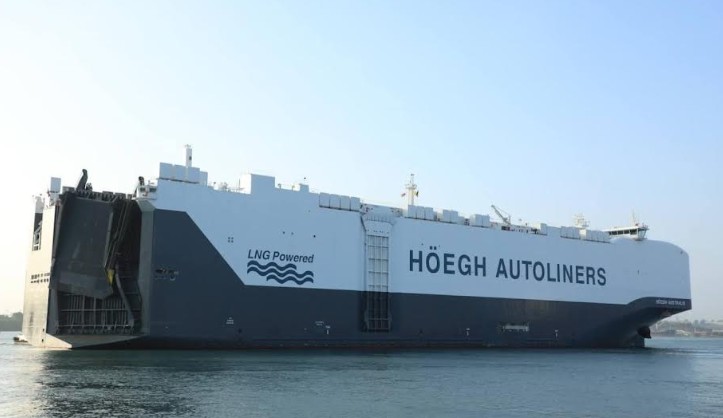

On the 26th of December, as cargo operations resumed along Kenya’s Indian Ocean shoreline, a Norwegian-flagged vessel eased into berth number one at the Port of Mombasa after an 11-day voyage from Singapore.
The ship, Höegh Australis, is powered almost entirely by liquefied natural gas, making it the first LNG-fuelled vessel ever to dock at an East African port. Its arrival marked a technical milestone for Kenya Ports Authority and a symbolic moment for a region whose trade arteries have long depended on some of the world’s most carbon-intensive fuels.

The Höegh Australis is a roll-on, roll-off vehicle carrier measuring 200 meters in length and nearly 38 metres across, with space for more than 9,300 vehicles spread over 16 decks. On this call, it discharged 824 vehicles and accessories destined for Kenya and neighboring landlocked markets that rely on Mombasa as their primary maritime gateway, including Uganda, Rwanda, South Sudan and parts of eastern Democratic Republic of Congo.
The scale of the vessel alone would be notable in any port. That it arrived running on 98 per cent LNG, using conventional bunker fuel only during engine start-up and limited manoeuvres, is what set this visit apart.
LNG-powered ships require different handling protocols, specialized safety procedures and crews familiar with advanced navigation and propulsion systems. The successful berthing demonstrated that Mombasa can meet these demands, an important signal to global shipping lines assessing which African ports are ready for the next phase of maritime transport.
International shipping is under pressure to change; The sector accounts for roughly three per cent of global carbon dioxide emissions, according to the International Maritime Organisation, and new IMO regulations require deep cuts in sulphur oxides, nitrogen oxides and particulate matter. Heavy fuel oil, the industry’s traditional mainstay, is among the dirtiest fuels in commercial use.
LNG does not eliminate emissions, but it reduces sulphur oxides and particulate matter almost entirely, cuts nitrogen oxides by up to 85 per cent and lowers carbon dioxide emissions by roughly 20 per cent compared to conventional marine fuels. For port cities such as Mombasa, Lagos and Durban, where shipping emissions mix with urban pollution, these reductions translate directly into cleaner air.
Globally, more than 1,200 LNG-capable vessels are now in operation or on order, a number that has more than doubled over the past five years. African ports, however, have lagged in accommodating them. South Africa’s Durban and Ngqura ports have invested in shore-side efficiency and cleaner equipment but have yet to see regular LNG vessel calls.
Read also: Nigeria’s maritime landscape shifts as Lekki Port records $9.3bn in cargo
In West Africa, Nigeria has explored LNG bunkering given its gas reserves, yet infrastructure development has been slow. North African ports such as Tangier Med have moved faster on efficiency and automation, but LNG adoption remains limited. Against this backdrop, Mombasa’s ability to receive Höegh Australis places it among a small group of African ports demonstrating readiness for lower-emission shipping.
The ship itself reflects how the industry is hedging its future. Built just a year ago, Höegh Australis is designed to be ammonia-ready, meaning it can be converted to run on zero-carbon fuels once safety standards, supply chains and port infrastructure catch up.
Ammonia-fuelled vessels have begun limited service in parts of Asia and Europe, but costs remain high and global bunkering networks are fragmented. For now, LNG serves as a bridge fuel, allowing shipping companies to meet tightening regulations while buying time for truly carbon-free options to mature.
For Kenya, the implications extend beyond environmental credentials. The Port of Mombasa handles more than 30 million tonnes of cargo annually and supports trade flows worth billions of dollars across East and Central Africa. Shipping efficiency affects everything from vehicle prices in Kampala to food costs in Kigali.
LNG-powered vessels are typically newer, larger and more fuel-efficient, enabling carriers to move more cargo per voyage at lower operating costs. Over time, this can translate into more competitive freight rates and more reliable services for African importers and exporters.

Kenya Ports Authority has framed the call within its Green Port Policy, which aligns with national clean energy objectives and Kenya’s broader climate commitments. In recent years, KPA has invested in electric rubber-tyred gantry cranes, energy-efficient lighting and digital traffic management to reduce congestion and emissions within the port.
According to KPA data, operational efficiency improvements have already cut vessel waiting times by more than 30 per cent over the past decade, reducing fuel burn at anchorage. Accommodating LNG vessels builds on these gains, shifting part of the emissions reduction upstream to the ships themselves.
Across Africa, ports are grappling with how to modernise under fiscal constraints while trade volumes continue to grow. The African Development Bank estimates that the continent needs more than $100 billion in port and logistics investment over the next decade to keep pace with demand. Sustainability is no longer a side consideration in that calculus.
European and Asian markets are beginning to factor shipping emissions into procurement decisions, and cargo owners are under pressure to decarbonise their supply chains. Ports that cannot service cleaner vessels risk being bypassed.
The arrival of Höegh Australis does not resolve these challenges, nor does it place Mombasa at the forefront of zero-carbon shipping. What it does show is that parts of Africa’s maritime system are beginning to adapt in step with global change rather than after it.
As LNG vessels become more common and alternative fuels edge closer to viability, the question for African ports will be how quickly isolated milestones become routine practice. On a quiet December morning in Mombasa, that transition moved from theory to steel, fuel lines and a ship safely alongside the quay.
Engage with us on LinkedIn: Africa Sustainability Matters
Engage with us on LinkedIn: Africa Sustainability Matters