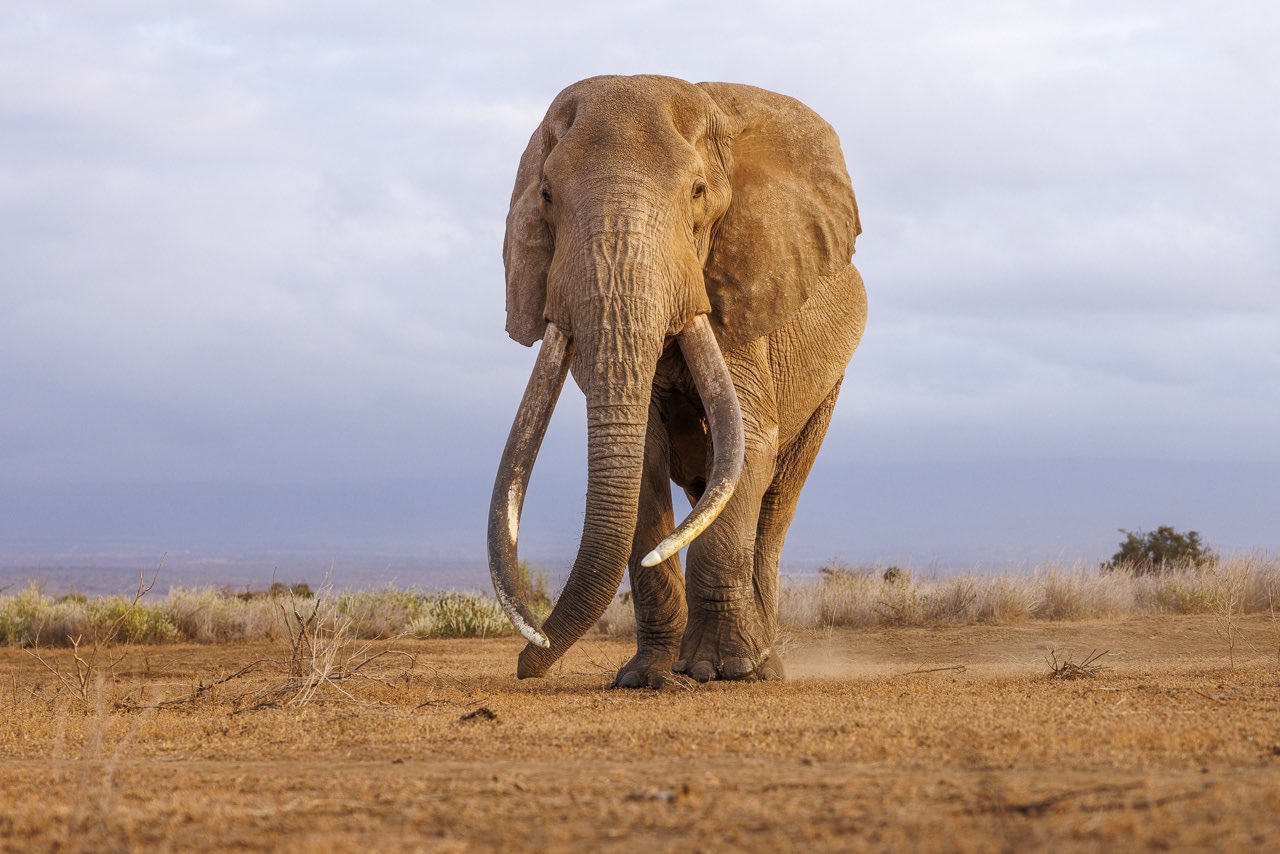

Craig, one of Africa’s last remaining super tuskers, died early on January 3, 2026, at Amboseli National Park in Kenya. The 54-year-old bull elephant, famed for his enormous tusks and calm demeanor, had lived under decades of protection by the Kenya Wildlife Service and local communities, making him a globally recognized symbol of wildlife conservation and a rare representative of a vanishing lineage of African elephants.

Legendary Amboseli Super Tusker Craig dies at 54: Kenya and Africa mourn iconic Elephant.
Born in January 1972 to Cassandra, a matriarch of the CB elephant family, Craig grew up at a time when elephants across East Africa were under severe threat from poaching. Super tuskers, defined by tusks weighing more than 45 kilograms each, were particularly targeted, and by the 1980s, tens of thousands of African elephants had been killed for ivory.

Kenya’s elephant population fell from over 160,000 in the early 1970s to fewer than 20,000 by the end of the decade. Craig’s survival through this period was the result of sustained protection measures, habitat management, and cooperation between wildlife authorities and local communities in Kajiado County, where Amboseli sits.
Craig’s tusks, sweeping the ground and weighing over 100 pounds each, made him instantly recognizable. But beyond his ivory, he was known for a remarkable temperament. Visitors, researchers, and filmmakers often observed him standing calmly as they approached, a behaviour unusual for male elephants of his age and size. This disposition not only facilitated scientific observation but also turned him into a living ambassador for Amboseli, projecting an image of African wildlife that combined majesty with gentle presence.
Read also: Elephants exited from South African zoos, sparking debate over access and conservation
Throughout his life, Craig contributed to the survival of his species through reproduction. He fathered multiple calves, passing on his genes and temperament to the next generation. Such individual contributions are particularly critical for super tuskers, as decades of selective poaching have altered elephant genetics across many African landscapes, with populations now skewed toward smaller tusks or tuskless individuals in some regions.
In countries like Mozambique and parts of southern Africa, the loss of large-tusked bulls has had measurable impacts on herd social structure and genetic diversity. Craig’s offspring, though a modest contribution on a continental scale, represent a tangible preservation of these rare traits.
Structured conservation strategies sustained Craig’s long life. Kenya Wildlife Service, together with conservation partners and local communities, maintained continuous monitoring, anti-poaching patrols, and habitat protection that allowed him to roam freely without the constant threat of human harm.
Read also: How Tanzania is using Nature-Based Solutions to secure the future of its Tourism industry
Amboseli National Park, covering roughly 392 square kilometres, is home to a high concentration of elephants, yet much of their range extends into community land and cross-border areas, exposing them to human-wildlife conflict. The elephant’s survival illustrates how combining state protection with local engagement can yield results even in landscapes under pressure from settlement, livestock grazing, and climate variability.

Legendary Amboseli Super Tusker Craig dies at 54: Kenya and Africa mourn iconic Elephant. Image source: Big Life Foundation
The elephant also became a figure in conservation finance and awareness campaigns. In 2021, East African Breweries Limited adopted Craig through its Tusker brand, highlighting the role of private-sector partnerships in supporting wildlife protection. Such arrangements are increasingly relevant across Africa, where wildlife agencies face funding shortfalls.
The African Development Bank estimates that the continent requires more than $700 million annually to secure protected areas, support anti-poaching operations, and maintain ecological corridors, resources that often exceed government budgets and donor contributions. Corporate partnerships, tourism revenue, and research funding can help fill that gap, as Craig’s example demonstrates.
Craig’s death has also been widely mourned online. Social media platforms across Kenya have been flooded with tributes, photographs, and personal stories, as citizens express grief over the loss of an animal many say symbolized the country’s natural heritage.
From heartfelt posts recalling sightings of the gentle giant in Amboseli to campaign messages emphasizing the importance of continued wildlife protection, the public outpouring reflects how Craig’s life transcended the park and became part of Kenya’s collective memory. Hashtags celebrating his legacy and calls to protect remaining elephants have trended, showing the power of digital spaces in shaping conservation awareness.
Craig’s death also highlights broader sustainability challenges. Elephant populations remain vulnerable to poaching, habitat fragmentation, and climate-related pressures. Estimates suggest that over 20,000 elephants are still killed each year across the continent. Super tuskers, once common in East Africa, are now found in single digits.
The loss of such animals is not merely symbolic; it represents a reduction in genetic diversity and the erosion of ecological processes, as elephants play central roles in shaping landscapes, dispersing seeds, and maintaining savannah ecosystems.

The global recognition of Craig underscores how individual animals can serve as focal points for conservation storytelling and policy attention. His presence in documentaries, research, and tourism campaigns demonstrated the interconnectedness of wildlife, local communities, and national economies.
Amboseli’s elephant-based tourism contributes significantly to regional livelihoods, directly supporting rangers, guides, transport operators, and local enterprises. The death of an iconic elephant like Craig is therefore felt not only ecologically but also economically and socially.
Craig’s death from natural causes marks the end of an era for Amboseli and African conservation, highlighting the fragility of super tuskers, of which only a few remain, and the urgency of sustained protection through strong institutions, community engagement, scientific monitoring, and blended financing.
His legacy endures in his offspring, the awareness he inspired, and the conservation frameworks that safeguarded him, serving as a reminder that Africa’s wildlife survival depends on long-term commitment amid growing environmental and socio-economic pressures.
Engage with us on LinkedIn: Africa Sustainability Matters
Engage with us on LinkedIn: Africa Sustainability Matters