


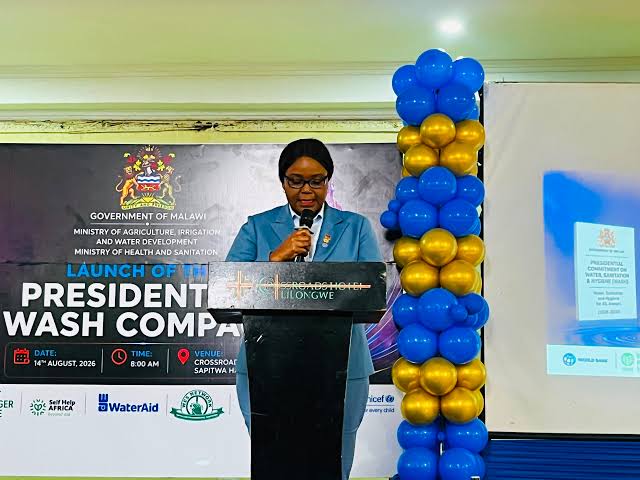
Malawi has launched a Presidential Water, Sanitation and Hygiene (WASH) Compact as the government seeks to accelerate universal access to essential services while confronting an estimated annual financing requirement of K555 billion, or about $320 million. The initiative, unveiled in Lilongwe on Friday, brings government, development partners and civil society into a common framework for strengthening WASH delivery, with climate shocks, weak coordination and limited domestic financing emerging as the principal constraints to implementation.
The scale of the funding requirement illustrates the challenge facing Malawi as it attempts to expand water and sanitation infrastructure while also maintaining systems that are already operating. The government has said it intends to increase WASH’s share of the national budget from about 1% to 5%, a proposed shift that would place substantially greater emphasis on water and sanitation within a constrained public-finance environment.
The compact comes against a backdrop of uneven access to WASH services. According to UNICEF Malawi, about 67% of households have access to drinking water, but the distribution is highly unequal between urban and rural areas. Improved drinking-water sources are available to about 87% of urban households compared with 63% in rural areas, while 37% of rural households spend at least 30 minutes collecting drinking water, compared with 13% in urban areas. UNICEF also reports that only about 77% of water points nationwide are functional, reflecting the importance of maintenance and management alongside new infrastructure.
The gap is more pronounced when access is measured against the higher standard of safely managed services. United Nations data show that only 18.2% of Malawi’s population was using safely managed drinking-water services in 2024, although this represented an increase from 6.9% in 2000. Safely managed sanitation coverage stood at 46.2% in 2024. Basic handwashing facilities, however, remained available to only about 15.4% of the population.
Those figures highlight why the compact is as much about service quality and reliability as it is about extending coverage. A borehole that is installed but subsequently breaks down, a water system that becomes unusable during drought, or sanitation infrastructure without adequate maintenance does not provide a dependable public service. For Malawi, the financial challenge is therefore not simply the capital cost of constructing additional infrastructure, but the recurring expenditure required to operate, repair, monitor and eventually replace it.

The country’s own WASH financing strategy has recognised this problem. Developed by the Government of Malawi and UNICEF, the Malawi Climate Resilient WASH Financing Strategy 2022–2032 was designed to identify ways of closing the sector’s financing gap while accounting for future climate scenarios and broader socioeconomic pressures. The strategy is aligned with Malawi 2063, the country’s Nationally Determined Contributions and adaptation priorities for the WASH sector.
The new compact therefore represents an attempt to translate longer-term policy commitments into a more coordinated national financing and implementation framework. UNICEF Representative Dr Penelope Campbell has welcomed Malawi’s WASH agenda while stressing that implementation should ultimately be judged by improvements in services rather than by the number of meetings or policy documents produced.
That emphasis is significant because Malawi’s WASH sector remains heavily dependent on development assistance. UNICEF’s 2025/26 WASH Budget Brief found that the sector’s budget represented about 3.5% of the total government budget, up marginally from 3.4% the previous year, but donor financing accounted for approximately 85% of sector funding. The brief warned that this dependence leaves WASH investment exposed to fluctuations in external financing.
The government’s proposed increase to 5% would therefore represent a move towards stronger domestic ownership of the sector. But the effect will depend on whether the additional allocation is actually released and converted into functioning services. UNICEF has previously noted the importance of timely disbursement of allocated budgets, particularly in social sectors facing repeated shocks and fiscal constraints.
Malawi’s fiscal position makes the financing question particularly difficult. WASH competes with health, education, agriculture, energy, social protection and debt-service obligations for limited public resources. UNICEF’s earlier WASH budget analysis found that debt servicing had already absorbed a substantial share of government expenditure, while the country’s fiscal deficits and revenue constraints limited the room available for social-sector investment.
The economic case for closing the WASH gap, however, extends beyond the infrastructure budget. UNICEF estimates that poor sanitation and hygiene cost Malawi about $57 million annually through health expenditure and productivity losses, equivalent to roughly 1.1% of national GDP. The cost is borne through preventable disease, lost working time, pressure on health facilities and reduced household productivity.
This makes WASH an economic productivity issue as well as a public-health concern. For rural households, unreliable water supplies can consume hours that could otherwise be used for farming, education or income-generating activities. Women and girls frequently carry much of the responsibility for collecting water, meaning that inadequate services can translate into lower participation in education and economic activity.
The gender implications were highlighted by Agriculture, Irrigation and Water Development Minister Roza Fatch Mbilizi at the compact’s launch. She linked inadequate water and sanitation to the dignity and rights of women and girls, putting the issue within the broader context of gender equality and social development. Climate change adds another layer of risk. Malawi has experienced repeated droughts, floods and other climate-related shocks that can damage water infrastructure, contaminate water sources and disrupt access to sanitation. UNICEF says droughts and floods have increased in recent years, with flooding in areas such as the Lower Shire displacing communities and disrupting WASH services.
Recent interventions illustrate the practical value of climate-resilient infrastructure. In Dowa District, UNICEF and the German development bank KfW supported a solar-powered water system at Nalunga Health Centre after repeated breakdowns of boreholes left communities without reliable water and contributed to vulnerability to cholera. The new system now supplies the health centre, a school, nearby households and a market, while community members have been trained to maintain the infrastructure. Similar investments are being made elsewhere. In March 2026, UNICEF reported that solar-powered water systems were improving access for communities and health facilities in Karonga, where drought and flooding had previously made water availability unreliable. Such projects demonstrate why climate resilience needs to be incorporated into infrastructure design rather than treated as an emergency response after systems fail.
The same principle is visible in Malawi’s emergency response. In June 2026, Japan and UNICEF launched a K1.3 billion project combining health, nutrition and climate-resilient WASH interventions in Thyolo and Salima. The programme includes upgrades to water, sanitation, handwashing and waste-management systems in health facilities and is designed to respond to overlapping threats including cholera and climate-related shocks. For development partners, the compact could offer a clearer mechanism for aligning projects with government priorities. Penelope Campbell has indicated that partners can align programmes, technical expertise and financing with Malawi’s national WASH agenda. That could reduce duplication and improve the use of scarce resources, provided that coordination is accompanied by transparent financing, measurable targets and effective monitoring.
Civil society also has a role in this process. Safari Mbewe, Executive Director of the Water and Environmental Sanitation Network, has said the organisation is prepared to support resource mobilisation and implementation. WESNET’s involvement reflects the need for community-level accountability because the effectiveness of a water point or sanitation programme often depends on local management, maintenance and user participation.
The challenge is particularly pronounced in rural areas. UNICEF’s 2025/26 budget analysis found that about 57% of major WASH investments were directed towards urban areas, reflecting the perception that urban projects can be easier to finance and implement. The organisation warned that this pattern could deepen existing disparities if rural sanitation, hygiene and water needs do not receive adequate investment. That imbalance has implications for Malawi’s broader development objectives. Rural communities depend heavily on agriculture and natural resources, both of which are highly exposed to climate variability. Reliable water infrastructure can therefore support not only household consumption and public health but also schools, health facilities, small businesses and local economic activity.
The compact also fits into the wider African policy agenda on climate resilience and sustainable development. Water and sanitation underpin several Sustainable Development Goals, while the African Union’s Agenda 2063 places emphasis on resilient communities, inclusive growth and environmentally sustainable development. For countries such as Malawi, these goals increasingly depend on the ability to finance infrastructure that can withstand climatic and demographic pressures.
The African financing challenge is considerable. Across the continent, governments face competing demands for infrastructure investment while development finance is under pressure and borrowing costs remain elevated. WASH projects can also be less attractive to commercial finance than revenue-generating infrastructure because the social benefits are substantial but direct financial returns are often limited. This makes public investment, concessional finance, grants and carefully designed blended-finance mechanisms particularly important.
For Malawi, the proposed five-percent budget allocation could strengthen the domestic foundation of the sector if it is accompanied by stronger public financial management and clear investment priorities. It will also need to be supported by better data on water-point functionality, service quality, groundwater availability and climate risks so that limited resources are directed towards areas where they can deliver durable results.
The compact’s success will ultimately be measured at the community level. A household that can access safe water throughout the year, a school with functioning toilets and handwashing facilities, and a health centre able to maintain reliable water supplies during a flood or drought provide more meaningful evidence of progress than the existence of a national framework alone.
For Malawi, the K555 billion annual requirement places the scale of the challenge in clear financial terms. The proposed increase in public spending could help reduce dependence on external financing, while stronger coordination among government agencies, donors and civil society could improve implementation. But without adequate maintenance, climate-resilient design and predictable funding, new infrastructure could reproduce the same cycle of breakdown and rehabilitation that has weakened WASH delivery in the past.
The Presidential WASH Compact consequently represents both a financing commitment and an institutional test. Malawi has already identified the economic, social and climate costs of inadequate water and sanitation services. The next stage will be whether the government and its partners can convert the compact into predictable investment, stronger institutions and reliable services across the country. For an economy facing tight fiscal conditions and repeated climate shocks, closing the WASH gap is not simply a matter of meeting a development target; it is increasingly part of protecting public health, productivity and the resilience of Malawi’s communities.


