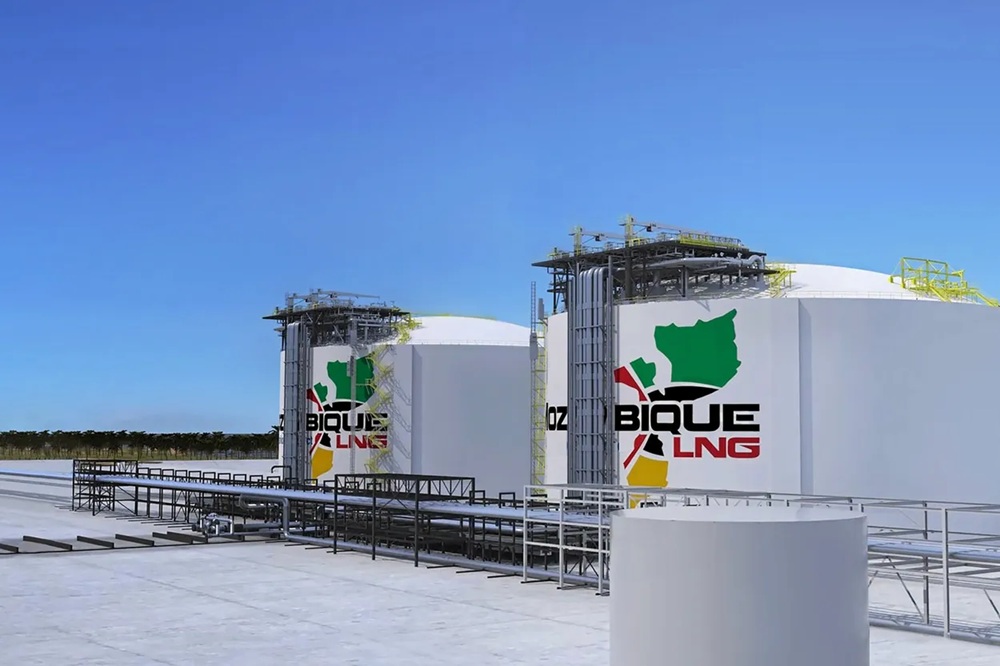

Mozambique has formally restarted work on its flagship liquefied natural gas project after the government and project partners agreed to resume full onshore and offshore activities following a four-year suspension triggered by insecurity in the country’s north. The decision marks a critical moment for the country’s economy, energy sector and long-term development strategy, as one of Africa’s largest gas investments moves back into execution.
The restart was announced on January 29 after a meeting in Afungi between Mozambique’s president, Daniel Chapo, and the leadership of TotalEnergies, the operator of the Mozambique LNG project. It follows a November 2025 decision by the Mozambique LNG consortium to lift force majeure, which had been declared in 2021 after escalating violence in Cabo Delgado disrupted construction and displaced thousands of residents.
Construction has now resumed both onshore and offshore at the Afungi site, with more than 4,000 workers mobilised, the majority of them Mozambican nationals. Project developers say the restart builds on work carried out during the suspension period, when engineering and procurement of major equipment continued despite the halt in physical construction. Overall project progress is estimated at around 40 percent, with first LNG production now expected in 2029.
Read also: Inside Africa’s 2026 energy outlook: New gas hubs, funding gaps and the battle for power access
The resumption reflects sustained efforts by the Mozambican government to stabilise Cabo Delgado, including enhanced security operations and continued cooperation with regional partners, notably Rwanda. Authorities say restoring security was a prerequisite for reviving investor confidence in a project viewed as central to Mozambique’s economic future.
Mozambique LNG is expected to be a cornerstone of the country’s development agenda, generating export revenues, jobs and foreign exchange over several decades. During the construction phase, the project is projected to create up to 7,000 direct jobs for Mozambicans, with contracts awarded to local companies expected to exceed $4 billion. Supporters argue that this scale of local participation is critical in ensuring that the benefits of resource development extend beyond state revenues.
Beyond construction, the project’s backers have placed emphasis on social and economic programmes in host communities. The Mozambique LNG Foundation, established in 2023 with a $200 million endowment, has been tasked with supporting livelihoods and resilience in Cabo Delgado. According to project officials, the foundation has already contributed to the creation of more than 8,000 jobs and provided support to about 7,000 farmers and fishers, addressing some of the economic pressures that have fuelled instability in the region.
For the Mozambican government, the restart carries both economic promise and political significance. LNG exports are expected to position Mozambique as a major player in global gas markets, strengthening its role in regional and international energy supply at a time of shifting geopolitical dynamics. Officials say the project will help anchor Mozambique as a regional energy hub while supporting skills development and workforce capacity in the domestic economy.

The project’s scale also raises broader sustainability and governance questions. While natural gas is often framed as a transition fuel in global energy debates, large LNG developments face increasing scrutiny over environmental impacts, carbon intensity and long-term alignment with climate goals. For Mozambique, balancing near-term development gains with long-term climate and fiscal risks will be a defining challenge as production approaches.
Mozambique LNG is structured as a joint venture involving several international and national partners, with TotalEnergies holding the largest operating stake alongside Asian and African energy companies and Mozambique’s state participation entity. The diversity of the consortium reflects both the scale of investment involved and the strategic importance of the resource.
After years of uncertainty, the restart signals renewed confidence by investors and the state in the project’s viability. Yet much depends on whether security gains in Cabo Delgado can be sustained and whether revenues are managed in a way that translates resource wealth into broad-based development. As construction ramps up and timelines move toward first production, Mozambique’s LNG ambitions are once again firmly back on the global energy map.
Engage with us on LinkedIn: Africa Sustainability Matters