


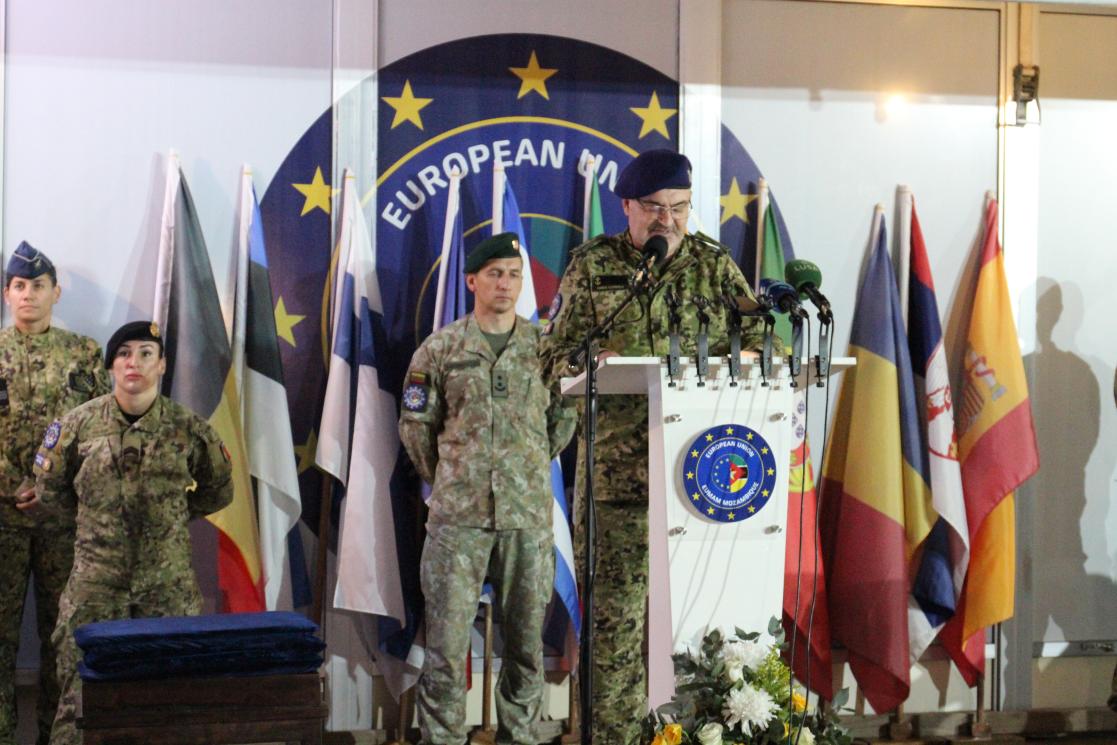
Mozambique has formally requested a two-year extension of the European Union Military Assistance Mission (EUMAM MOZ), underscoring the continued importance of international security cooperation in protecting the country’s multi-billion-dollar liquefied natural gas (LNG) sector and restoring long-term investor confidence in Cabo Delgado Province. The request, made by President Daniel Chapo during an official visit to Portugal, comes despite notable improvements in security conditions and reflects the government’s determination to safeguard one of Africa’s most strategically important energy developments from a persistent Islamist insurgency that has destabilised northern Mozambique since 2017.
According to information reported on 20 July by Club of Mozambique and statements carried by the Mozambican News Agency (AIM), President Chapo asked Portugal, which leads the European Union mission, to support extending the military assistance programme for at least another two years beyond its current expiry date of 31 December 2026.
“We are completing the first agreement phase and are now negotiating an extension of at least two more years because we believe it is extremely important,” Chapo said during meetings in Lisbon.
The request highlights the close relationship between security, energy investment and economic development in Mozambique. Cabo Delgado is home to some of the largest natural gas discoveries in Africa, with projects led by TotalEnergies, Eni and ExxonMobil expected to position Mozambique among the world’s leading LNG exporters over the coming decade. Together, these developments represent investments exceeding US$60 billion and are widely viewed as transformational for the country’s economy, public finances and export earnings.
However, the success of those projects remains closely tied to security conditions in the region.
The European Union Military Assistance Mission in Mozambique was established to strengthen the operational capacity of the Mozambican Armed Defence Forces through specialised military training, tactical support and institutional capacity building. According to official figures released by the European Union in May, the mission has completed more than 40 training cycles since September 2024, preparing approximately 1,200 Mozambican soldiers for deployment in Cabo Delgado and other security-sensitive areas.
In May 2026, the European Council approved a six-month extension of the mission, bringing its current mandate to the end of December 2026. Mozambique’s latest request signals that authorities consider international military support essential even as government forces continue to regain territory previously occupied by insurgent groups.
Beyond military cooperation, discussions between Mozambican and Portuguese officials also covered broader governance priorities, including strengthening parliamentary cooperation, advancing the Inclusive National Dialogue process and reinforcing collaboration within the Community of Portuguese Language Countries (CPLP), according to Mozambican media outlet MzNews.
While security cooperation remains the immediate focus, the underlying objective is economic stability.
Since 2017, Cabo Delgado has experienced one of Africa’s most severe insurgencies. According to the Armed Conflict Location & Event Data Project (ACLED), the conflict has claimed more than 6,000 lives and displaced approximately one million people, creating one of Southern Africa’s largest humanitarian crises. The insurgency has disrupted livelihoods, weakened public service delivery and significantly delayed investment in one of the continent’s most promising natural gas provinces. The province contains the Rovuma Basin, estimated to hold more than 100 trillion cubic feet of recoverable natural gas reserves. These discoveries have attracted major international energy companies seeking to expand global LNG supply amid growing demand for cleaner-burning fossil fuels as countries transition away from coal.
Italian energy company Eni has already commenced production from the offshore Coral Sul Floating LNG project and is progressing with the Coral Norte development. French energy major TotalEnergies is leading the US$20 billion Mozambique LNG project, while ExxonMobil continues preparations for the Rovuma LNG development, one of Africa’s largest planned onshore LNG facilities.
Together, these projects have the potential to reshape Mozambique’s economic trajectory.
According to the International Monetary Fund (IMF), LNG exports are expected to become the country’s largest source of foreign exchange earnings while significantly increasing government revenues over the coming decades. The World Bank similarly notes that successful development of Mozambique’s gas resources could finance critical investments in infrastructure, healthcare, education and climate resilience, provided revenues are managed transparently and inclusively.
Yet the industry’s vulnerability became evident in March 2021 when insurgents attacked the strategic town of Palma, located near the Afungi LNG site. The assault forced TotalEnergies to suspend construction, evacuate personnel and declare force majeure, delaying one of Africa’s largest energy investments for nearly five years.
Construction only resumed in January 2026 after improved security conditions enabled approximately 4,000 workers to return to the Afungi peninsula. At the time, President Chapo emphasised the government’s commitment to protecting the project.
“We are doing everything possible to ensure that the project never stops again,” he said.
Despite those advances, security analysts caution that the insurgency has not been fully defeated.
Earlier this year, President Chapo stated that “there is no longer any village in any district of Cabo Delgado under terrorist control,” reflecting substantial gains achieved through joint operations involving Mozambican forces, Rwandan troops and the Southern African Development Community (SADC) Mission in Mozambique.
However, according to the Mozambique Conflict Monitor, insurgent activity continued to evolve throughout late 2025, with militant groups expanding operations in parts of northern Cabo Delgado, including areas surrounding the Afungi LNG complex. Although attacks have become less frequent than during the conflict’s peak, sporadic violence continues to influence operational planning and investment decisions. The persistence of low-level insecurity illustrates the complexity of stabilising conflict-affected regions where military operations must be accompanied by governance reforms, economic development and community recovery.
According to the United Nations Development Programme (UNDP), long-term peacebuilding in Cabo Delgado will require sustained investment in livelihoods, education, local governance and social inclusion alongside continued security interventions. Addressing the structural drivers of conflict—including poverty, unemployment and limited economic opportunities—remains essential for preventing renewed instability.
Regional security cooperation also continues to play an important role. Since 2021, Rwanda has maintained a military deployment in Cabo Delgado that has been widely credited with helping secure strategic infrastructure and enabling displaced communities to begin returning home. Financing that deployment has recently become a diplomatic issue. Earlier this month, President Chapo announced that the European Union would resume financial support for Rwandan forces after a period of uncertainty linked to United States sanctions imposed on Rwanda. According to AIM News, the renewed funding provides additional certainty for ongoing regional security operations.
For international investors, the extension request signals Mozambique’s recognition that sustained security remains fundamental to unlocking the country’s vast natural gas potential. Global energy companies increasingly assess political stability, institutional resilience and operational security alongside geological potential when making long-term investment decisions.
According to the International Energy Agency (IEA), natural gas is expected to remain an important component of global energy systems during the energy transition, particularly as countries seek lower-carbon alternatives to coal while expanding renewable energy. African LNG producers, including Mozambique, Senegal, Mauritania and Nigeria, are therefore positioned to play an increasingly significant role in global energy markets.
For Africa, Mozambique’s experience highlights the increasingly close relationship between energy security, economic development and geopolitical cooperation. Major energy investments can generate transformative fiscal revenues, create employment and expand regional infrastructure, but their success depends equally on stable institutions, effective governance and sustained security.
As negotiations over the extension of the European Union military mission continue, the outcome will influence not only Cabo Delgado’s security landscape but also the pace at which one of Africa’s largest energy developments contributes to Mozambique’s economic transformation. The government’s request reflects a broader understanding that safeguarding strategic investments requires long-term partnerships combining defence cooperation, institutional strengthening and inclusive development capable of delivering lasting peace alongside economic opportunity.


