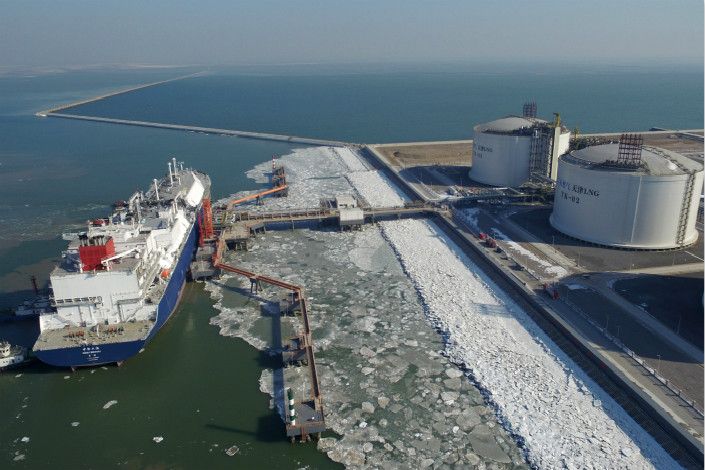

Mozambique’s only outstanding international bond weakened sharply on Thursday(October 30th), falling more than three cents on the dollar after ExxonMobil unexpectedly pulled out of a joint media appearance with President Daniel Chapo. The scheduled briefing was intended to provide clarity on the stalled $30 billion gas export terminal, a project whose future is inseparable from the country’s fiscal outlook. The abrupt cancellation instead reignited long-standing investor fears that insecurity and shifting risk tolerance could continue delaying a pillar of the nation’s foreign-currency revenue ambitions.
The bond later recovered some ground but still closed over two cents lower, reflecting unease rather than panic. In the thinly traded frontier-debt market, such moves serve almost as political barometers. For Mozambique, they reveal the precarious balance between investor confidence and on-the-ground realities in Cabo Delgado, where an insurgency that first disrupted megaprojects in 2021 continues to threaten progress. 
In global markets, confidence is built on signals: credible communications, predictable timelines, and governance stability. The expectation that ExxonMobil would address LNG advancement in person with the presidency was one such signal. Its absence left a vacuum now filled with uncomfortable questions. Investors are watching closely because Mozambique’s economic narrative, from debt distress to recovery, rests heavily on the transformative revenues promised by liquefied natural gas. Annual earnings projections reach tens of billions of dollars once exports fully ramp up. Yet for now, the country remains exposed to volatile sentiment.
Read also: Congo secures $60M World Bank support to reinforce urban resilience and climate-safe infrastructure
Further adding to market caution was confirmation that Mozambique’s cabinet has enlisted Alvarez & Marsal to support a public-debt restructuring process. The firm is known globally for sovereign and corporate turnaround mandates, a fact that simultaneously reassures in terms of professional capability and unsettles in terms of implications. Although authorities describe the reforms as proactive, a strategic strengthening of public-debt management and capital market regulations, memories of the “hidden debt” crisis that derailed the economy less than a decade ago are still fresh among investors and citizens.
Mozambique’s Finance Minister Carla Loveira acknowledged the scale of the challenge with unusual candor, calling debt sustainability one of the greatest threats to economic stability. Her message reflects the pressure government faces as external financing costs remain elevated while essentials such as food imports and security operations strain public finances. Mozambique’s GDP may be growing, but fiscal space remains fragile without gas exports to ease the foreign-exchange deficit and broaden revenue sources.
The revived insurgency in Cabo Delgado compounds every element of the risk picture. In purely financial terms, delayed construction pushes back royalty flows, taxes and export earnings that have already been securitized in some forecasts. In practical terms, insecurity means rural livelihoods are disrupted, displacement grows, and the cost of protecting investment zones climbs, all of which heighten social and economic exposure to future shocks. As Mozambique pushes forward with climate-vulnerable coastal development and resource extraction, these layers of instability risk undermining the sustainability narrative it hopes to champion.

For Africa as a whole, the episode illustrates a deeper structural tension. Countries rich in natural assets, from gas to minerals required for global energy transitions, remain limited by capital access and market perception.
When climate finance flows slowly and concessional loans fall short, governments increasingly rely on commercial markets and natural-resource futures to fund development. Those markets in turn react sharply to governance uncertainty, conflict headlines or signs of fiscal tightening. The continent’s industrialization aspirations, including energy transition agendas, are therefore tethered to external optics in ways that remain inequitable and economically inefficient.
Mozambique’s bond tremor is not merely a market reaction to a cancelled press briefing. It is a reflection of the stakes of transforming LNG potential into national resilience. Done well, revenue from the Rovuma Basin could accelerate rural electrification, fund diversified infrastructure, and finance adaptation responses to cyclones and coastal erosion that threaten thousands annually. Done poorly, delays and mismanagement could repeat past mistakes: high expectations yielding low development outcomes while debt burdens worsen.
Investors have not abandoned Mozambique. Standard Chartered and others note that holder sentiment remains cautious, not catastrophic. But the message implicit in Thursday’s pricing is clear: transparency and security progress must move in parallel, neither can lag without consequence. In a global environment where risk premiums are rising and debt affordability is tightening for developing nations, credibility is as critical a currency as gas.
As President Chapo seeks to assure backers that LNG remains firmly on course, Mozambique faces a pivotal moment. The bond shift is a reminder that sustainability, economic, social and environmental, is never abstract. It is measured daily in the trust placed in a nation’s future and in the stability of the systems designed to deliver it.
Engage with us on LinkedIn: Africa Sustainability Matters