


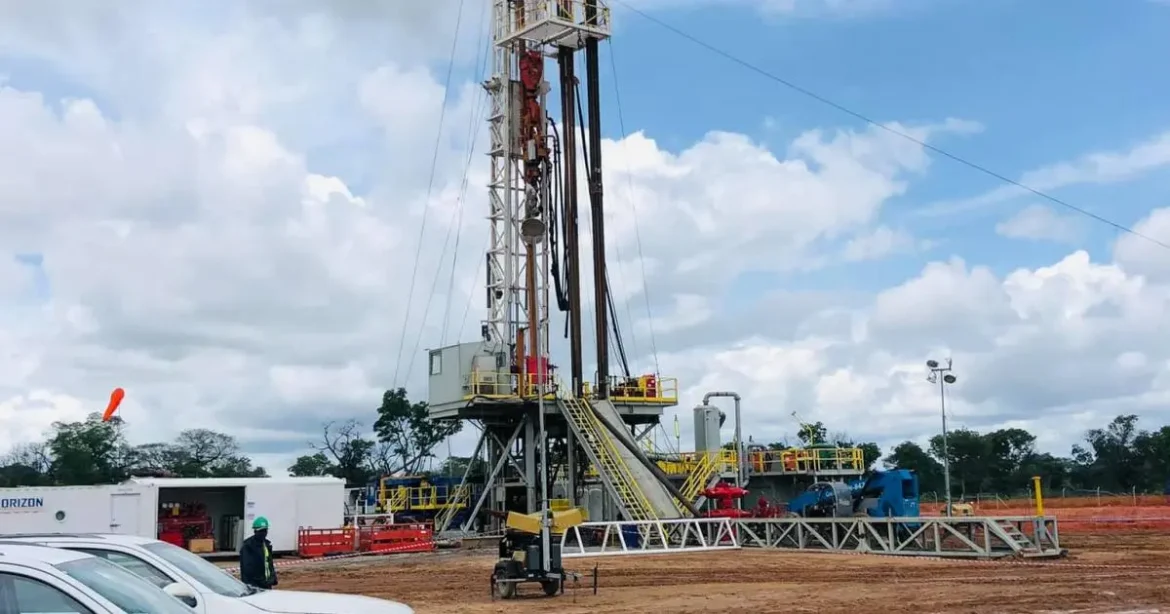
Namibia has recorded its first confirmed onshore hydrocarbon flow to surface after Canadian explorer Reconnaissance Energy Africa (ReconAfrica) announced preliminary production test results from the Kavango West 1X discovery well, marking a potentially significant milestone in the country’s emerging upstream energy sector. The company said production testing successfully brought natural gas to the surface from the Elandshoek Formation, while preparations are now underway to test the shallower Huttenberg Formation, where well log analysis has identified 76 metres of net hydrocarbon pay across a broader 182-metre reservoir section.
The announcement represents an early technical achievement rather than confirmation of commercial production, but it reinforces Namibia’s growing position as one of Africa’s most closely watched hydrocarbon frontiers. According to ReconAfrica, hydrocarbon samples collected during testing have been dispatched to laboratories in the United States for compositional analysis to determine the precise characteristics of the natural gas and any associated liquids. The remaining hydrocarbons produced during the test were flared as part of standard well testing procedures.
ReconAfrica President and Chief Executive Officer Brian Reinsborough described the successful flow as the first hydrocarbons ever produced to the surface from an onshore well in Namibia, noting that the company is evaluating a horizontal or deviated sidetrack from the existing wellbore to intersect a larger portion of the natuafricrally fractured carbonate reservoir. According to the company, international analogues suggest horizontal drilling could substantially improve production rates compared with conventional vertical wells if commercial volumes are ultimately confirmed.
The company cautioned that the results remain preliminary and should not be interpreted as evidence of future commercial production. Well testing primarily confirms the presence and mobility of hydrocarbons rather than long-term reservoir performance, recoverable reserves or project economics. Production rates could not be accurately measured during the initial flow tests because of equipment limitations, although ReconAfrica reported increasing tubing pressures of up to 2,300 pounds per square inch before subsequent tests, indicating reservoir deliverability.
The next phase of testing will focus on three zones within the Huttenberg Formation, where geological analysis suggests more substantial matrix porosity than the deeper Elandshoek interval. According to ReconAfrica, each production test is expected to require approximately ten days, with further operational updates anticipated later in August.
The development comes as Namibia continues to attract growing international interest following a series of major offshore discoveries that have repositioned the country among Africa’s most promising new petroleum provinces. While international attention has largely focused on the Orange Basin offshore, the Kavango Basin presents a different exploration opportunity centred on onshore sedimentary formations that remain comparatively underexplored. Success in establishing commercially viable onshore production would diversify Namibia’s emerging hydrocarbons portfolio while potentially lowering development costs compared with deep-water offshore projects.
For African energy markets, the significance extends beyond exploration success. The continent continues to face the dual challenge of expanding energy access while financing the transition toward lower-carbon development pathways. Natural gas is increasingly viewed by many African governments as a transition fuel capable of supporting industrialisation, electricity generation and manufacturing while complementing renewable energy expansion. If commercially developed, domestic gas production could reduce dependence on imported fuels, improve energy security and provide feedstock for industries including fertiliser production, petrochemicals and power generation.
The discovery also illustrates the increasingly complex relationship between hydrocarbon development and sustainability across Africa. While global climate commitments are accelerating investment in renewable energy, many African economies continue to argue that responsible development of domestic natural resources remains essential for financing economic diversification, expanding infrastructure and addressing persistent energy poverty. International financial institutions and multilateral development partners have increasingly acknowledged that the pace and structure of Africa’s energy transition will differ from developed economies because of lower historical emissions, expanding populations and significant unmet energy demand.
At the same time, hydrocarbon projects face growing scrutiny over environmental management, biodiversity protection and community engagement. ReconAfrica stated that it remains committed to minimising habitat disturbance and implementing international environmental and social best practices across its operations. These commitments are likely to become increasingly important as investors, regulators and civil society organisations apply more rigorous Environmental, Social and Governance (ESG) standards to resource extraction projects.
 For Namibia, successful commercial development would also carry broader fiscal implications. Hydrocarbon revenues could strengthen public finances, expand foreign direct investment and create opportunities for domestic supply chains, provided resource governance frameworks effectively manage future revenues and ensure long-term economic diversification. Experience elsewhere across Africa demonstrates that translating natural resource discoveries into broad-based development depends not only on geological success but equally on institutional capacity, transparent governance and strategic investment in human capital and infrastructure.
The latest production tests therefore represent an important technical milestone rather than a definitive commercial breakthrough. Confirmation of sustainable production rates, reservoir characteristics and economic viability will determine whether Kavango evolves into a commercially productive basin. Nevertheless, the successful flow reinforces Namibia’s expanding role within Africa’s evolving energy landscape, highlighting both the opportunities and governance challenges facing countries seeking to balance resource development with long-term sustainability and economic transformation.


