


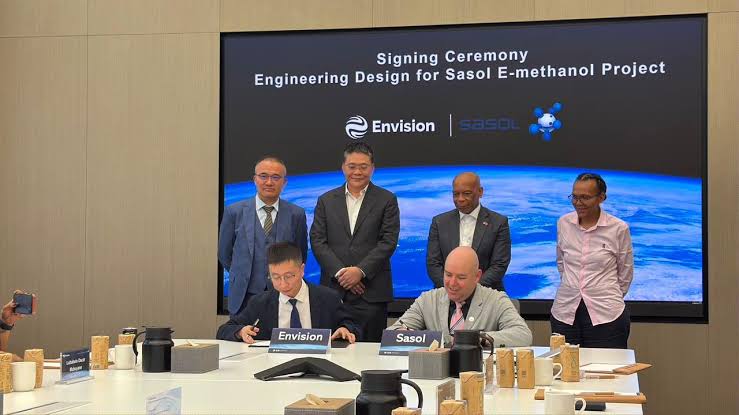
Sasol Ltd. has signed an agreement with Chinese renewable energy company Envision to undertake a front-end engineering and design (FEED) study for a renewable-powered green hydrogen project at Sasolburg, marking another significant step in South Africa’s ambition to establish a competitive green hydrogen economy. The engineering study, supported by the Industrial Development Corporation (IDC), will assess the technical and commercial feasibility of producing green hydrogen for use in e-methanol and potentially sustainable aviation fuel (SAF), positioning the country to benefit from growing global demand for low-carbon fuels driven by tightening decarbonisation policies, particularly in the European Union.
The agreement reflects Sasol’s broader strategy to transition from coal-based hydrogen production towards cleaner alternatives as international markets increasingly prioritise low-carbon industrial products. While Sasol has been producing hydrogen for decades to support its petrochemical and fuels operations, nearly all of its hydrogen has traditionally been derived from coal through carbon-intensive processes. The proposed Sasolburg project represents an important milestone in the company’s long-term decarbonisation roadmap and South Africa’s wider efforts to build a globally competitive green hydrogen industry.
According to Mining Weekly, Envision will lead the engineering study, which is expected to conclude by October 2026. The study will evaluate the project’s engineering requirements, renewable energy integration, storage solutions, electrolyser configuration and commercial viability before a final investment decision is considered. Sasol has not yet disclosed the proposed electrolyser capacity or anticipated production volumes for green hydrogen or e-methanol.
If the project proceeds, green hydrogen produced at Sasolburg will primarily serve as feedstock for manufacturing e-methanol, a synthetic low-carbon fuel increasingly viewed as a promising alternative for decarbonising international shipping. The partners also intend to evaluate the future production of sustainable aviation fuel (SAF), another rapidly growing market as airlines seek to reduce lifecycle carbon emissions in response to evolving international regulations.
The timing of the initiative reflects accelerating global policy shifts. The European Union’s ReFuelEU Aviation and FuelEU Maritime regulations require aviation and maritime operators to progressively increase the use of sustainable fuels over the coming decades. These regulatory frameworks are creating new international markets for green hydrogen derivatives such as e-methanol, green ammonia and sustainable aviation fuel, presenting export opportunities for countries with abundant renewable energy resources. According to the International Energy Agency (IEA), hydrogen produced through electrolysis powered by renewable electricity will play a central role in decarbonising hard-to-abate sectors including heavy industry, aviation, shipping and chemicals. While global green hydrogen production remains relatively limited, investment announcements have accelerated significantly as governments and industries seek pathways towards net-zero emissions.
South Africa has emerged as one of Africa’s leading contenders in the global hydrogen economy because of its exceptional solar and wind resources, well-developed industrial base and strategic export infrastructure. The country’s Green Hydrogen Commercialisation Strategy identifies hydrogen as a future pillar of industrial development capable of attracting investment, creating skilled employment and supporting export-led economic growth. The Sasolburg project forms part of that broader national strategy. The industrial complex already hosts a 3-megawatt solar power plant supplying electricity to pilot electrolyser systems and recently became home to South Africa’s first locally manufactured electrolyser, developed in partnership with the government’s Hydrogen South Africa (HySA) programme. These pilot projects are intended to build domestic technical expertise while demonstrating the commercial potential of green hydrogen technologies.
Speaking during the signing ceremony in Chifeng, Inner Mongolia, South Africa’s Minister of Electricity and Energy, Dr Kgosientsho Ramokgopa, said the partnership reflects the country’s commitment to adopting cleaner industrial technologies capable of supporting long-term economic competitiveness while reducing greenhouse gas emissions.
Sasol also emphasised that the engineering study represents only an initial phase in a much longer commercial journey. Danie Cronje, Senior Vice President at Sasol, said the assessment will determine how renewable energy generation, battery storage and electrolysis technologies can be integrated to produce green hydrogen competitively within South Africa’s industrial landscape. Several challenges remain before large-scale commercial deployment becomes viable. According to the Hydrogen South Africa (HySA) programme, electrolyser technologies remain capital intensive, requiring significant investment in renewable electricity generation to produce competitively priced hydrogen. South Africa also continues to face infrastructure gaps, including limited hydrogen transportation, storage and export facilities, all of which will require coordinated investment from both the public and private sectors.
The project’s financial backing from the Industrial Development Corporation (IDC) highlights the growing role of development finance institutions in supporting emerging clean energy industries. Across Africa, public finance is increasingly being used to de-risk early-stage hydrogen projects and attract private capital into sectors where commercial technologies remain relatively immature. Beyond Sasolburg, Sasol continues to expand its hydrogen ambitions through the HySHiFT consortium at Secunda in Mpumalanga. According to the Green Hydrogen Organisation, the consortium plans to develop a 200-megawatt electrolyser powered by approximately 450 megawatts of renewable energy, with the objective of producing around 50,000 tonnes of sustainable aviation fuel annually. If realised, the project would rank among Africa’s largest green hydrogen-based aviation fuel initiatives.
From a sustainability perspective, the transition from coal-derived hydrogen to renewable-powered electrolysis could significantly reduce industrial emissions while strengthening South Africa’s position within emerging global low-carbon value chains. Green hydrogen also presents opportunities for industrial diversification, technology transfer and export growth, particularly as international markets increasingly place a premium on low-carbon products.
According to the International Renewable Energy Agency (IRENA), Africa possesses some of the world’s most competitive renewable energy resources, providing the continent with an opportunity to become a major producer of green hydrogen and hydrogen-derived fuels. However, realising this potential will depend on sustained investment in renewable energy infrastructure, supportive policy frameworks, competitive financing and international market demand.
For South Africa, the Sasol-Envision partnership represents more than a feasibility study. It signals the continued evolution of one of Africa’s largest industrial companies towards cleaner production technologies while reinforcing the country’s ambition to become a regional leader in green hydrogen. Although the project remains subject to engineering, financing and regulatory approvals, its progress will be closely watched by investors, policymakers and energy markets seeking practical models for Africa’s participation in the global energy transition.


