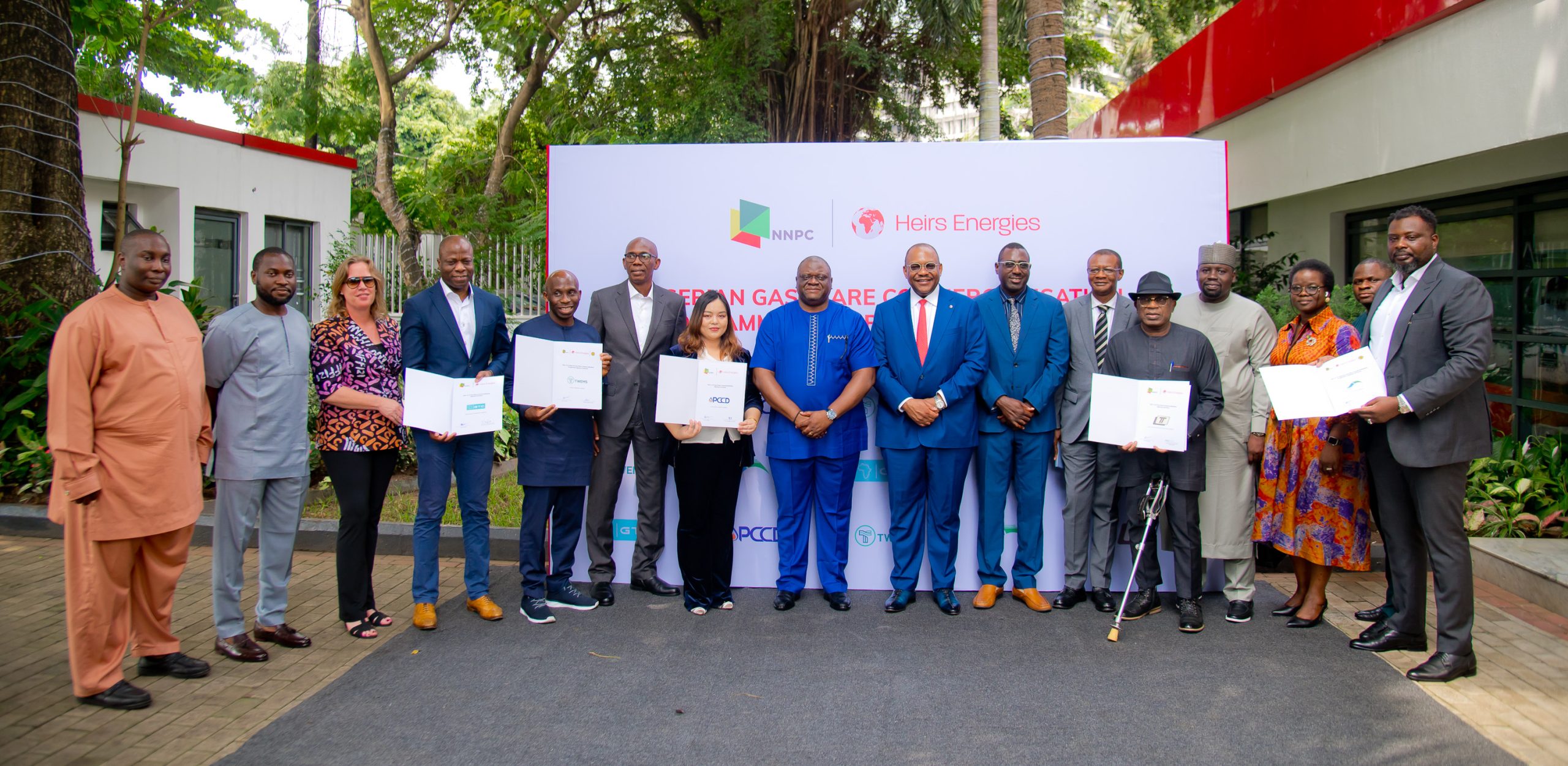

Nigeria took a concrete step toward reducing routine gas flaring on Tuesday as the NNPC/Heirs Energies Joint Venture at OML 17 signed commercial agreements that will channel previously wasted flare gas into power, industry and household energy markets. The deals, involving five approved off-takers and backed by national regulatory institutions, mark the start of full-scale project implementation under the Nigerian Gas Flare Commercialization Programme (NGFCP).

The ceremony signaled a shift that industry insiders have been waiting for: moving from approvals on paper to infrastructure that can actually convert flare volumes into usable gas. For a country that flares an estimated 275–300 million standard cubic feet per day across various fields, enough to generate roughly 1,000 MW of electricity if fully harnessed, the development at OML 17 offers a needed proof of approach.
Read also: Nigeria’s Agbada-67 Gas Well restored, boosting Eastern power generation by 455MW
The joint venture’s operator, Heirs Energies, will work alongside AUT Gas, Twems Energies, Gas & Power Infrastructure Development Limited, PCCD and Africa Gas & Transport Company Limited to capture and commercialize flare volumes that have long escaped into the night sky above the Niger Delta.
In practical terms, this means a gradual reduction of the bright orange plumes that communities have lived beside for decades, along with new capacity to support LPG distribution, compressed natural gas development and industrial gas supply.
For NNPC Limited, the initiative fits into a wider national position: Nigeria has consistently stated that gas sits at the center of its long-term energy mix, even as the world accelerates efforts to cut carbon emissions. The country holds Africa’s largest proven gas reserves, yet still experiences power shortages so routine that businesses depend on diesel generators to function.
Commercializing flare gas will not resolve the energy deficit overnight, but it widens the pipeline of domestic gas supply at a time when new power plants, fertilizer facilities and midstream companies are looking for reliable feedstock.

At the signing event, the Nigerian Upstream Investment Management Services unit, speaking through Engr. Seyi Omotowa, made clear that NNPC sees the project as part of a practical industrial strategy rather than a regulatory tick-box exercise.
That framing aligns with data emerging from Nigeria’s upstream sector: roughly 10–12% of associated gas produced is still flared, according to international energy tracking platforms, representing both environmental harm and lost revenue. Capturing even half of that could generate hundreds of millions of dollars annually while reducing emissions that contribute to air pollution in host communities.
The Nigerian Upstream Petroleum Regulatory Commission (NUPRC), represented by senior officials at the event, emphasized its backing for operators and off-takers working under the Petroleum Industry Act. With the PIA now reshaping incentives across the upstream sector, new gas projects are beginning to reflect clearer investment rules, something investors have long demanded. The Heirs Energies initiative becomes one of the early examples of how the PIA’s gas provisions translate into real transactions.
Read also: How EU’s softer pollution rules could hurt Africa’s green exports
For Heirs Energies, the projects fit a consistent pattern. Since taking over OML 17, the company has focused on improving brownfield performance, particularly gas delivery to the domestic market.
Gas output from the asset has risen through targeted repairs, infrastructure optimization and operational restructuring, a shift that analysts say mirrors broader changes in Nigeria’s independent energy space, where local firms increasingly anchor supply to local markets instead of export-only strategies.
The broader significance stretches beyond Nigeria. Across Africa, between 7 and 9 billion cubic meters of gas are flared each year, enough to supply nearly 50 million households with electricity. Angola, Algeria, Libya, Equatorial Guinea, Congo-Brazzaville and Ghana all face similar challenges, though the scale and causes differ.
As the continent pushes for more industrialization; cement plants, petrochemicals, fertilizer production, steel manufacturing, Flare-to-Value projects offer one of the fastest ways to build energy resilience while cutting emissions without shutting down oil production.

African governments are also facing growing pressure to demonstrate that oil-dependent economies can produce energy more responsibly. Multilateral lenders increasingly tie financing to emissions performance, and several energy-exporting nations now find that routine flaring complicates their access to credit, carbon markets and infrastructure funding.
Nigeria’s OML 17 project therefore carries a narrative that resonates from Luanda to Algiers: domestic value creation from a resource that has historically burned off as waste.
Communities around OML 17 are also watching the shift with a mixture of hope and caution. Gas flaring has shaped environmental conditions in parts of the Niger Delta for generations, influencing everything from air quality to farmland productivity.
Read also: Nearly 30 green projects selected for Africa’s 2026 summit as demand for climate finance grows
The joint venture has invested in healthcare outreach, education initiatives and skills development, but residents often judge progress by what happens at the flare stacks. Once the commercialization projects enter full implementation, reductions in flare volume should become visible, and measurable, in daily life.
Engage with us on LinkedIn: Africa Sustainability Matters
Engage with us on LinkedIn: Africa Sustainability Matters